The Hamilton Review of Books’ Independently Published Bestsellers List: January 2024 — Hamilton Review of Books
Spreading across Canada from author Mitchell Toews boreal home, north of 50° on Jessica Lake near the historic Tie Creek Basin, comes Bestseller #6 in Fiction, “Pinching Zwieback.” Toews’ debut collection of short stories from At Bay Press (Wpg, 2023) is scoring points with readers, booksellers, critics, and reviewers in the “Mennosphere” and far beyond…
Three Reviews—Confluence; Trifurcation; Sangam

“Pinching Zwieback: Made-up Stories from the Darp” Mitchell Toews (At Bay Press, 2023)
Here is a triumvirate of REVIEWS for my debut collection of short stories: Tim Huber, Associate Editor of Anabaptist World…Patricia Dawn Robertson, a familiar Canadian reviewer, critic, and writer with a review from the Winnipeg Free Press…Robert Boucheron, writer and editor/publisher of the Rivanna Review of Charlottesville, Virginia and his review as it appears in Ottawa’s Literary Heist.
And, here’s where to buy your copy, and where to send your friends to get theirs: https://mitchellaneous.com/2023/12/17/where-can-i-buy-pinching-zwieback/
Libraries & BiblioCommons
Want to borrow PINCHING ZWIEBACK from your local library? NO PROBLEM!
Services like BiblioCommons are linked to At Bay Press and a copy can go to your local library in Canada, the US, the UK, or Australia. ALMOST ANYWHERE. Just request Pinching Zwieback by Mitchell Toews (At Bay Press, 2023) and you can get it. . . In Burlington, Springfield (all of them), Come by Chance, WaWa, Walla Walla, and Wallaby Junction.
Okay, I made the last one up. But seriously, it’s AVAILABLE!
(Or BUY it here: https://bit.ly/BUYpinchingzwieback)
The Shuffling of Souls

Image: *Preservings* Issue Number 47, FALL 2023: “Marriage of Russlaender Maria Pauls and Old Colony Cornelius Driedger, March 1927. JAKE BUHLER PRIVATE COLLECTION
 Here are some thoughts about class and gender conflict with quotes from a variety of observers.
“The indelicate clacking of the men’s heels and the shuffling of their soles reminded him that their grade of culture differed from his. He would only make himself ridiculous by quoting poetry to them which they could not understand. They would think that he was airing his superior education.”—MC Gabriel’s thoughts in “The Dead” from James Joyce in Dubliners (Public Domain).
Is Joyce’s judgemental Irishman not interchangeable with a haughty Russlaender attending some inelegant, rustic affair in a prairie podunk like Gruenfeld or Neubergthal? Could this class-conscious thinking—reductive and dismissive—just as well be aimed at some random Kanadiers; a huddling of farmers in hand-me-down Sunday suits? Are Mennonites not just as guilty as any ethnic or religious group in their tireless search for an unloved “they” to diminish?
“That in the beginning when the world was young there were a great many thoughts but no such thing as a truth. Men made the truth and each truth was a composite of a great many vague thoughts… There was the truth of virginity and the truth of passion, the truth of wealth and of poverty, of thrift and of profligacy, of carelessness and abandon.” —Author Sherwood Anderson from the prologue of Winesburg Ohio (Public Domain).
The distant cannon fire of class and gender warfare, this time from the rolling hills of Middle America, where sinners and their sins are pilloried by the colour of their licence plates.
“I had heard about Mennonites all my life, about the brawls, the fist-fights at socials and hockey games. The hypocrisy as they kept liquor out of their town, but then drove to La Broquerie or Ste, Anne for booze. How they’d look down their noses at us for doing in the open what they did in the dark,” —MC Richard’s acute observations from Matthew Tétreault‘s Hold Your Tongue (NeWest Press, 2023) summarizes the abrasive relationship common between Francophone/Métis Ste. Anne, Manitoba and its nearby, predominantly Mennonite neighbour, Steinbach.
“I hear them (the ‘wealthy church ladies’) get up from the living room and walk past the kitchen. They’re coming down the stairs now, all talking at once. Like cedar waxwings, in a flock, turning in the sky, then landing as one. Beautiful in a way, but still capable of turning on you. Hurting you to make things better for themselves.”—MC Justy Zehen’s thoughts in “Willa Hund” from Pinching Zwieback (At Bay Press, 2023).
“This book is a double bun, doughy anecdotes from a spirited childhood coupled with the realisation that manhood is a more complex goal than just being strong, especially when strength translates into bullying, especially of women, the archetypal bakers of the author’s imagination.” —Linda Rogers van Krugel in her REVIEW of Pinching Zwieback (At Bay Press, 2023).
The quiet shuffling of souls—betraying different classes, genders, racial origins, and beliefs both phobic and apologist together with their ironfast allegiances—appear to be present in all groups, denominations, and Gemeinde: from those who jumped the turnstiles on the Ha’Penny Bridge to those living in the dusty towns of Southern Manitoba to the Buckeyes of Ohio and beyond.
As an author with a momentary, leaky thimble full of influence, I have made an effort to recognize and embed some questions about this “prost” (ignoble) trait that I see in myself and in Mennonites and their selfish schisms. The unfettered compulsion to divide and re-divide until the original differences are impossible to discern. This flaw is present without relief in my life experience outside of Mennonite familiars too. It’s in all the places I have been and in all the people I have learned to know. I’ve seen more marketing and public relations and gossipy slander in these social groups than in all the thousand vulgar ad campaigns I created, put together.
Are we all Baudelaire’s “Les Fleurs du mal?” Or is there is hope? My conclusions in “Pinching Zwieback” are doggedly optimistic, but then, I set out to put hope into every circumstance, even the most vile. I did so despite the constant human wickedness and the despair it has caused. In the end, I suppose I’m like the character Justy Zehen, “I don’t want to be a little Russian boy hiding in the rhubarb.”
A Review of Pinching Zwieback

https://bit.ly/WFPpzREVIEWpdRobertson
Here are stories written and compiled over the years 2015-2023. Many of them are based on my personal experience in the half-century from the late Fifties onwards but have been given the cloak of fiction. It is Autofiction that is meant to be read in the spirit of openness by all members of the human congregation.
Stories written, submitted, rejected, re-written, combined, disintegrated, edited, and re-submitted many times. Like a treasured recipe, altered and fine-tuned and dependent on the ingredients at hand.
In the end, I believe At Bay Press and I have made a collection that is comfortable on a wide variety of bookshelves, nightstands, coffee tables, and in commuter jacket pockets. An eclectic variety of readers; including but not just Mennonites, nor Anabaptists or Christians, and not just those who are none of those.
I hope all my readers, no matter their filters or experiences, can draw from this book. My aim is to make available meaningful connections for readers and provide thoughtful enjoyment through the characters’ lives and interactions. I also want to enable readers to relate when read as stand-alone vignettes or when viewed as a whole, from the broader narration that the plenary arc seeks to achieve.
REVIEW: Chekhov of the darp – Winnipeg Free Press
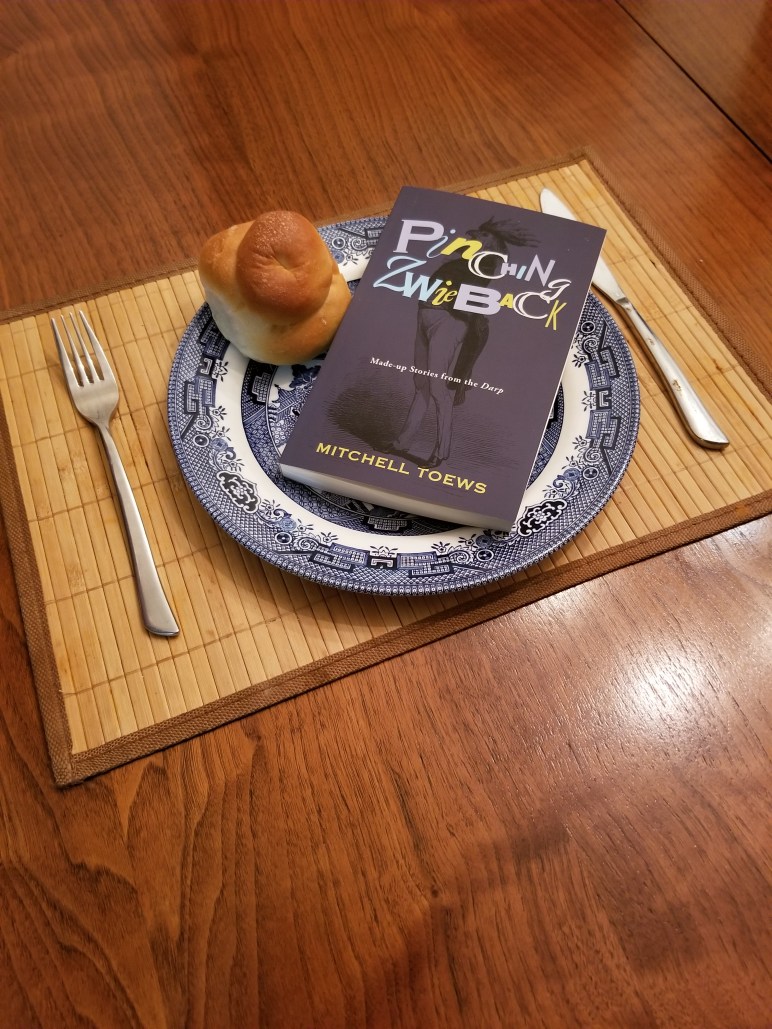
https://www.winnipegfreepress.com/arts-and-life/entertainment/books/2023/12/30/chekhov-of-the-darp
In 1966-67 a journeyman defenceman from Lethbridge named Autry (Aut) Erickson was sent up to the big club in Toronto from the Victoria Maple Leafs. Erickson finished out the season with the Leafs and his name is etched into the Stanley Cup.
I think Chekhov’s place in literary history is safe and I won’t be throwing any hip-checks at Ms. Munro or W.O. Mitchell. Like any hard-working rookie, I am thrilled to be mentioned in the same article as the greats, but as that perennial all-star word dangler Robert Frost observed, “etj hab väl miele noh gohna eea etj schlop*. . . ” and I can hardly even skate backwards!
Where to buy PINCHING ZWIEBACK: https://mitchellaneous.com/2023/12/17/where-can-i-buy-pinching-zwieback/
_____
Boucheron REVIEW of PZ in Literary Heist
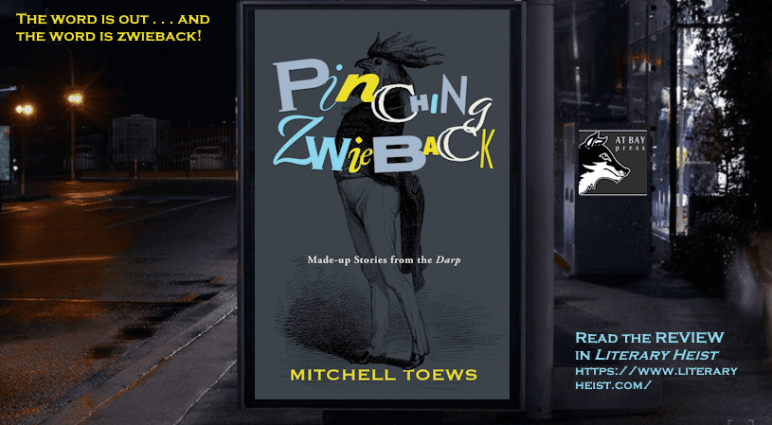
NEW REVIEW! See what Robert Boucheron, Saturday Evening Post contributor & editor/publisher of Charlottesville, VA’s Rivanna Review, has to say about “Pinching Zwieback.”
Find it here: in Ottawa’s Literary Heist
Pinching Zwieback, stories by Mitchell Toews, At Bay Press, paperback, 257 pages, $24.95
WHERE Can I Buy “Pinching Zwieback?”

“Pinching Zwieback” ISBN 9781998779055 by Mitchell Toews (At Bay Press, Wpg) may be purchased:
From At Bay Press: “Individual orders are placed through our website by adding books to your cart and then checking out with our secure online payment. Orders may also be placed over the phone by calling 204-489-6658 and payment will be taken over the phone. You may send an email with any questions or concerns to atbaypress@gmail.com.”
McNally Robinson Booksellers all locations.
The gift shops at both Mennonite Heritage Village (Steinbach) and Mennonite Heritage Museum (Abbotsford).
CommonWord Bookstore and Resource Centre in Winnipeg, MB
At small, independent book stores near you. That may be Misty River Books in Terrace, BC or Mulberry Bush Books in Qualicum Beach, BC, or Prairie Lights Books and Cafe in Iowa City, IA or Fables Books in Goshen, IN, or many, many other bookish places in Canada, the US, the UK or wherever you happen to live. Request a copy and we’ll get it there.
Shop in person: Canadian Bookstore Map or visit the At Bay Press website SHOP LOCAL page to find the Independent bookstore near you.
This SHOP LOCAL link shows all the retail locations in Winnipeg where you can buy PZ! https://shoplocal.bookmanager.com/isbn/9781998779055 or PUT YOUR OWN POSTAL CODE IN to find a bookseller near you!
Virtually all ONLINE book sources WORLDWIDE including Amazon, Barnes and Noble, Thriftbooks, etc.
Libraries and booksellers in Canada and the U.S. may purchase books from At Bay Press’s distribution partners:
Canada: http://www.litdistco.ca/
U.S.: https://www.casemateipm.com/9781998779055/pinching-zwieback/
Aus/NZ: https://peribo.com.au/
Other countries: Please see https://atbaypress.com/ordering or contact Matt Joudrey atbaypress@gmail.com
Requesting “Pinching Zwieback” by Mitchell Toews (At Bay Press, Wpg, 2023) at your favourite bookstore or library is also a simple way to get a copy!
DIRECT FROM THE AUTHOR: Contact me to receive a personally signed copy. Mail costs to Manitoba addresses are reasonable! (If you don’t mind a sturdy-but-previously-used envelope.) Payment via beep-beep-boop online magic systems like e-payment and PayPal, etc.
Author Gregg Norman

Lake Dauphin is part of a unique prairie watershed. It is the wind-worked home to pickerel and pike surrounded by wetlands and peaty sedge meadows. The lake represents a mature ecology bounded by strong parkland features and clearly influenced by the seemingly unending prairie to the south and west. The northern-influenced climate and relatively sparse human population present a persona still wild in its soulful inner self but outwardly, a place of calm and quiet strength.
This account of place could just as easily describe one of the region’s residents: five-book author Gregg Norman. I’ve had the good fortune to stumble onto Gregg’s writing and just as enjoyably, his cordial, affable, and knowledgeable personality. After a few years of comments and emails, reading each others’ work and becoming online friends it’s time to write a proper review.
Drawing from two of Gregg’s novels—A Gift of Scars and Bingo at the Legion—here’s a summary that offers an overview of author Norman’s overall skills and attributes as a writer, as well as commentary on these two excellent reads.
In Gregg Norman’s books, we find a stabilizing foundation beneath the storytelling. Part of his underlying prose meter is to allow readers to view life and its intricacies, complexity, and sudden reversals almost exclusively through the experiences of the characters. As a result, fiction readers looking for an escape from their own day-to-day entanglements will find in these books a place where transportation into a virtual world is pleasingly easy and without the slippery footing so common in current literary fiction. Norman’s gripping realism feels exacting and personal even if it is drawn from places and characters that could be right next door. The scenes arrive, ruddy-cheeked and vital, from any one of a number of common memories and experiences that the author provides. Common only in their familiarity; uncommon in their singular personality and well-delivered descriptions. Norman steeps his stories in slowly revealed character studies, influenced as they should be, as they must be, by landscapes and neighbourhoods and relationships that this strong, characterful author knows well. Knows in his bones and his scars and his mature sensibility. He communicates fluidly, with the firm hand and big heart we desire from a storyteller.
Even treacherous ground like a failed high school romance renewed does not succumb to treacle or overwrought plotting and stilted dialogue. Instead, the relationship is renewed with subtle vibrancy, coming off the page and drawing us in with the feelings and emotions we know to be true to the situation. Norman has that deep well to draw from:
“The supreme question about a work of art is out of how deep a life does it spring. Paintings of Moreau are paintings of ideas. The deepest poetry of Shelley, the words of Hamlet bring our mind into contact with the eternal wisdom; Plato’s world of ideas. All the rest is the speculation of schoolboys for schoolboys.” —James Joyce, Ulysses
Norman adheres to this Joycean ethic without seeming as though he is trying to. His books about average, flawed people are indeed, “paintings of ideas;” word paintings, cut carefully with dialogue, imagery, word craft and the caring of a fully-invested artist.
Sometimes the characters may at first appear bleak or we find they are placed on stoney emotional ground. But unfailingly, they evolve at a pace well controlled—never contrived. Feelings furrow the ground, turning aside our first inclinations towards the character and revealing the core individual Norman has created. By allowing the characters to emerge more fully, the reader is brought along without effort or disbelief.
Families behave like families do: there is a hint of dysfunction and imperfection, even if the core is based on love and respect. Friendships have rough spots. Cars don’t always start when you need them to. If there was a rocket ship or a superhero or a cataclysmic event in a Norman book, it would sputter or flutter or remind you of butter—this author is simply not tempted by overkill and literary hyperbole. Rather than depend on mighty but unlikely events or personalities, Norman’s stories move along in less imposing circumstances and arrive where they should, after a satisfying and trying struggle. The author leaves the reader—and often the main character—worse for wear, but better for the experience.
People fall in love. They become ill. Some recover and others die. Dreams die too, though somehow we know that among those dreams, even those belonging to characters we first believed to be weak or ignoble, might be given a second chance.
A Gift of Scars: Gritty, untarnished realism with the deftly applied fictional touch of an observant and world-wise writer. At times darkly shaded, in the end, Scars leaves us with the feeling that perseverance, emotional honesty and the ability to keep striving despite our despair will serve us well.
In Bingo at the Legion, we think we have happened upon a quotidian gathering of “ordinary folks.” While this is not untrue, the underpinning fact is that there are no ordinary lives and that life is both fickle and generous. We know from watching Brenna, Grady, and Jasper that past missteps can be retaken and it is within our scope to alter what fate has given us no matter how unlikely it seems.
The lessons available through these enjoyable contes de vie are provided with a delicate touch—no authorial overburden. The characters become known to us and real in our minds. When we reach the tightly written conclusions, we may be surprised but never shocked or taken outside of the story. The characters reveal what we have been skillfully led to see in them.
The perfect Christmastime getaway? Travel to Lake Dauphin and back via Bingo at the Legion, Oz Destiny, Not My Dog, A Gift of Scars, and Lovely Way to Burn. https://greggnormanauthor.com/books/
“
 Mitchell Toews