Dappled Things has announced the finalists for its 2022 J.F. Powers Prize for Fiction, and I am one of the 28 authors selected.
“Well, now,” I said to myself, “I sometimes do interviews with other writers. Why not do one with me? An auto-interview?”
So here it is, with inspiration from interview subjects near and far, young and old, Catholic and Mennonite…
What drew you to this contest?
That is an excellent question. You are not only handsome but wise. Okay, here’s what Dappled Things say about the content they seek for the periodical.
“People fascinate us; sin bores us. Beauty amazes us; surface concerns leave us cold. Experience intoxicates us; world-weariness makes us yawn.”
That appealed to my sense of loftiness. Of aiming high. So that’s what I did — with the story and with the submission.
Were you, a Mennonite, concerned by the fact that the publication and the J.F. Powers contest are sponsored by an organization that is “Wholeheartedly Catholic?” Did this fact change your approach to the story?
Not concerned, as much as intrigued. In my experience in South Eastern Manitoba where disparate small towns dot the farmland, there are many predominantly Mennonite, Lutheran, Catholic, and Ukrainian places. Despite coming from distinctly homogenous communities, each with its own dominant religion, people somehow always end up mingling. Whether it is through work, play, school or — inevitably — romance, intersections are created and blending results. Not right away, but over time. I saw this many times in my own family and beyond.
In this way, my story about a mixed Catholic and Mennonite family with a close sibling relationship between two of the children seemed to be a natural fit for the ethos of Dappled Things and the J.F. Powers Prize.
Did it change my approach? No. In fact, the merging of two, I would say, strong faiths, plus the fact that the early “Mennists” grew out of the Catholic religion makes the religious undercurrent in the story a strengthening factor and one that adds an interesting complexity.
Does religion play a major role in your story?
No. Religion is there, the same way the Manitoba prairie is there, to offer context and grounding. In fact, I can’t see how the story could have “got out of its own way” if religion would have been the central theme. I wanted the characters’ inner humanity and the always present tension between our selfish desires and our innate generosity and compassion towards others to be the core conflict. Describing where that generosity comes from is not part of my authorial responsibility. I’m just there to tell a clear story and let the reader find in it what they may.
So… you have a chance?
Nah. Like a platter of Niejoahsch’kuake1 in the church basement on Christmas Eve, I will be long gone after the first wave. The writers in this prize are the Iowa Writers’ Workshop types, The Paris Review essayists, the ones who put the “Masters” in MFA.
And yet?
Yes, and yet if I read my story, I know there is always hope.
1 New Year fritters. Deep-fried, dusted with icing sugar, sinfully good.
Please feel free to share this post! I welcome all comments.
“But words are things, and a small drop of ink, Falling like dew, upon a thought, Produces that which makes thousands, perhaps millions, think.”
—Lord Byron (1788-1824)
This posting was edited and updated on September 25, 2024.
Timewarp: 1974 me (Photo: Rob Fast)
Note: some of the images and statistical details in this article contain sensitive content.
While preparing a study session article for my writing group (the Write Clicks) about “Writing the Other” with my focus on older adult characters, I take a break. I slurp up a bowl of plain yogurt mixed with turmeric, organic blueberries, and hemp seeds. It’s a snack few people below a certain age—I’m unsure of what that age is, precisely—would eat. Pretty sure I would not have eaten this slop in 1974.
I pause, mid-antioxidant, in front of the TV where a 25-year-old woman discusses how she feels isolated because of her age. She feels old. Oh?
There it is. “Age” in all of its imprecise, vague, fluid, and ambiguous glory.
The woman, one many would readily term a younger woman, is a U.S. Olympic figure skater and her presence on the team is, in statistical terms, an anomaly. The 25-year-old figure skater feels “old,” even though— only days later—a 35-year-old woman wins gold in speed skating.
Context is everything.
For our writing, how do we define the terms: Old, Older, Older Adults (AP and other style guides’ preferred term), Older Persons (another benign choice), Older Writer, Older Author, Older Artist, Elder, Elderly, Aged, Senior, etc.? I’m not sure if any clear-cut definitions can be applied.
While definitions are tricky and may not be necessary, it’s important to use words that describe individuals and groups accurately and without bias or inference, intentional or otherwise.
To be honest, I began this process—researching and preparing an essay on age and ageism in writing—with a sense that I was a part of the stigmatized cohort and therefore had an intuitive, insider perspective. I am a 66-year-old (born in 1955) emerging writer and I have experienced many of the negative situations older people commonly endure. I frequently find examples on “writer Twitter” that are demeaning towards older emerging writers.
While all that is true, it’s also true that there are many others who suffer far more than me. Those who are older than me (not all but some); those who struggle financially, older adults with serious mental or physical health challenges, those who live alone or reside in remote locations or those in regions where exploitation, neglect, abuse, and violence towards older men and women is endemic—all these tolerate more than I. And what of older individuals who also are part of other marginalized, stigmatized, or mistreated groups?
I also need to confess that deeply embedded habits and preconceptions still live on in me despite my recognition of my own advancing age and despite my best intentions. My personal age bias persists. With respect, I suggest you check your own—I’d be surprised if you didn’t find that you too have entrenched beliefs and your vocabulary is rife with problematic (maybe even ageist) word choices. Our society has entrenched in us a vernacular of systemic bias towards older populations.
That’s the point, isn’t it? To become aware of the insidious microaggression of “slings and arrows1” and to stop their proliferation in literature. Ideally, we will embrace better choices and enact our own individual programs to stop the underlying mindset that gives permission to ageism.
Certain phrases and once socially acceptable sayings most people today to experience feelings… Feelings that extend beyond the superficial message in the statement. Take for example, “That’s women’s work.” Say it aloud to yourself. Feel it? An uncomfortable sag in your mood? Depending on your point of view, your feelings may run from “So what?” to “How the eff could that ever have been acceptable?” For most today, I believe, this obsolete, misogynist phrase never was-never can be acceptable. It was insidious and powerful in its time and those who used it as a verbal weapon knew what they were doing. What they were really saying had to do with their view of order: “Males are superior; females are inferior.”
Now, what about age and ageism, today? My observation is demeaning stereotypical statements concerning older adults are not only common but are often given tacit permission and validity by tepid or nonexistent rebuttals. Where is that “uncomfortable sag” when we hear someone described as “just an old fool?” This slur implies that most older adults suffer from dementia, or what used to be called “senility.” And, while we’re on the topic, the etymology of the word “senility” is derived from an ageist source:
Like gender bias, age bias has many false comforts built into the language; into the mindset. Our society still stubbornly accepts most ageist stereotypes as truth. We are conditioned to allow this.
“He’s just having a senior moment…” Stereotyping: seniors lack mental acuity.
“Well, I think it’s just ADORABLE to see her try to waterski!” Condescension or belittling behaviour: treating older adults as if they were children. Another example, one that takes sharp aim at appearance and our enslavement to youth is the title of Editor/Contributor Rona Altrows’ collection of essays, short stories, and poetry, You Look Good For Your Age. Discussing the original idea for her book, Ms. Altrows writes:
“I returned to the same respiratory therapist for my annual checkup. I told her that her words to me, ‘You look good for your age,’ had inspired a book. ‘Wow!’ she said. ‘You wrote a whole book about that?’” —You Look Good For Your Age, The University of Alberta Press, https://www.uap.ualberta.ca/titles/985-9781772125320-you-look-good-for-your-age
“Blue Hairs… Porcelain Hips… Silverbacks.” Caricaturing: Using insulting names like these or “geezer,” “old fart,” “old bag” to let a perceived attribute or broadly applied characterization represent an entire group of people.
Even more deplorable are these two aces in the caricature deck: “Angry Old Man” and “Crazy Old Lady.” These two pejoratives herd all ages and personalities into a single, stigmatic “type” that is at once degrading and handily gender specific. These objectional phrases in fact draw few actual objections.
Then there is the everyday salad bar of feckless labels… A plethora of crudities, code-words, and depricating blanket descriptors:
stingy, creepy, smelly, unpleasant, needy, baffled by technology, slow-witted, simple, demented, senile, incompetent, weak, slow-moving, unfit, has-been, stuck in the past, indifferent, uninformed, uncool
sexually inactive, unattractive or perverse (take your pick or choose column C: [] All of the Above)
Had enough? Me too.
Society has made progress towards de-normalizing negative language and attitudes towards women, and increasingly, towards other groups for whom a history of bias and discrimination exists: look at race, religion, sexual nature… So why is it seemingly still OKAY to malign older individuals?
Furthermore, how can we reduce the importance of age in our assessment of older people, without disregarding the positive aspects of age? How can we properly and appropriately recognize age and approach older adults as equals, albeit ones with a differing set of circumstances, experiences, and background references, among other things?
Once again we must ask, “who—exactly—are ‘the old?’” Finding one definition seems improbable. We need to incorporate individual, circumstantial factors.
Without fail and throughout our lives, every one of us is viewed as if through a constantly shifting kaleidoscope of age: Seen simultaneously by some as “old” and by others as “young.”
II. Diminishing Harm; Normalizing Ageism
Is ageism really that big of a problem? Does ageism compare to racism or misogyny or other societal bias and discrimination? If you really, really love your grandmother, for example, how could you possibly harbour ageist thoughts or sympathies?
Like me, I suspect many of you will start out with a “no-no-no way” self-assessment. Part of what is entrenched in systemic ageism are the diminishing arguments that seek to uphold what we’ve come to see as norms. So, please be wary of blinders you may have in place and take a hard look.
If we don’t honestly confront our own embedded ageism we won’t be able to keep it out of our writing.
“It seems to me that this determination by the non-elderly is a consequence of the death-denying culture in which we live, where youth is overvalued, the middle-aged control the world, and the old are perceived as useless, and therefore, better dead.”
—Sharon Butala (Officer of the Order of Canada) in “This Strange Visible Air – Essays on Aging and the Writing Life”
Butala is not alone in her unflinching appraisal. The Gerontological Society of America sees ageism as having its roots in a kind of hateful miasma, utilizing violent terms like “Coffin Dodger” and “Boomer Remover.” They see a condition in which,
“The rhetoric of disposability underscores age discrimination on a broader scale, with blame toward an age cohort considered to have lived past its usefulness for society and to have enriched itself at the expense of future generations.”
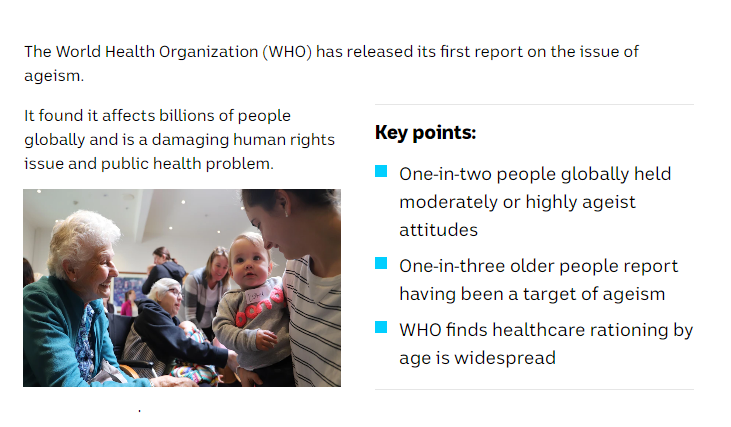
It’s worth reminding ourselves too that, according to the World Health Organization global study, “15.7 percent of older people—or almost one-in-six—are victims of abuse.”
The grief of older people and their plight in our society is greatly undervalued.
This meme is extreme. Few would side with this repugnant comment, but it is in the public domain. No one objected. The online forum did not remove it. In fact, it presents, in my opinion, a perfect example of hate speech and that’s why I shared it—to expose it; for “situational awareness.”
Older adults are unfailingly “young adjacent.” In the everyday workday life of older writers, specifically, there is no escaping to a separate generational safe room where ageism is non-existent. Older writers must operate in the presence of—and sometimes in spite of—those who may wish to denigrate, stereotype, and caricature older adults in their writing and express negative sentiments toward older writers in their writing practices.
2024’s Threads, said to be a “kinder, gentler” forum for writers recently contained a lengthy discussion on “old people” ending with a classic, phobic, toxic “some of my best friends are old and I don’t mind them,” comment from a self-described “young writer invested in life-long learning.”
A recent article in the Canadian literary source, Quill and Quire, stated that approximately 77% of the writing jobs in Canadian literature were held by those age 40 or less. (I don’t have a citation for this, but welcome a correction or a confirming citation.)
The artistic lives of older writers are inextricably interwoven with younger writers, editors, publishers, critics, reviewers, and others who have a say in our professional fate.
Lunatic Fringe?
Ageists are not confined to a small group of outliers. For a present-day, real-world indicator of the state of ageism and its potential for negative influence, consider the Covid experience, worldwide.
“Whether it’s the impacts on their own health or losing their jobs or the isolation or exclusion from treatments [COVID-19] has really shone a light on ageism,”
While older adults (statistically, slightly more men than women) are always going to lead the mortality percentages over more youthful cohorts—not surprisingly, age is a strong predictor of death rates—older Canadians had this statistical abnormality: in 2020, there was a statistical jump of 11,386 more deaths than the long-standing norm, for all age groups. Of these, the cohort of those age 65 or greater recorded 78% of those 11,386 anomalous deaths. This can be attributed to no other factor than Covid.
Covid has revealed a tear in our social fabric and is chilling to consider.
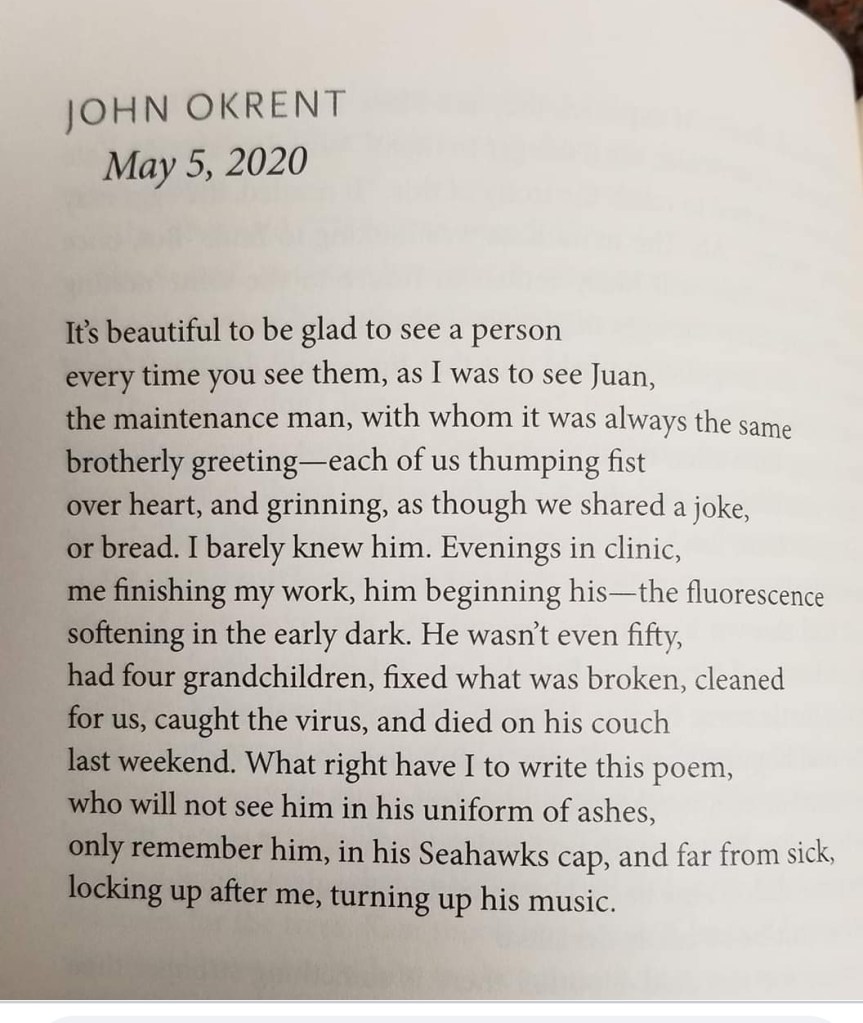
Furthermore, for the many older adults who also overlap certain other marginalized populations (experiencing the effect of intersectionality), there may be an even greater and more shocking comparative “excess” death rate. John Okrent’s moving verse touches on this and offers inspiration to us as writers.
Last, we would do well to remember that older adults represent a significant portion of the Canadian “patchwork quilt.” In Canada today, StatsCan estimates, “Almost one in five (18.5%) Canadians are now aged 65 and older.” This segment is growing—if we assess the number of older characters in Canadian literature today, will it reach 18.5%? Representation, as they say, matters.
Moreover, Saskatchewan Seniors Mechanism reports in Ageism and Media in Saskatchewan, that: “By the year 2050, it is predicted that the number of older adults will exceed the number of younger persons to reach approximately 22% of the world’s population”
—Abdullah and Wolbring 2013; Nosowska, McKee, and Dahlberg 2014
This situation cries out for our attention. It begs our activism as citizens first, but also as writers and communicators because we can so effectively lead by example, help to inform public opinion and drive change in popular culture.
“Ageism can operate both consciously (explicitly) and unconsciously (implicitly), and it can be expressed at three different levels: micro-level (individual), meso-level (social networks) and macro-level (institutional and cultural).”
—Determinants of Ageism against Older Adults: A Systematic Review
III. There are Many Negatives—What are the POSITIVES?
Negative media and gut-turning examples abound (see the images below, if you still doubt that) but we need some positive input to balance the scales and keep us from smashing all the dishware.
Strive for Positive Words
Avoiding negative communication is half the battle.
As artists, we must strive for positive words and phrasing. There is much to be admired in older adults and also in the uplifting canon of writing about elderly individuals. I cite John Okrent above and Old Man and the Sea a bit further on. Here are several other exemplars from my own bookshelf:
—The older characters in The Grapes of Wrath. Steinbeck’s characters, by the way, were drawn literally from real life. He embedded as a documentary journalist with a large group of migrants heading west and his The Grapes of Wrath characterizations were hybrids of the behaviour he witnessed first hand.
—Fight Night, Miriam Toews’ shining, unafraid story of an older woman living out the last joyful but complicated months of her life and the descriptions of her loving—but often fractious—family relationships is a superlative guide. It is an insightful, true depiction of a singular character who, more than anything, “wanted to be in the thick of things!” She did not allow systemic ageism or the social stigma of age or her physical challenges stop her.
—Moonlight Graham is one of my favourite literary characters. W.P. Kinsella brings the character to life in the novel Shoeless Joe. It’s a rich and complex template for writing about an older adult character.
[…] “That’s what I wish for. Chance to squint at a sky so blue that it hurts your eyes just to look at it. To feel the tingling in your arm as you connect with the ball. To run the bases – stretch a double into a triple, and flop face-first into third, wrap your arms around the bag. That’s my wish,”
—Moonlight Graham, in Shoeless Joe, discussing his dream to have an at-bat in a big league ball game
The Graham character expresses his wish, not in terms bound by time or constrained by a stereotypical view of an older person’s body, but rather from the viewpoint of a strong ballplayer, ready to take on the mental and physical challenges that create a definition of who he is. It’s how he sees himself and how we see him too.
—And yet, age is not imagined. Our bodies change and that can include our mental and emotional state as well. There’s no need to sugar-coat this or pretend that an end to life is not real. This must be faced for what it is. Who better than a poet to take this on?
[…] “You live a while and then time happens…
his knobbly hands lying on the white sheet blue almost grey ridges of blood running across his hand’s map his thin arms the pale blue top nurses tied in bows at his back his brown eyes you could see through if you weren’t afraid…“
—Patrick Friesen, The Shunning
—Here’s another moving example: an adult son considering his father’s later-life adversity. It is written with respect and honesty. An excerpt from Ralph Friesen’s lovely memoir, Dad, God, and Me.
[…] “(Mom) called the next morning to say that Dad had died…I hung up the phone, went to the living room, and picked out a Peter, Paul, and Mary LP from the stack on the table…The trio of voices, so harmonious, celebrated Stewball, the legendary racehorse: ‘Oh way up yonder / Ahead of them all / Came a prancin’ and a dancin’ / the noble Stewball.’Tears started in my eyes; I did not know why. Today I think of the song as an ode to my father, who had always put himself second, who abjured dancing, who was humble and slow-moving. Now, released from his pain-body, he was a beautiful thoroughbred, dancing proudly, crossing the finish line first.” https://www.youtube.com/watch?v=hXdQB-mR4tg
IV. If Only There Was a Style Guide.
In Gregory Younging’s brilliant, Elements of Indigenous Style – A Guide for Writing By and About Indigenous Peoples, the author covers the full spectrum of do’s and don’ts and (in my estimation) a few “Hell, NOs!” Older adults and those who write about/depict them could take some pages, literally, from Younging’s book.
Elements of Indigenous Style outlines 22 principles of Indigenous style. The author goes into detail and these tenets are specifically Indigenous, not “cookie-cutter.” It’s worth noting too that in Elements of Indigenous Style the seventh Principle is “Elders.”
“Indigenous style recognizes the significance of Elders in the cultural integrity of Indigenous Peoples and as authentic sources of Indigenous cultural information… Indigenous style follows Protocols to observe respect for Elders.”
Page 100-101, “Elements of Indigenous Style – A Guide for Writing By and About Indigenous Peoples,” Appendix A. Brush Education Inc. 2018.
Younging’s work concerning Elders, in particular, could be seen as a trailblazer and inspirational matter, and writers depicting older adults of all “race, creed, colour, and religions” can draw substance from this work.
A similar groundwork—an “Older Adult Style Guide” perhaps—is needed. Something with Elements of Indigenous Style‘s comprehensive nature; a Strunkian Elements of Older Adult Style.
Happily, such a guide DOES exist! In fact, more than ONE!
Words are Powerful A Style Guide for Writing and Speaking — avoiding ageist concepts and language
An excellent publication from nearby Saskatchewan is Words are Powerful. A link to the PDF and the website is included and I’m sure readers will find this to be an excellent source.
For this resource and more, please see Other Reading, below.
V. A Style Guide for Older Adult Characters, Scenesand Stories
[…] “analysis of past and present literature shows that the aged have been stereotyped and portrayed negatively. By not assigning them a full range of human behaviours, emotions, and roles, authors have categorized them, resulting in ‘ageism’—discrimination against the elderly.”
—Anita F. Dodson and Judith H. Hauser, “Ageism in Literature. An Analysis Kit for Teachers and Librarians.” 1981 (Sponsored by U.S. Dept. of Education.)
It’s cogent to note that the conditions found in the 1981 study cited above have not changed much. For me, this status quo suggests that if there are no rules, the lowest common denominator will continue to prevail for older adults in literature. (The biggest bully wins… well-known to schoolteachers, bartenders, and parliamentarians.) So, as a point of embarkation, here are a few basic ground rules for those writing about older adults as “the other:”
1. Examine your reasons: exactly why is it necessary for you to write for or about someone outside of your own experience, in this particular situation? Could this better be left for older adultauthors to take on? #ownstory
Confession: I’m in the camp of wanting lots of writers to write about “the other;” about older adults. The more often older characters appear, central to the plot and treated as equals, the better.
2. Recognize and avoid “young saviour” syndrome.
3. Do your homework. Know the issues. Read older adult authors. Go to their places, meet with older adults, listen, observe, participate. Ask.
4. Review your draft with older adults. Consult with accredited individuals or those recognized by peers. (You might have to pay them.)
5. Assign older characters to main character roles and place them in a diverse range of occupations and settings.
6. Older adults do not necessarily see themselves as “OLD,”or at least, not entirely.Writers must capture this aspect of self-identification when they write older characters.
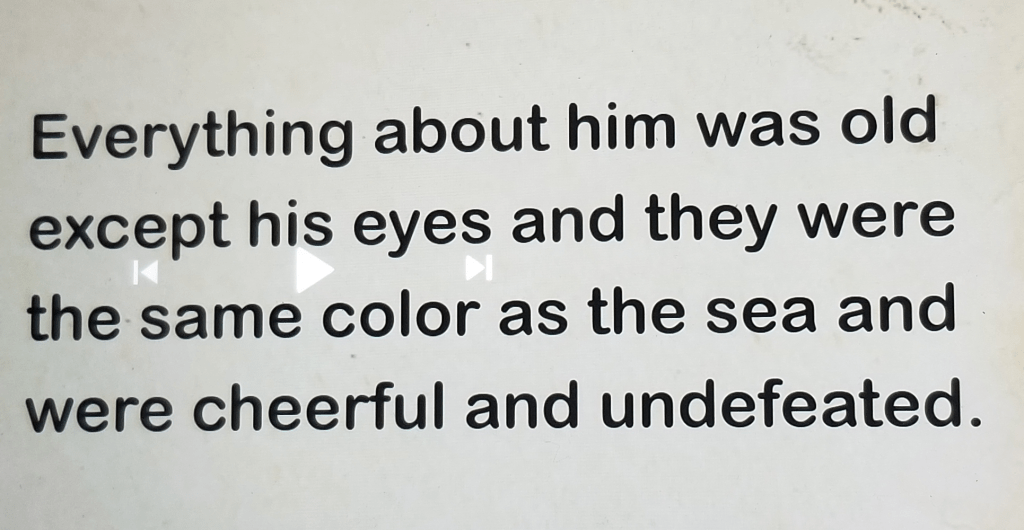
—Ernest Hemingway, describing the MC, “Santiago” in “The Old Man and the Sea.”
Sidebar: The Cojimar fisher upon whom Hemingway based the Santiago character was late forties-early fifties. So “old” as a definitive description is assailed once again.P.S. — Canadian Prime Minister JUSTIN TRUDEAU, who is often used as an example of youth, was born in 1971, putting him in his early fifties.
7. “Older Adults” is not a homogenous or coherent group*—it is as diverse as any younger group in all categories including AGE.Recognize and avoid cliched older adult tropes
8. Older people may not always want to be judged by “young” standards. Older adults are not “failed*” or “under-performing” young people, THEY ARE THEIR OWN DISTINCT COHORT. Furthermore, like other groups who are made invisible by prevailing bias and discrimination, older adults want to be seen as individuals and not just as an interchangeable part of a group or category.
9. Attack your own bias. Seeing, revealing, and dismantling your own personal prejudices will unlock a sense of honesty in others. (And free your writing from a disingenuous constraint.)
10. WHAT IS MISSING FROM THIS LIST?
VI. Conclusions
1. Ageism is unique and distinct from other similar social problems. At the same time, the approaches used successfully by other systemically marginalized groups can be considered and may be adapted to combat ageism.
2. Ageism is no less serious than other forms of discrimination or bigotry.
3. It is within the scope of art, including all kinds of writing, to uplift older adults and address ageism directly and at the source.
Other Reading:
1Treatment of the Elderly in Shakespeare Shakiya Snipes Denison University
One Last Thought…I’ve made over 700 submissions to literary markets in Canada, the U.S. and the U.K. since 2015. In my experience, I’ve seen ONLY ONE submission guideline that prohibits ageism by name: Agnes & True, see below. (If you find another, please place a link in the comments!)
More positively, here is the formal submission guideline from one of the largest circulation literary periodicals of the past three decades, Tin House. They address prospective authors in a Diversity, Equity, & Inclusion statement crafted with care and specificity.
“In particular, we are looking to engage with work by writers from historically underrepresented communities, including—but not limited to—those who are Black, Indigenous, POC, disabled, neurodivergent, trans and LGBTQIA+, debuting after 40, and without an MFA.”
As noted above, a Canadian literary periodical that is noteworthy is Agnes and True, which […] “celebrates the achievement of women…” and also states, “In addition, we are particularly interested in discovering and publishing the work of emerging older writers,” and “We also do not publish work that is racist or sexist or ageist or that would incite others to become racist or sexist or ageist. We reserve the right to define all the above-mentioned terms for ourselves.”
I’ll also add that it is perplexing to see Agnes & True as the only Canadian literary periodical/journal/review that explicitly sets out age/ageism as intolerable. Winnipeg’s Prairie Fire recently took a bold step by publishing a (exceptionally popular) “50 Over 50” collection—a landmark, age-related moment in CanLit. (To be clear, men and non-binary individuals were not included in this submission call.)
I know from personal experience that there are numerous Canadian literary markets that accept work from older writers of any description. My hope is that they will soon feel comfortable enough to stipulate to this, in print, in their DEI statements.
(NOTE: The Canadian Charter of Rights and Freedoms sets ample, legal precedent for publishers: discrimination based on age is prohibited in Canada.)
DEI Addendum
September 25, 2024: During my recent submissions and while prospecting for short story markets I came across these Diversity, Equity, & Inclusion statements in U.S. Publications. There appears to be a discernable surge in the number of top literary markets and affiliated organizations, universities, and other publishing bodies that explicitly specify AGE and AGEISM in their public DEI statements.
Besides Tin House, mentioned earlier, here are some “big market” American examples of how Ageism’s long reign as a covert, modern-day “scarlet letter” seems to finally be coming to an end:
“We are seeking writers whose work speaks to issues and experiences related to inhabiting bodies of difference. This means writing that centers, celebrates, or reclaims being marginalized through the lens of race, ethnicity, gender, sexuality, age, class, religion, illness, disability, trauma, migration, displacement, dispossession, or imprisonment.” —Adina Talve-Goodman Fellowship, Brooklyn, New York
~~~
“Shenandoah aims to showcase a wide variety of voices and perspectives in terms of gender identity, race, ethnicity, class, age, ability, nationality, regionality, sexuality, and educational background (MFAs are not necessary here). We love publishing new writers; publishing history is not a prerequisite either. “ —Shenandoah Literary, Washington & Lee University, Lexington, Virginia
~~~
“The Paris Review is an equal opportunity employer. We evaluate qualified applicants without regard to race, color, religion, sex, sexual orientation, gender identity, national origin, disability, veteran status, age, familial status, and other legally protected characteristics.” —The Paris Review, Big Sandy, Texas
~~~
“Furthermore, we’re interested in working against past and present inequities by publishing work by individuals from systemically marginalized groups, including writers of color, nonbinary and trans writers, members of the LGBTQIA+ community, neurodivergent writers, disabled writers, working-class and low-income writers, older writers, and all others who consider themselves underrepresented in contemporary literature.” —The Cincinnati Review, the University of Cincinnati
~~~
Sidebar: Cincinnati Review Managing Editor Lisa Ampleman further reported, “When we did a survey two years ago, attention to older writers was one of the major requests from those who took it.” (9.25.24)
Please feel free to share this post! I welcome all comments.
Most mornings… in fact, most mornings as long as I can remember, I wake up happy. It’s a trait I would not trade. I am a cheerful morning person with a positive outlook. However, I must admit that some mornings are more of a poutlook. Soo gohne daut; so goes it.
Pouty mornings I sometimes call, “The Morning After Nothing.” A kind of bitter hollowness, apropos of nothing, with nothing left to lose, and nothing is more true than that you still have to get up and make the bed and get going. There is no cancel button for this illness.
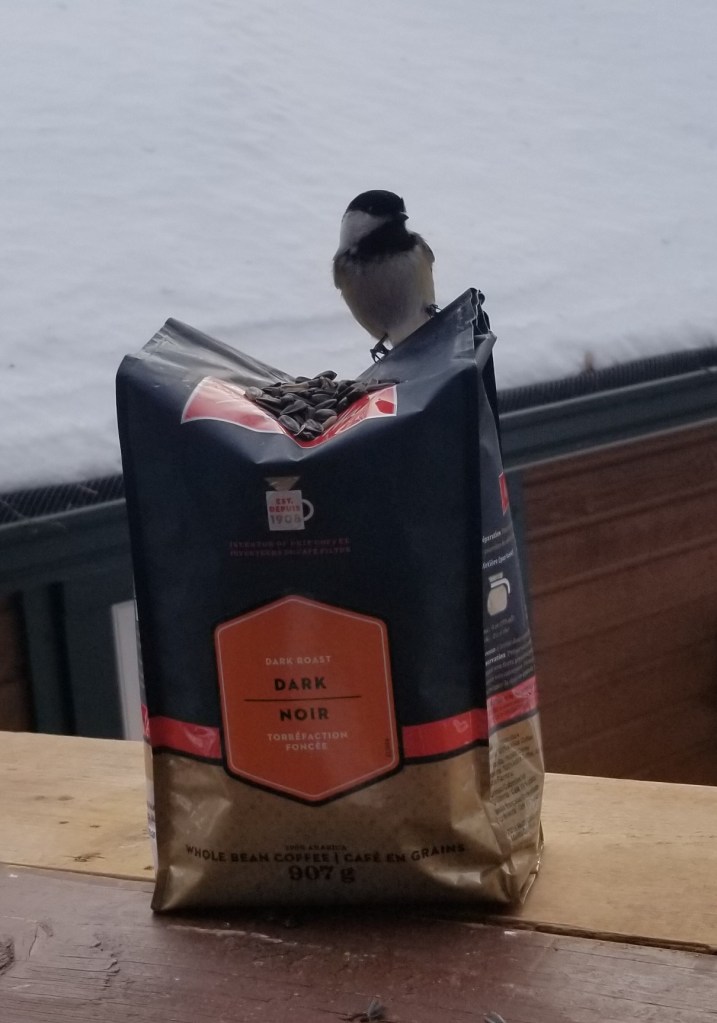
“Cancel” starts with a C. What else starts with C are the things that conquer the dog-breath stench of waking up on a Morning After Nothing: coffee, chickadees, and creativity. My go-to fixes, respectively: Medium C, Little Cs, and Big C.
Coffee and the antics of our neighbour chickadee pals are self-explanatory cheer-bringers. Creativity is the third great remedy because it takes you away from the grumbly place and puts you far on the other side of Nothing. This last C takes you straight to Elsewhere: rapping at a keyboard, pushing wood through a saw, trying to learn a new move on the windsurfer. Painting something for a friend or for one of our pog grandkids. (That’s my wife Janice’s usual way out.)
“Dee-dee-dee!”
Today, I found the coffee less than stimulating and the chickadees were their usual acrobatic and fearless 15-gram selves but I still had the look of the guy at the back of the longest line at the grocery store… the guy with the dripping container of ice cream.
But, C-ing is believing, as the saying goes, so I moved on to Creativity: “C’mon Creativity, papa needs a new toque!” I wound up considering a difficult short story I’ve been working on for a long time. It’s an outside-your-comfort-zone story, with nary a Mennonite in sight. The story is dark and harsh, and carries a gut-shot of implicit violence. Well, if you’re gonna write about toxic masculinity, I guess you gotta break a couple of… Uhh, scratch that—sounds too glib, and not a little.
Cal Rhinehart. Big and mean. Damaged goods and all about the booze and the dope. Everyone else’s fault but his. Maybe his dad beat the shit out of him or maybe one fight too many or maybe he just had bad chemicals in his head; got dealt a rotten hand, Fiona thought, sad and furious and terrified all at once. Maybe understanding too well. Maybe even feeling a sort of mongrel kinship. But she shook that thought away. Positive thinking, Doctor Tracewski always says.
—Main Character, Fiona Hewel, in “Four Baths, Great View, Bank Owned Mountain Home”
This is the story that started up in my head after reading an incredible story by the super-pog Becky Hagenston, “Midnight, Licorice, Shadow.” I was determined to jump outside of my skin—that old, wrinkly bag of derma—and take on the many risks attendant for an older man who writes a story that contains difficult passages; violence both emotional and physical and violence against both men and women.
Violence is real. Violence towards women happens. Violence is at the heart of the topic I wanted to broach, and yet, how could I, “go there?”
Would it be best to just bail-out? Let someone else handle this topic? Did you just shout, “Hell yeah?” I understand, and yet, I have an indelible memory; something that happened to me, in real life, in the real world on the #1 Highway just west of the Bow Flats, at the feet of Big Sister, Middle Sister, and Little Sister.
“What in the world? Look at that!” Joe said, straightening his back and shifting his attention to the road ahead. A red SUV accelerated along the merge lane of an intersection. Behind the speeding car, a tattooed, bareback man ran in a dead sprint.
“Is he chasing them?” Fiona said.
Tall and broad shouldered, the man had an athletic build and long dirty blonde hair. The white drawstrings of his grey sweatpants fluttered and snapped behind him like kite tails as he ran after the vehicle. His bare feet pounded on the gravel strewn pavement.
The bizarre drama played on and Joe slowed the car as they closed on it. A white, flatdeck truck, “Rhinehart Well Drilling” in bold letters along the side, sat parked at a cockeyed angle near the intersection—driver door open, blinker on.
The running man slowed and hopped a few strides on one leg, then staggered to a lame halt. He bent at the waist to inspect his foot. The SUV sped away on the highway.
—”Four Baths, Great View, Bank Owned Mountain Home”
As you can see, I choose to go ahead with the story. The early iterations were the cause of some “Morning after Nothing” feels, but “vann aul, dann aul,” as is said in the Plaut: “if already, then already,” or “if you’re going to do it, go all the way!”
So I did.
Ugh. The result was more than one editor, I fear, not seeing the Red Badge of Courage in my choices, but instead feeling triggered and put upon. More than one editor who might have stroked me off a list or two. For good, or longer.
Still, this the way of it, is it not? If there’s no risk, then I will stay forever in the safe-feeling place—potentially a moribund state for my writing—where I just write happy, little stories about wise Mennonites. Where grey-bearded Opas nod knowingly and open their mouths to release a dazzling, atmospheric river of axiomatic truths and cornpone savviness. Savvy like, “vann aul, dann aul.”
But… many rewrites and tough critiques later, I feel as though the story has evolved and now comes closer to the way I want it. Consider: I am a male writer, someone who grew up in times and places where even the worst acts of wanton male violence were sometimes forgiven—forgiven (or given up) even by those who suffered the violence. Forgiven by those whose job is was to police this violence: pulpit, patrol car, politician. I lived this condition, directly and indirectly. Is that not a story worth considering? Is it not important to write from a point of view that—without absolution and without friendly framing—tells a human story in all of its unsettling truth?
I vote yes.
There’s a part near the end of “Midnight, Licorice, Shadow” where the author describes something being thrown into a dumpster, “with a thud,” and your heart sinks, and you feel a bit sick to your stomach. Without that passage the story is still wonderfully strong, but when you read it… when you read, “with a thud,” you are moved in a way that will last.
That! That result is the big prize, the one worth taking some risks to attain. It’s how a story can make a difference. It’s certainly one way to beat the Morning After Nothing blues!
Besides, as some wily Mennonite Oma must have said, to some future author on some far shore: “the best way to catch fish is to keep fishing!”
So I will.
Please feel free to share this post! I welcome all comments.
[Image Caption: Re-purposements… a 1960 fishing plug used as the pull-chain fob on the Toews’ living room ceiling fan.]
Trigger Warning: This article contains a lot of sexy plumbing talk.
Almost every day as I ramble around our home in the north woods I am always struck, like a proud curator, by how many treasures I have around here. Things we have bought (meh…) that have served well, but more so stuff Jan and I have thought up, designed and built. Ahh, endorphin rush sting me with thine euphoric prick.
Sorry, that last line didn’t come out quite right, but time is money and there’s no money for editing this month.
To continue about treasures… I get a thrill from the various objects that we have built, mended, replaced, and re-purposed. That last one, re-purposed, is an awkward but useful word that has not yet achieved hyphenless status, even though “hyphenless” has, according to Grammarly and WordPress. I particularly treasure those items that have had their purpose re-defined and radically so, such as the 2001patio door leaves that have become fixed windows in my writing room by the lake; the 1950 fir windows that now grace the She-Shed gazebo-screen porch down by the shore; the old Mistral windsurf board that hangs as a thematic outdoor light fixture above the garage door (can you picture that?) and other detritus of eras past and patents not applied for.
But the Mona Lisa of my collection is the 1950s-era child’s fishing rod that now is a a flexible actuator-whacker for the start-stop switch on our water pump. It’s obvious this needs further scientific/theological description, like the definition of the Holy Ghost, so here goes: The switch has lost its fine-tuning. If you set it so that it starts the pump when needed (like during the rinse-cycle of a shower) it won’t shut-off when the demand is satisfied. Arggh. Conversely, if I literally crawl into the crawlspace beneath the cottage where the pump and its harem of 10-trillion spiders live, and re-adjust the switch so it will shut-off, it then becomes obstinate about STARTING. Yoma leid etj sei! That is, it will shut-off just fine but will not for love nor Lubriplate, start-up! Doh! and double-doh! There is no middle-ground, only a crawly, dusty, oneiric no-man’s-land where spiders wear octa-legged harem pants and thick mascara and the potentate pump grins sardonically, as pumps and potentates are wont to do, damn their O-ring eyes!
Anyway… I note in my curse-filled administrations that a light tap with my screwdriver allows the pump to overcome its refusal to start. (Freudian?) Aha! A clue to the solution? So, what if… I set the actuator switch to always automatically shut-off without fail — thus eliminating the danger of a pump run-on that would burn out the dry-running guts — and then I came up with a way to manually give it a light tap to get it to start-up. Hmm. The trouble is, the only way to tap it is to crawl under the cottage. This crawling is a big ask for me, a guy with joints made of goat-cheese and ossified bone as pitted and porous as Manitoba limestone. How then, to tap without crawling down into that dim spidery hellspace?
I eye the kitchen floor above the pump, Makita drill in hand. “Ey-yi-yi,” Janice says with a you-gotta-be-kidding pump-grin, “Can’t you come up with another approach? We can’t have a hole in the middle of the floor! For the love of Cloaca Maxima!” she says, with a callous reference to the God of Plumbing. (We have a shrine to her in our garage.)
“But the crawling, the T-A-P-P-I-N-G… ” I whine like our truck in reverse.
“Figure something else out.” Her final edict. Inalterable. She hath spake.
Alive and filled with mother-of-invention impetus, I rake through the junk on the junk-shelf, next to the shrine.
“What are you looking for?” Cloaca Maxima asks. (Gods are so nosy!)
“I’ll know when I find it,” I reply in perfectly plausible circular logic. In that instant, I strike gold. A 1950s-era three-foot long fiberglass fishing rod. My re-purposer synapses fire like George Gatling’s murderous gunpowder hydra and I SEE it in my mind: a cord running from the edge of the deck and underneath all the way to the crawlspace wall, through a tube, into the crawlspace, with its terminus at the tip of the midget fishing rod. I TWANG and release the cord and the flexy rod will snap against the actuator switch, effectively mimicking my crawling tap-tap-tap. Like humankind’s ancient forbearers, I have risen up from the crawling stage and have freed my hands to grasp tools. Vive la évolution!
There it is: a way to administer an actuating sting with my re-purposed flexible prick. (Again,not really liking the way that image plays out, but, gotta finish this post and get out there in the sunshine, so I’ll just leave it as is.) The point is (eww!) this is the kind of MacGyvering that passes for progress around here, and I, inventor son of an inventor son of an inventor, find it provides a highly endorphilic, artistic pleasure for me here in the Fifth Re-purpose Arrondissements Municipauxde Jessica Lake. Gertrude Stein would be impressed, “A prick is a prick is a prick!” she might observe.
Anyway-anyway-anyway… The real purpose of this long build-up is to say that, like my invented treasures here-about, I take an equal amount of JOY from my literary works of art. They don’t bloody my knuckles — well, not in a literal way — but they take just as much effort and like my craftwork at Jessica, they come from old objects, re-purposed. Life experiences of mine and others taken and writ large in stories and essays.
Here is one such. It’s one of my favs and I like to show it off, like one might a ’57 Chevy with “Old Fart” license plates, only my stories are re-purposed to give a different kind of a ride on a different kind of a road. The story “Fast and Steep” first appeared in the Canadian lit journal, Agnes and True.
And, for a little variety, here’s another — a short essay that graced rob mclennan’s blog some time ago, it is a wise-crack that let some light in, in a Leonard kind of way: http://bit.ly/mySMALLPRESSwritingdayToews
allfornow,
Mitch
Please feel free to share this post! I welcome all comments.
“What all I don’t know,” is a kind of Steinbach* way of describing all that I’ve not yet experienced or learned.
My what all deficit is big. This is true even though I’ve experienced a lot. (I’m kind of old and a high-miler in some ways.) Anyway, what all I don’t know is a lot. How big “a lot” is, I don’t know because, well, I don’t know what all I don’t know.
Who does know what all I don’t know? And what would I do if I did know what all I don’t know about querying and novels and short story collections and literary agents and small presses and synopses and loglines and other Cinderella story bullet points? Predictably, I don’t know.
I DO know that there are those who know what all I don’t know.
Who are these what all knowers? I believe they are a facet of Cinderellaness called MENTORS. These fabled folk, awash in knowledge and given to sharing and patience and paying back and paying forward and other characteristics that may earn them wings, or a permanent place at the ball, or other indications of grace… as the glass slipper fits.
I know they exist because they have snuck into the collection of what all I do know. I have experienced them by chance and good fortune and benefited from their abundance. They include: abiding friends who waded through early drafts. The writer friends and comrades who did likewise; who were tough but kind, honest and objective. The paid freelance editors who gave me my money’s worth and much more. Much more. The Writers in Residence who also did what they were selected to do — help writers with their craft — and took an interest; gave more than required by their mandate. The Guild and lit journal volunteer readers, editors, and website builders and etcetera specialists who work in the wille hundat** of the literary world. The family members who bit their tongues when biting was not their first inclination and cheered even when cheering seemed a little “Toews sinks a lay-up with his team down 27 and 55 seconds left on the clock,” ish.
There is link between the two what alls: what all I don’t know and what all I do know. There must be! The link, the synapse, the causeway, the gossamer thread is this aforementioned group of virtuous MENTORS.
Where are the MENTORS that form this link? What are they doing right now? Do they herd or are they lone wolves? What or who do they prefer to mentor? What is the extent of their range and how are they best found in the wild? Are there Mentor-whisperers?
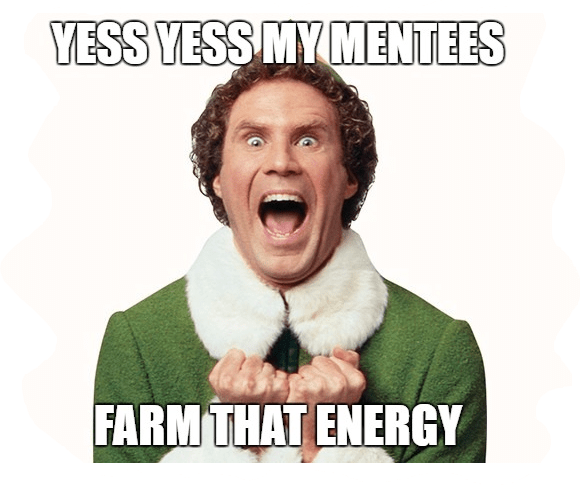
How do I become a MENTEE?
~~~
*Steinbach: my old hometown in rural Manitoba.
** wille hundat: a Plautdietsch or Low German expression meaning, “of unknown origin or towards an unknown destination” as defined in the “Mennonite Low German Dictionary.” (Jack Thiessen, Max Kade Institute, 2003) I think of this as the hundred acres, or so, on a farm that is not yet cleared and constitutes a wild bushland of unknown native flora and fauna; an unexplored landscape of mystery and supposed, unspecific threat.
Please feel free to share this post! I welcome all comments.
Last May (2020) I wrote this, a bit of snide comedy in response to The Mango Schiet Stain’s openly racist comments at the time. Now, a year later, we see the horrible, tragic aftermath as his repugnant legacy of racist violence lives on. And grows. I hope we speak out against would-be Canadian copycats who mimic these core hatreds, endorsed by American conservative leadership, and by extension, their evangelical yesmen.
“Queen Sensula, do you mean to tell me that the Romulans created and then spread the deadly Space Virus? (Appalled. Much Elizabethan flavour.)”
I was approached by an organization tasked to investigate Basic Income in Canada, with special attention to those of us in the Arts. They created a commission and invited artists from around the country to offer opinion and comment on the concept of Basic Income and how, specifically, it might affect the lives of artists.
I was invited to provide an Artist’s Testimonial and here is what I wrote:
I believe that Canada, wealthy and progressive as we are, could become a country that invests in its marginalized people by providing a guaranteed annual income for all citizens. I envision a graduated scale designed to offer a helping hand to get started or a financial safety net to mitigate financial trouble in an individual’s life and also to be there for those with obstacles to their ability as wage earners.
Why do this? Because life is unscripted and almost everyone, even those in our large “middle class” population needs help from time to time. Furthermore, and maybe of most importance, there is widespread suffering in Canada caused by poverty. By acting proactively, we have an opportunity to reduce suffering and at the same time empower a class of Canadians who may not otherwise achieve their dreams or even, in truth, live the life that most of us take for granted.
“The Poor” do not want to be “The Poor!”
A guaranteed basic income would reduce hardship, support upward mobility and drive greater aspiration across all levels of financial reality.
Plus, guaranteed basic income is in large part simply moving the dollar investment from the end of the cycle — being reactive and giving cash or services to people in desperate circumstances — to the beginning. We should spend to prevent rather than to rescue. Prevention offers a solution earlier in life, when people are in the formative process, especially concerning education and career.
Now, as to artists, specifically: Choosing the path to your dream of a career in the Arts is daunting because of the long, difficult period of education, training, and incubation. This means, with few exceptions, that those who wish to be professional artists — whatever the discipline — must expect and endure a long initial period as low-income earners.
In my personal experience, even with my parents’ financial support available as I finished college, I chose not to pursue a career in the Arts. I decided to take the safer route, financially, and “save” my art for a later date. That later date took a lifetime to arrive and while I have no complaints, I did not devote myself to my love — fiction — until age sixty. Now I am an emerging artist at age sixty-five and while I am extremely pleased with these last five years, I can’t help but wonder… “What if?”
In my case, perhaps the security of a guaranteed basic income would have given me the courage to chase my artistic dreams and not postpone or dismiss them? It’s impossible to say, but I can say for certain that our society is made more vital by the availability of choice. It’s empowering to know that your basic needs will be met even if the career path you are on will take a while to reach fully-supportive status. Furthermore, Arts Councils, armed with the underpinning of guaranteed basic income could focus all of their efforts on the many professional aspects and not worry about the artists’ core financial needs. The guaranteed basic income would take the pressure off the artists and the Arts Councils, for the betterment of both. This is true for all stakeholders in the artistic “value chain” and would breed an environment of possibility and less of a dismal “starving artist” scenario that defeats many artists before they begin.
Please feel free to share this post! I welcome all comments.
However, this popular post — and by popular, I mean 28 reads, so you know, not exactly biblical circulation — was looking a little raggedy. I took it down, feeling like it was kind of too scattershot, even for me, and likely was in need of a vitriol change.
So stand back and stand by… OOPS! I mean, well, I don’t mean THAT, I mean hold on and let me get back to you with a retuned version of original mixed-metaphor symphony. (See what I did there?)
Crib Notes:
😦 I’m just not wild about the whole RAPTURE thing. It seems like a Monty Python sketch or a far-out graphic novel that somehow turned into the end game for a worldwide religion. Where is SKELETOR? I keep asking myself.
😦 Why is it that so many evangelicals are big C conservatives in Canada and Republicans-slash-radicalized zealots in the loud, twangy country on our southern flank? When I read the Bible, it occurs to me — it occurs to me in GIANT FLASHING NEON LIGHTS — that every Christian today would undoubtedly be a Bernie Saunders Dem or an NDPer. RIGHT? Like, Jesus was way more Robin Hood than Sherriff of Nottingham. Tell me I’m wrong.
😦 When did JC and DJT (#45) become best buds? I did not see that one coming. It’s like Rocky and Bullwinkle, but you know… more Game of Thronesy and hate-filled and fundamentally disturbing. Also, would DJT really be seen hanging out with a long-haired, pacifist Jew? A sandal wearing POC? A wandering sometimes-carpenter, lay-minister of no fixed address? Right, cuz that’s zactly the kinda dude ol’ Donnie hangs with…
😦 How did so many average folks go from twittering red-cheeked at The Dating Game in the Sixties to outright pipe-bomb-making Twitter hatred of any and all LGBTQ individuals? (What’s it to ya, anyway, ya bunch of Tim Horton silo-dwellers?) And to all the nice, even-tempered, well-behaved Grannies who love the shit out of their gay grandchild or the level-headed, up-and-coming young CIS male fella who openly respects his Aunt for coming out… God bless you and keep you.
😦 Why are ANY Canadian Mennonites nativists? Remember: Russian Mennos (including my G-G-Opa) moved into the shiny, brand new place called Manitoba in 1874 and then promptly gave the orbstewel to a bunch of minding their own beeswax, pre-existing residents of the place. Then these new land-owner Mennos started acting holier-than-the-Catholic-church until today these great-grandkids of the 1874ers (and subsequent waves) don’t want to let some of the latest batch of refugees and opportunity seekers in. Huh? What? You snooze you lose? Are all traces of emigration and diaspora erased after three washings — or three generations — like a pair of the tight jeans you wear to rave in? At church? In the front row, arms waving like amber waves of (red fife) grain?
Okay. Wait a minute… this is getting all ranty and kill-zone prose on me, so I’ll hold off. Phew! Caught myself just in time.
allfornow, Mitchell (the slob previously know as Mitch) Toews
Please feel free to share this post! I welcome all comments.
As this rabid cannibal of a year winds down, I wonder about my writerly struggle and the artistic return on investment for me as a writer, 2015-2020.
ROI, baby.
Aside from all the “hard work is its own reward,” kind of sentiment, to which I subscribe and to whose driving power I owe one of the best periods of my redheaded life (apart from the baby powder tinged, little league coaching, proud dad/granddad parts), I wondered about how much of an imprint I’ve been given/achieved so far.
What is my gravitas quotient, or lack of same?
Am I #futility or do I stand a chance? There’s no punter (in the UK slang sense) who knows how to handicap me, there’s no Vegas line on my puny literary squirming, like the last water bug of the season making a tiny ripple that no one else notices.
An editor commented recently that I had a unique voice worth publishing. I fought back the urge to argue with her, and in that moment of cessation, found a glimmer. A glimmer not of hope — that sworl of Van Gogh luminant turbulence is still light years away — but a lifeline thrown out to me in the cold, deep water by a compassionate friend.
When I look at my C-V, I see a lot of online acceptances, a lot of out-of-province markets, and several repeat markets. This is telling of the state of the world of fiction, my preferences, my ability, my relative reputation in a world of water bugs, and my inclination to spend the years on the far side of three score with friends and heroes, not the miserable and the banal.
Anyway… I noticed that the attention of the curator for a certain specific geschichte writer list is focused solely on PRINT. I accept that. There’s so much online writing that it makes sense to begin your list with those in print. Not that I’m not proud (and more than a little) of many of my online publications, but, you know — I get it.
So here fellow water bugs, punters, friends, heroes, banal high-horsers out for a romp among the plebs… is my 2015-2020 Print Catalogue, based on about 100 distinct flash fictions and short stories sent out in over 400 submissions all over the English language literary world.
Ca — “A Fisherman’s Story” Rhubarb MagazineIssue 39 2016 Ca — “So Are They All” VoicesVol 16 No.2 2016 Anthology India — “I am Otter” The Machinery – A Literary Collection 2017 UK — “Nothing to Lose” The Best of Fiction on the Web 1996-2017 2017 Anthology Ca — “Sweet Caporal at Dawn” Blank SpacesMagazine 2018 Pushcart Prize Nomination Ca — “Away Game” Pulp Literature Issue 20 2018 Ca — “Sweet Caporal at Dawn” Just Words, Volume 2 2018 Anthology US — “Groota Pieter” River Poets Journal Special Themed Edition: “The Immigrants” 2018 Anthology US — “Peacemongers” The MOON magazine: “Out of This World” The Best Short Stories from the MOON Volume 1 2019 Anthology Australia/US — “Groota Pieter” Pact Press “We Refugees” 2019 Anthology Ca — “Fast and Steep” Riddle Fence Issue 34 2019 US — “The Log Boom” River Poets Journal Special Themed Edition: “A Fork in the Road”2020 Anthology Ca — “My Life as a Corkscrew” (CNF) Blank SpacesMagazine 2020 Ca — “Piece of My Heart” Pulp LiteratureIssue 27 2020 Winner of the Editors’ Choice in the 2020 Bumblebee Flash Fiction Contest US — “Away Game” Quail Bell Magazine 2020 Ca — “My Life as a Corkscrew” (CNF) Just WordsVolume 4 2020 Anthology US — “The Sunshine Girl” Cowboy Jamboree Magazine John Prine Tribute Issue 2020 Ca — “The Margin of the River” Blank SpacesMagazine 2020 Pushcart Prize Nomination
(Updated 12.4.20)
A few of these are printed on a rolling basis and so may not be out in the wild yet.
I also have 65 stories in various online publications in the US, the UK, and Canada.
Please feel free to share this post! I welcome all comments.
This thought has been irritating me, like a pebble in my shoe — a squarish pebble lodged where it cannot be reached. It has bothered me all day and the only way to get rid of it is to jot this down. Barefoot, maybe. Toes wiggling.
Whether it is Irish writing or Jewish writing or Indigenous writing… or even if it is Mennonite writing, I think the full complement needs to be part of the accounting. All constituents must be consulted to speak their unquiet peace. Not only the praise-makers, the honouring, the apologists, the happy-talkers, and the yammering wholly satisfied but most importantly perhaps, all of the others.
All the others.
Who would best know the naked truths and speak freely about what they know? Do the rich paint their discontent on the subway walls? How many fat cats walk a beat on city streets, risking rubber bullets or worse? No, They cause resentment, they don’t suffer from it.
Go ask these: The fallen. The betrayed and the shunned. The aggrieved. The marginalized, the disavowed, the once-close — now distant. The ambivalent who hang suspended still from the ties that bind, but who would cut them if need be… if they had no other choice.
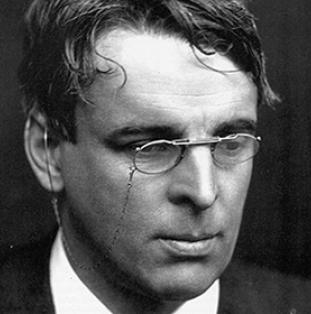
In W.B. Yeats’s dark masterpiece, Leda and the Swan, we are told that Leda could feel the swan’s strange heart beating, “where it lies,” as if it was somehow disembodied, no longer a part of the bestial being.
Does this mean that to capture the truth, we don’t go to the apparent source? Go rather to those who offered up a sacrifice and received aggression in return. Or something sadly “indifferent” as the poet suggests.
The presence of indifference might reveal more than all the rest combined.
Please feel free to share this post! I welcome all comments.













 Mitchell Toews