We’re All Just “temporarily embarrassed millionaires…”

Originally posted on a friend’s Facebook page. The italic comments are my subsequent additions. (Cooler heads prevailing? Maybe…)

Who looks out for low-income Canadians? The lawmakers? Okay, but aren’t they mostly wealthy individuals, some for many generations?

If not most, then many. After all, their salary, benefits, celebrity, and pension are enough to be financially attractive to most Canadians.

Aren’t many others “first-generation wealthy” who might see their elected membership in Parliament (and other institutions) as a handy, effective means of wealth generation and preservation? A few might be from lower income cohorts but far more (a statistical majority, in fact) are likely to be extremely rich; elites who may take the attitude that, “if the poor don’t like it, they should have made more money!”

“Extremely rich” is hyperbolic, but compared to those of average income and debt loads (who lack the opportunity to earn income after their public political life), many elected officials are financially well-off.

All those elected officials who complain that government pharmaceutical programs would be “socialist” activities are likely wealthy (and so do not fully appreciate the burden of pharmaceutical costs), likely don’t see “the poor” as a significant voting block, and are probably recipients of MP (or other gov’t position) pharma, dental, travel, etc. care plans.

The “Falk in our stars” are those who, as members of Parliament or Provincial Legislatures have a Pharma plan as part of their government pay package. If it disgusts him to the point of public displays of angry bluster, (and if I could) I would gladly take over TF’s coverage. I won’t vote for him as a result (that transaction would be illegal), but I will feel better about his election rhetoric and he will be able to point to his noble intent and superior moral character.

A better remedy than my angry rant might be to go back and read “The Grapes of Wrath” again.

In Praise of Contradictory Characters

Humans evolved as viable beings in part through our ability to maximize our senses as a whole. This is unlike many other creatures with specialized areas of excellence: a hummingbird’s flight or an eagle’s vision, for example. We homo sapiens have not been able to supercharge any single sense but have created a life-giving skill of summarization. We’ve been able to condense all of our senses to create almost instantaneous and frequently accurate compound impressions that let us make fast decisions.

When walking in the woods, the leaf-muffled sound of something above makes us instinctively glance in that direction, lower our centre of gravity, and rely on our unconsciously gathered, short-term knowledge of our immediate surroundings to guide us and avoid a falling branch.

These intuitive, “always on” survival instincts are given to us before we are born; these powers are in our genes and the DNA that plots our growth.

We combine all available data to create almost prescient responses to situations and we do it thousands of times each day, even while we sleep. Each second, we are automatically collecting, sorting, saving, discarding and responding—or preparing a response—to the myriad sources of input we insatiably seek to acquire.

Relentless and ruthless, we categorize and make assumptions as a necessary by-product of our rapid-fire process of collect-examine-act. It works! 750-pound sabre tooth felines are extinct but 122-pound soccer moms wearing spandex leggings and hot pink tank tops jog with their stroller-strapped infants through modern society’s statistical valley of death: roadside urban environments.

We depend on our ability to rapidly rate & discern danger or safe haven. This savant-like skill has made our population grow to the point where we have become our own worst enemies.

This island of genius, summarization, extends to our art as well. In fiction, we create characters whose true selves are, to the observant reader, readily visible. Seemingly stereotypical. However, our “bad guys” may at first appear as great dads, loving boyfriends, fearless advocates of the downtrodden, or otherwise trustworthy sorts. And so they may be, until they, like the tree branch, suddenly SNAP!

Like we somehow knew they would.

Bait and switch. Hidden foreshadowing. On Star Trek, the never-seen-before crew member who is featured in the opening segment of the show as a loyal but inconsequential player sets off alarms in our sensory array. We KNOW this character is shown for a reason. This herring with a sunburn is going to: a.) die horribly, b.) be transformed into some unstoppable alien predator, or c.) shapeshift into a lookalike for Kirk, Spock, Bones, or Scotty. The music, dialogue, the point in the story arc, and a dozen other micro telltales (a signature Nimoy eyebrow lift perhaps) give us a sense of certainty that all that remains to discover is the skill with which this yarn is unravelled. We grab a bowl of sugary cereal at the scene break and hurry back when the familiar “back-from-commercial” music entreats us to return and see if maybe there could be some knot in the plot we did not foresee.

Generally, the only way to fool us and our all-seeing assessment tools is to introduce some hitherto unknown, unknowable factor: a force field, a distant planet’s illogical cultural more, or a character flaw for which NO CLUES were ever offered. Shame, screenwriter, for giving us insufficient data. How un-Hitchcock of you! How Bradburyless!

But wait! Is there shame in this lack of situational prep work by the author? Must all characters wear either the white stetson or the black? Is it binary? God and the Devil? Must we be drawn always into our heroic and melodramatic roots over and over again? Can’t there be confusion? Contradiction?

#

In my “reads like a novel” collection of short stories, “Pinching Zwieback” (At Bay Press, 2023) there is one recurrent character who is, one could say, clearly contradictory. In her first appearance, “Justy” is a stoic, “old-soul” kind of young mom, whose love and earnest devotion for her family is both beautiful and beguiling. When I read this story to audiences, I can feel her charm and purity making them love her and want her to succeed. So do I.

In the next installment, about mid-way through the collection, we meet her again but this time Justy is the world-worn mother of teenagers in a fish-bowl small town where every means of escape has proven futile. This older Justy smokes cigarettes, drinks liquor, and otherwise spits on male Mennonite overreach into her life. The Grittiness of Mango Chiffon showcases her willingness to confront her male antagonist with laser beam accuracy and we find in her a beacon of hope for the lowly. (A group in which she finds herself, despite her powerful character.) Echoing a figurative page from another story in the book (Breezy) she reminds us of the message found in one of my favourite short stories: “Forgive the weak for they are always fighting.” —Layne Coleman wrote in “Tony Nappo Ruined My Life” (Exile V45.2, in which this story was named the $15K winner of the “Best Canadian Short Fiction.”)

Justy’s final appearance shows us the caustic effect of sorrow, self-pity, and surrender. Human frailty is the currency and Justy is no more the bright, heroic young mother willing to take on any burden and defy all odds against her. Nor is she still the cynical but bold and unyielding knight Perceval; older but still focused on her Holy Grail, though we might see in her some flickering signs of weariness and a quiet desire to set herself apart from the constant meanness.

At the end of Grittiness, we are left imagining her in growing despair, abiding a life among the paltry and the unbecoming. She remains unseen until at last, in Rommdriewe, she reappears finally and is forever seen as broken. The defilement of her earlier selves is complete.

The message in Rommdriewe is, as my writer friend Brian Hughes of Winnipeg said during a critique session of this story, “to not hate the poisoned victim—rather, hate the poison.” Justy is cruelly denied this kindness. In Rommdriewe, her son (now a man) and his aging father come to terms with their fractious relationship. Justy is left outside of this treaty, with only the smallest of hopes left for her to save herself and become the pure girl-woman-truth seeker she once was.

Justy is the undisputed hero of the book and yet she is denied heroic status. She becomes the sin-eater for the others, sacrificing herself to show them how honour and defiance (Trotz) and courage can be used to survive. Even as she slips over the icy edge with little Matt at the end of Fast and Steep, we know we’ll not see her again except as the defamed sin-eater who subtly and without troubling us, gives her soul in exchange for others.

In the end, maybe Justy is the opposite of a contradictory character. Perhaps, somehow, she becomes the hero made perfect, without seeking perfection. Justy is no faux male Jesus vainly declaring anguish while knowing his everlasting fate is secure. No, Justy’s stoicism is as pure and giving as her motherly love and her endlessly heroic trotzijch mettle in the face of all adversity against her loved ones.

In this river of love flowing uphill, Justy remains true to her innermost self and is in this way the ultimate contradictory character.
The Hamilton Review of Books’ Independently Published Bestsellers List: January 2024 — Hamilton Review of Books

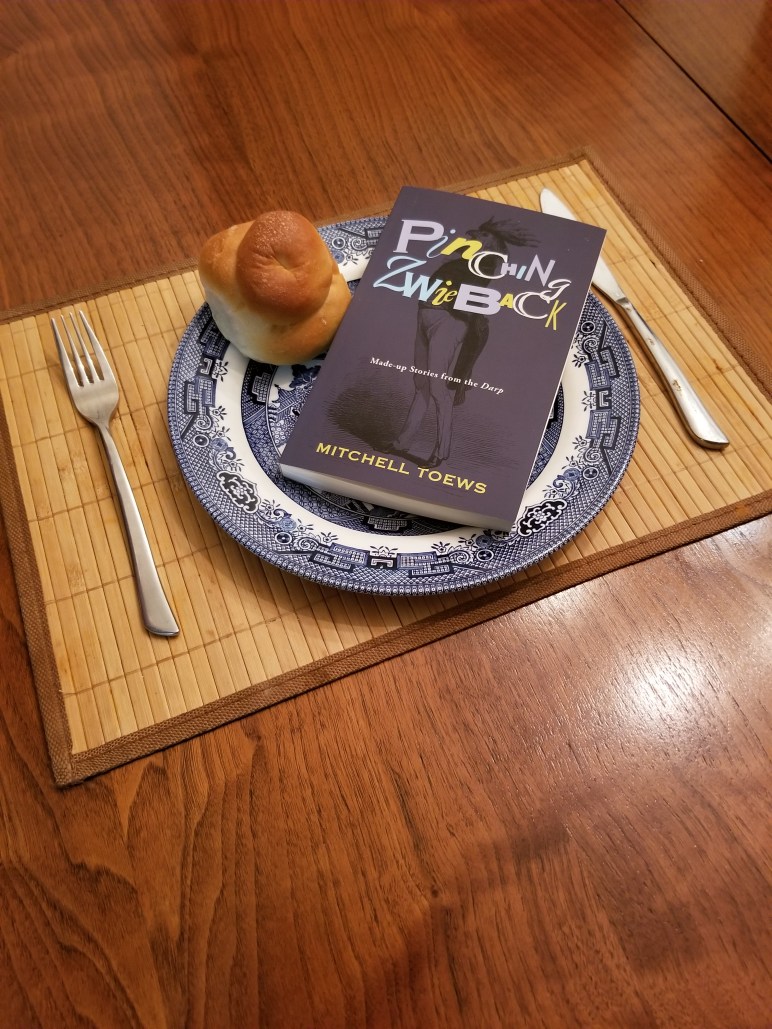
Spreading across Canada from author Mitchell Toews boreal home, north of 50° on Jessica Lake near the historic Tie Creek Basin, comes Bestseller #6 in Fiction, “Pinching Zwieback.” Toews’ debut collection of short stories from At Bay Press (Wpg, 2023) is scoring points with readers, booksellers, critics, and reviewers in the “Mennosphere” and far beyond…

Source: The Hamilton Review of Books’ Independently Published Bestsellers List: January 2024 — Hamilton Review of Books

REVIEW: Chekhov of the darp – Winnipeg Free Press

https://www.winnipegfreepress.com/arts-and-life/entertainment/books/2023/12/30/chekhov-of-the-darp

In 1966-67 a journeyman defenceman from Lethbridge named Autry (Aut) Erickson was sent up to the big club in Toronto from the Victoria Maple Leafs. Erickson finished out the season with the Leafs and his name is etched into the Stanley Cup.

I think Chekhov’s place in literary history is safe and I won’t be throwing any hip-checks at Ms. Munro or W.O. Mitchell. Like any hard-working rookie, I am thrilled to be mentioned in the same article as the greats, but as that perennial all-star word dangler Robert Frost observed, “etj hab väl miele noh gohna eea etj schlop*. . . ” and I can hardly even skate backwards!

Where to buy PINCHING ZWIEBACK: https://mitchellaneous.com/2023/12/17/where-can-i-buy-pinching-zwieback/

_____

*“I have miles to go before I sleep.”

Author Gregg Norman

Lake Dauphin is part of a unique prairie watershed. It is the wind-worked home to pickerel and pike surrounded by wetlands and peaty sedge meadows. The lake represents a mature ecology bounded by strong parkland features and clearly influenced by the seemingly unending prairie to the south and west. The northern-influenced climate and relatively sparse human population present a persona still wild in its soulful inner self but outwardly, a place of calm and quiet strength.

This account of place could just as easily describe one of the region’s residents: five-book author Gregg Norman. I’ve had the good fortune to stumble onto Gregg’s writing and just as enjoyably, his cordial, affable, and knowledgeable personality. After a few years of comments and emails, reading each others’ work and becoming online friends it’s time to write a proper review.

Drawing from two of Gregg’s novels—A Gift of Scars and Bingo at the Legion—here’s a summary that offers an overview of author Norman’s overall skills and attributes as a writer, as well as commentary on these two excellent reads.

In Gregg Norman’s books, we find a stabilizing foundation beneath the storytelling. Part of his underlying prose meter is to allow readers to view life and its intricacies, complexity, and sudden reversals almost exclusively through the experiences of the characters. As a result, fiction readers looking for an escape from their own day-to-day entanglements will find in these books a place where transportation into a virtual world is pleasingly easy and without the slippery footing so common in current literary fiction. Norman’s gripping realism feels exacting and personal even if it is drawn from places and characters that could be right next door. The scenes arrive, ruddy-cheeked and vital, from any one of a number of common memories and experiences that the author provides. Common only in their familiarity; uncommon in their singular personality and well-delivered descriptions. Norman steeps his stories in slowly revealed character studies, influenced as they should be, as they must be, by landscapes and neighbourhoods and relationships that this strong, characterful author knows well. Knows in his bones and his scars and his mature sensibility. He communicates fluidly, with the firm hand and big heart we desire from a storyteller.

Even treacherous ground like a failed high school romance renewed does not succumb to treacle or overwrought plotting and stilted dialogue. Instead, the relationship is renewed with subtle vibrancy, coming off the page and drawing us in with the feelings and emotions we know to be true to the situation. Norman has that deep well to draw from:

“The supreme question about a work of art is out of how deep a life does it spring. Paintings of Moreau are paintings of ideas. The deepest poetry of Shelley, the words of Hamlet bring our mind into contact with the eternal wisdom; Plato’s world of ideas. All the rest is the speculation of schoolboys for schoolboys.”James Joyce, Ulysses

Norman adheres to this Joycean ethic without seeming as though he is trying to. His books about average, flawed people are indeed, “paintings of ideas;” word paintings, cut carefully with dialogue, imagery, word craft and the caring of a fully-invested artist.

Sometimes the characters may at first appear bleak or we find they are placed on stoney emotional ground. But unfailingly, they evolve at a pace well controlled—never contrived. Feelings furrow the ground, turning aside our first inclinations towards the character and revealing the core individual Norman has created. By allowing the characters to emerge more fully, the reader is brought along without effort or disbelief.

Families behave like families do: there is a hint of dysfunction and imperfection, even if the core is based on love and respect. Friendships have rough spots. Cars don’t always start when you need them to. If there was a rocket ship or a superhero or a cataclysmic event in a Norman book, it would sputter or flutter or remind you of butter—this author is simply not tempted by overkill and literary hyperbole. Rather than depend on mighty but unlikely events or personalities, Norman’s stories move along in less imposing circumstances and arrive where they should, after a satisfying and trying struggle. The author leaves the reader—and often the main character—worse for wear, but better for the experience.

People fall in love. They become ill. Some recover and others die. Dreams die too, though somehow we know that among those dreams, even those belonging to characters we first believed to be weak or ignoble, might be given a second chance.

A Gift of Scars: Gritty, untarnished realism with the deftly applied fictional touch of an observant and world-wise writer. At times darkly shaded, in the end, Scars leaves us with the feeling that perseverance, emotional honesty and the ability to keep striving despite our despair will serve us well.

In Bingo at the Legion, we think we have happened upon a quotidian gathering of “ordinary folks.” While this is not untrue, the underpinning fact is that there are no ordinary lives and that life is both fickle and generous. We know from watching Brenna, Grady, and Jasper that past missteps can be retaken and it is within our scope to alter what fate has given us no matter how unlikely it seems.

The lessons available through these enjoyable contes de vie are provided with a delicate touch—no authorial overburden. The characters become known to us and real in our minds. When we reach the tightly written conclusions, we may be surprised but never shocked or taken outside of the story. The characters reveal what we have been skillfully led to see in them.

The perfect Christmastime getaway? Travel to Lake Dauphin and back via Bingo at the Legion, Oz Destiny, Not My Dog, A Gift of Scars, and Lovely Way to Burn. https://greggnormanauthor.com/books/

Poetry to be Stickered

they are the grit in my mennonite eye
says the young mother
with the hundred year sigh

the bitter green melon at the tom boy store
the one that is rotten
to its pale green core

you are the bread that would not rise
lonely and sad
under cotton dry skies

his is the hand with the frail wrinkled skin
the piano teacher
softly
let us begin

they are the fist clenched in loud might
tell me then girlie
what wars did you fight

he is the kind of girl we all knew
a solo skirmish
on a pew made for two

die owlah grips my arm with a clasp o so firm
until seven or eight
the extent of my term

so pitter and patter
and round we all go
fox and geese in the binary snow

time comes for us all
surprisingly fast
and the first ones now
shall later be
last

~ ~ ~

My old hometown, Steinbach, Manitoba, has recently enacted a policy through the City Council requiring library staff to place a warning label—an “LGBTQ content” sticker—on the cover of children’s books in the city’s public library. Is it permissible for a publicly funded institution to do this? LGBTQIA2S residents of Steinbach may ask why the City Council is using public funds to enact and fund a bylaw that discriminates against them. After all, neither LGBTQIA2S taxpayer parents in the city nor their children need a warning sticker on books with LGBTQIA2S content. In fact, they desire these books to be in the public library along with other non-dominant topics and are entitled as citizens of Canada to this. Does the Canadian Charter of Rights and Freedoms not prohibit discrimination based on sexual orientation? Is the Council edict not discriminatory in its intent? It is certainly not comparable to a library listing books under broad literary genres like Mystery or Cook Books or Christian but rather is an attempt—potentially—to isolate LGBTQIA2S authors and their work. It is bullying. It is openly segregationalist. LGBTQIA2S stickers are tantamount to book banning in a conservative community like Steinbach. It is religious overreach disguised as generic public policy. Is this not an aggressive move by a homophobic, ideologically unified Council to effectively banish (or “shun”) certain authors based on their sexual orientation? Will The Writers’ Union of Canada become involved in prosecuting actions that mistreat its members?

The Steinbach Public Library is not the private library of the City Council nor is it a private church library.

Warning: RACCOON CONTENT! Recently, while discussing this issue with other ex-pats from Steinbach, I asked this: “Are LGBTQ cover stickers not the same as demanding that a sticker be placed on a children’s book about raccoons? After all, if a children’s book can coerce children into wanting to change their sexual orientation, it must also—by definition—be able to persuade kids to want to change their species.” Is it not just that ludicrous? A book cannot coerce a child to change their species or their sexual orientation. No stickers are required for either raccoon books or LGBTQIA2S books.

Were ANY LGBTQIA2S members of the local community asked for input when the policy was under discussion?

Last, here’s some rainbow logic of my own colourization: You don’t have to be green to recognize that the colour green exists. You don’t need to be the blue sky to co-exist in a world that contains a blue sky. Bullies are all yellow.

A Strong Post from Author-Essayist-Blogger MaryLou Driedger

Pinching Zwieback Events

Image: Author Mitchell Toews reads at the annual Prosetry event at Jessica Lake, in the Winnipeg River basin of eastern Manitoba.

Book launches, book chats, readings, panel discussions, and writing sessions coming up as Mitchell Toews’ debut collection of short stories is mixed, proofed, punched, cut, pinched, and baked.

Action shot pinched from The Steinbach Tribune

Pinching Zwieback: Made-up Stories from the Darp (Updates and schedule changes provided asap)

Nov 2 Mennonite Heritage Museum, Abbotsford “Books and Borscht” meal at noon, book chat at 1 P.M.

The view in Abbotsford, Nov 2. Borscht (or Chicken Noodle, your choice) preceded a reading to a friendly and engaged audience. Host Robert Martens (a poet and author himself) did an exceptional job of introduction and “connectivity” for the well-attended gathering. Excerpts from “Swimming in the Bazavluk,” “The Raspberry Code,” “The Peacemongers,” and “”The Grittiness of Mango Chiffon” were presented. Thanks to Robert, the MHM, and Jennifer Martens for this excellent and cordial event! Also to attendees from Vancouver, Matsqui (via Steinbach), Yarrow, Lynden, and beyond!

Nov 8 McNally Robinson Booksellers Grant Park, Winnipeg Mitch will read from “Pinching Zwieback” and will join Ariel Gordon (co-author-poet, with Brenda Schmidt) who will introduce “Siteseeing,” a book in which, “The poets wrote about the natural world and people making their way through it all.”  The evening will be hosted by Sue Sorensen (another At Bay Press author) and Sue will read for Brenda who cannot be in attendance this evening. 7 P.M.

The always-entertaining (insightful, convivial, talented…) Ariel Gordon

Nov 9 St. John’s Heritage Church & Arts Centre, Lac du Bonnet with Ariel Gordon (“Siteseeing”), Mitch and At Bay Press publisher, Matt Joudrey. Local musicians will complement the readings: singer-songwriters Bernadette Carlson, Lefty Auger (Daryl Reimer), and Paul McIntosh. 7 P.M. This event will rock.

Nov 15 Mennonite Heritage Village, Local Authors Night in Steinbach with Host Nita Wiebe, and Elma Koop, Mary Lou Driedger, Noreen Janzen, and Mitch. 7 P.M.

Mary Lou Driedger (Lost on the Prairie, Sixties Girl), Andrew Unger (Once Removed, The Best of the Bonnet) and Mitch discuss Steinbach—the literary city—at The Public Brewhouse.

Nov 18 The Public Brewhouse, Steinbach with EmCee Andrew Unger and co-hosts Dave Driedger and John “Hans” Neufeld for beer (or tasty non-alcoholic alternatives) and book chat. 7 P.M. (Arrive early—limited seating.)

Nov 21 Public Library, Altona 7 P.M. Book launch.

Nov 22 Public Library, Pinawa 7 P.M. Book launch.

Nov 23 Public Library, Winkler 7 P.M. Book launch.

Nov 28 Public Library, Morden 7 P.M. Book launch.

Mitch reading at a venue in Vancouver for PULP Literature Magazine, with daughter Meg and granddaughter Hazel in attendance.

Dec 3 Fireside Book Market, Park Theatre, Winnipeg with authors and publishers from four local presses for a fall fest of book sales, signings, and lots of book chatter. 10 A.M.—6 P.M.

Dec 13 The Listening Room Open Mic, Lac du Bonnet 7 P.M. Mitch will sign-up on the Open Mic list and read a few selections from Pinching Zwieback in the historic St. John’s Heritage Church & Arts Centre. (Books for sale, here at one of Mitch’s “happy places.”)

.
Dates TBA in the Public Libraries in Kenora (2023) and Lac du Bonnet (Spring 2024)

https://atbaypress.com/books/detail/pinching-zwieback

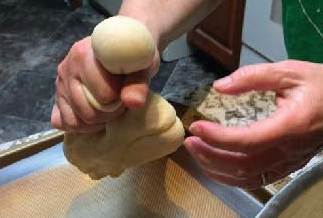
On child birthdays we toss the kids in the air, make wishes and offer a “pinch to grow an inch.” Pinching Zwieback is a gathering of pinches as a young man, dough in the hands of powerful albeit diminished women that rises in the oven of cultural expectation to a better understanding of his place in the world beyond the kitchen of his creation… Life is reaching for the light, which never falters even as the human characters flicker and fade.—Poet Laureate, feminist, and author Linda Rogers Van Krugel

~ ~ ~

Mitch Toews speaks from the margins of small-town society, claiming a space for the underdog and the undervalued. His characters must go through all manner of tests and challenges, but in the end–love wins. —Ralph Friesen, author of Between Earth & Sky: Steinbach’s First 50 Years and Dad, God, and Me.

~ ~ ~

Moves like a tide through visceral daily experiences—quintessentially Canadian, some heart wrenching, each powerfully evocative.”—Alanna Rusnak, Blank Spaces Magazine.

~ ~ ~

Mitchell Toews’ stories range from Tom Sawyer-like tales of boyhood squabbles to the heartbreak of family dysfunction to the cruelty of small-town hypocrisy. Hilarious and tragic in turn, Toews explores facets of Mennonite life that other Mennonite writers have not touched.—Armin Wiebe, author of The Salvation of Yasch Siemens and Grandmother and many more.

“Pinching Zwieback:” Book, Author, Publication Details

Last UPDATE: Nov 4, 2023

Barn: Guide Meridian, Lynden, Wa.—mjt

Author Mitchell Toews

After eight years in creative writing, 120 prose pieces placed in periodicals and anthologies (and over 650 rejections 😊) Mitch is launching his first book, a collection of short fiction published by At Bay Press of Winnipeg.

So who is this guy, Mitchell Toews?

Mitchell James Toews is the great-great-grandson of Mennonite Delegate C.P. Toews from Molotschna, Russia; the grandson of C.F. (“Roy,” “Schusta”) and Rosa Toews of Steinbach; grandson also to former “Jantsieda” (residents from the “other side” of the Red River) Diedrich and Marie Harder of Steinbach; and son of the Steinbach Bakery family: Norman “Chuck” and Jessie Toews. He is married to Janice Kasper of Steinbach and they have two married daughters.

Among his stop-overs and occupations: a year (1973/74) at UVIC in Victoria, two years at U of W in Winnipeg and (much later) a Master’s Certificate in Marketing Communication from York U. Mitch founded—with his father and uncle Earl Taves—and operated a small overhead door manufacturing company. In 1996, the now solely-owned business, Hanover Doors, was sold by Janice and Mitch and Mitch’s advertising and marketing career began. In 2016 after time well-spent with companies like Smith, Neufeld, Jodoin Law (Steinbach), Loewen Windows (Steinbach), Yarrow Sash & Door (Winnipeg), and Lynden Door (Abbotsford), Mitch devoted himself entirely to creative writing—a lifelong and much-delayed passion.

Janice and Mitch live in their 1950 lakeside cabin at Jessica Lake in the Manitoba territory that is part of Treaty 1 & 3 land and home to the Métis Nation, just north of the Fiftieth Parallel in the Winnipeg River basin. Their daughters Megan and Tere live in British Columbia and trips to see the families, particularly grandkids Ty, Hazel, James, and Floyd are as frequent as circumstances permit.

Mitch is an avid windsurfer, rower, and cross-country skier and the lifelong rigours of climbing ladders and swinging hammers, along with baseball, volleyball, basketball, and golf all contributed in past days to the current sorry state of his joints.

Book Synopsis

Pinching Zwieback comprises stories that recount events and conflicts from the “Mennosphere”—inwardly oriented communities that can generate wonderful characters and practical, often beautiful, solutions to life’s confusion. Other times, a solution may be elusive.

Hartplatz is the imaginary home for many of the recurrent characters. (Also Winkler, Aldergrove or fictive places like them—a small town pastiche.) These are rural Canadian junctures where vectors intersect: faith and doubt; pacifism in a world at war; honour and temptation; fervour and absurdity; the temptations of the wide welt, and of course, humour. Often gritty, it’s K-mart fiction or maybe better yet: schmaundtfat fiction. (A Low German glossary is provided!)

“God causes it to rain on Chevs and Fords alike,” as Diedrich, the main character in three* of the 20 stories puts it. It’s in this context that the characters resist, pitting their will against that of their foe—the foe they seek to love.

*Other main characters include Matt Zehen, his mother and father, Hart and Justy Zehen, Matt’s grandmother Rosa, and Matt’s close friend, Lenny Gerbrandt. A family tree provides a guide to the cast for readers.

Where to Purchase Pinching Zwieback

“Pinching Zwieback: Made-up Stories from the Darp” 2023 ISBN 9781998779055 by Mitchell Toews (At Bay Press, Wpg). Publication Date October 24, Release Date November 7, Launch Date Nov 8. Contact us for assistance: check with Mitch or Matt on where to buy and also about how to receive signed copies or for information concerning special situations, author appearances, writing workshops, and more.

Requesting “Pinching Zwieback” by Mitchell Toews (At Bay Press, Wpg) at your favourite bookstore or library will get you a copy. Coming soon to libraries in Kenora, ON and Manitoba locations in Brandon, Lac du Bonnet, Pinawa, Altona, Winkler, and Morden. More to follow.

“Pinching Zwieback” 5″X8″257-page quality paperbacks may be purchased:

From At Bay Press: “Individual orders are placed through our website by adding books to your cart and then checking out with our secure online payment. Orders may also be placed over the phone by calling 204-489-6658 and payment will be taken over the phone. You may send an email with any questions or concerns to atbaypress@gmail.com.”

McNally Robinson Booksellers (Pre-order available) all locations.

The gift shops at both Mennonite Heritage Village (Steinbach) and Mennonite Heritage Museum (Abbotsford).

CommonWord Bookstore and Resource Centre in Winnipeg, MB

Misty River Books in Terrace, BC

Manitoba Made Events & Shop in Lac du Bonnet, MB

Shop in person: Canadian Bookstore Map

Virtually all ONLINE book sources WORLDWIDE including Amazon, Barnes and Noble, Thriftbooks, etc.

Libraries and booksellers in Canada and the U.S. may purchase books from At Bay Press’s distribution partners:

Canada: http://www.litdistco.ca/
U.S.: https://www.casemateipm.com/9781998779055/pinching-zwieback/
Aus/NZ: https://peribo.com.au/

For other countries: Please see https://atbaypress.com/ordering or contact Matt Joudrey atbaypress@gmail.com

Events

https://mitchellaneous.com/2023/10/20/pinching-zwieback-events/

Coming Soon

A first REVIEW of “Pinching Zwieback” by the eminent Canadian author, Poet Laureate, and literary leader, Linda Rogers van Krugel of Victoria will be placed shortly. Several other reviews, from Canada and the U.S., are underway.

Early Praise

“Pinching Zwieback Observations” from Canadian literary notables Zilla Jones, Ralph Friesen, Alanna Rusnack, Armin Wiebe and more.

Follow Mitch & Pinching Zwieback

Follow Mitch’s FaceBook page and this blog (Mitchellaneous.com) for unboring updates, news, and other crumbs and chicken feed as “Pinching Zwieback” struts in wider and wider circles around the coop.