“Pinching Zwieback:” Book, Author, Publication Details

Last UPDATE: Nov 4, 2023

Barn: Guide Meridian, Lynden, Wa.—mjt

Author Mitchell Toews

After eight years in creative writing, 120 prose pieces placed in periodicals and anthologies (and over 650 rejections 😊) Mitch is launching his first book, a collection of short fiction published by At Bay Press of Winnipeg.

So who is this guy, Mitchell Toews?

Mitchell James Toews is the great-great-grandson of Mennonite Delegate C.P. Toews from Molotschna, Russia; the grandson of C.F. (“Roy,” “Schusta”) and Rosa Toews of Steinbach; grandson also to former “Jantsieda” (residents from the “other side” of the Red River) Diedrich and Marie Harder of Steinbach; and son of the Steinbach Bakery family: Norman “Chuck” and Jessie Toews. He is married to Janice Kasper of Steinbach and they have two married daughters.

Among his stop-overs and occupations: a year (1973/74) at UVIC in Victoria, two years at U of W in Winnipeg and (much later) a Master’s Certificate in Marketing Communication from York U. Mitch founded—with his father and uncle Earl Taves—and operated a small overhead door manufacturing company. In 1996, the now solely-owned business, Hanover Doors, was sold by Janice and Mitch and Mitch’s advertising and marketing career began. In 2016 after time well-spent with companies like Smith, Neufeld, Jodoin Law (Steinbach), Loewen Windows (Steinbach), Yarrow Sash & Door (Winnipeg), and Lynden Door (Abbotsford), Mitch devoted himself entirely to creative writing—a lifelong and much-delayed passion.

Janice and Mitch live in their 1950 lakeside cabin at Jessica Lake in the Manitoba territory that is part of Treaty 1 & 3 land and home to the Métis Nation, just north of the Fiftieth Parallel in the Winnipeg River basin. Their daughters Megan and Tere live in British Columbia and trips to see the families, particularly grandkids Ty, Hazel, James, and Floyd are as frequent as circumstances permit.

Mitch is an avid windsurfer, rower, and cross-country skier and the lifelong rigours of climbing ladders and swinging hammers, along with baseball, volleyball, basketball, and golf all contributed in past days to the current sorry state of his joints.

Book Synopsis

Pinching Zwieback comprises stories that recount events and conflicts from the “Mennosphere”—inwardly oriented communities that can generate wonderful characters and practical, often beautiful, solutions to life’s confusion. Other times, a solution may be elusive.

Hartplatz is the imaginary home for many of the recurrent characters. (Also Winkler, Aldergrove or fictive places like them—a small town pastiche.) These are rural Canadian junctures where vectors intersect: faith and doubt; pacifism in a world at war; honour and temptation; fervour and absurdity; the temptations of the wide welt, and of course, humour. Often gritty, it’s K-mart fiction or maybe better yet: schmaundtfat fiction. (A Low German glossary is provided!)

“God causes it to rain on Chevs and Fords alike,” as Diedrich, the main character in three* of the 20 stories puts it. It’s in this context that the characters resist, pitting their will against that of their foe—the foe they seek to love.

*Other main characters include Matt Zehen, his mother and father, Hart and Justy Zehen, Matt’s grandmother Rosa, and Matt’s close friend, Lenny Gerbrandt. A family tree provides a guide to the cast for readers.

Where to Purchase Pinching Zwieback

“Pinching Zwieback: Made-up Stories from the Darp” 2023 ISBN 9781998779055 by Mitchell Toews (At Bay Press, Wpg). Publication Date October 24, Release Date November 7, Launch Date Nov 8. Contact us for assistance: check with Mitch or Matt on where to buy and also about how to receive signed copies or for information concerning special situations, author appearances, writing workshops, and more.

Requesting “Pinching Zwieback” by Mitchell Toews (At Bay Press, Wpg) at your favourite bookstore or library will get you a copy. Coming soon to libraries in Kenora, ON and Manitoba locations in Brandon, Lac du Bonnet, Pinawa, Altona, Winkler, and Morden. More to follow.

“Pinching Zwieback” 5″X8″257-page quality paperbacks may be purchased:

From At Bay Press: “Individual orders are placed through our website by adding books to your cart and then checking out with our secure online payment. Orders may also be placed over the phone by calling 204-489-6658 and payment will be taken over the phone. You may send an email with any questions or concerns to atbaypress@gmail.com.”

McNally Robinson Booksellers (Pre-order available) all locations.

The gift shops at both Mennonite Heritage Village (Steinbach) and Mennonite Heritage Museum (Abbotsford).

CommonWord Bookstore and Resource Centre in Winnipeg, MB

Misty River Books in Terrace, BC

Manitoba Made Events & Shop in Lac du Bonnet, MB

Shop in person: Canadian Bookstore Map

Virtually all ONLINE book sources WORLDWIDE including Amazon, Barnes and Noble, Thriftbooks, etc.

Libraries and booksellers in Canada and the U.S. may purchase books from At Bay Press’s distribution partners:

Canada: http://www.litdistco.ca/
U.S.: https://www.casemateipm.com/9781998779055/pinching-zwieback/
Aus/NZ: https://peribo.com.au/

For other countries: Please see https://atbaypress.com/ordering or contact Matt Joudrey atbaypress@gmail.com

Events

https://mitchellaneous.com/2023/10/20/pinching-zwieback-events/

Coming Soon

A first REVIEW of “Pinching Zwieback” by the eminent Canadian author, Poet Laureate, and literary leader, Linda Rogers van Krugel of Victoria will be placed shortly. Several other reviews, from Canada and the U.S., are underway.

Early Praise

“Pinching Zwieback Observations” from Canadian literary notables Zilla Jones, Ralph Friesen, Alanna Rusnack, Armin Wiebe and more.

Follow Mitch & Pinching Zwieback

Follow Mitch’s FaceBook page and this blog (Mitchellaneous.com) for unboring updates, news, and other crumbs and chicken feed as “Pinching Zwieback” struts in wider and wider circles around the coop.

A Toews Prose Sampler

From the sleepy stubble fields of Manitoba Mennonite country to the shores of the Rivanna River in Charlottesville, Virginia, here are four not-so-sleepy short stories. Besides my stories, the contents of The Rivanna Review are alive with unique literature, pictures, and book reviews. See the contents, here: https://rivannareview.com/

Single copies and subscriptions are extremely reasonable in price!

These four pieces are original works of mine, examples of “the organic story,” according to Print Editor Robert Boucheron. These stories are not in the forthcoming collection, “Pinching Zwieback” from At Bay Press (October 24), so no overlap!

Sweet Caporal: Life presents many unexpected dramas, especially for teenagers.

Hundred Miles an Hour: Set in the same lakeside location as Sweet Caporal; home to a darker drama.

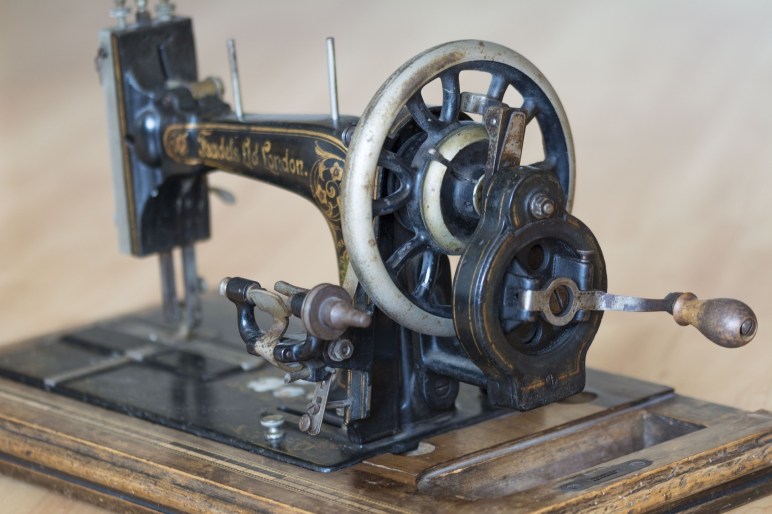
The Sewing Machine: 1931 Winnipeg is the backdrop for unlikely combatants.

The Seven Songs: Pride, desperation, and deception know no one locale, no religious or national boundaries, and no exceptions.

Reprised: “The Spring Kid” —Macrina Magazine

https://macrinamagazine.com/general-submissions/guest/2022/09/10/the-spring-kid/

One of my favourite stories as it appears in

PLEASE NOTE: “The future of Macrina depends on whether we can establish a base of monetary support and grow our editorial and administrative team. Until then, our website will remain active, so you can read and share what we have already published.”

—The Associate Editors of Macrina Magazine

As the above indicates, it’s been a tough spring for this exceptional publication. If you can help out in any way, please contact Editor-in-Chief Micah Enns Dyck. https://www.facebook.com/MacrinaMagazine

Steinbach Then and Now

I was born in Steinbach, Manitoba and spent more than fifty years there, in a variety of roles. I’ve also lived in Victoria and Winnipeg, and in Chilliwack from 2007-2016. We’ve lived in the Whiteshell for the last seven years. My forthcoming collection of short stories, “Pinching Zwieback: Made-up Stories From the Darp” is drawn in part from my lived experiences in Steinbach. I also share local legends, and (with permission) the experiences of others. It’s fiction but the writing has its underpinnings in memoir and history.

Since 1955, the nature of the town has changed. Or so I’m told. When I try to reconcile the Steinbach I knew so well with the Steinbach that seems to be emerging now, I feel confused and see many conflicting signals about the true nature of the place. It’s complicated.

Steinbach was a remarkably homogenous place of between 3,000 and about 10,000 residents during my tenure. It was—especially in my childhood—a community in which I had deep roots and numerous connections. I was known to or related to almost everyone in town. I have many memories, fond and less so, that give me a broad base from which to examine my hometown. The Steinbach of today is demographically different than that old two-traffic-light prairie outpost where a locked door was as rare as a clegywoman.

Recent articles and op-eds suggest that “this is not your Grandfather’s Steinbach” and yet, I am skeptical. Partly because of what my gut tells me and partly because there’s a certain PR ring to the tone. (I should know, having spent a few years on the Chamber of Commerce, pounding the table with my out-sized Loewen Windows fist.) Certainly, there is still a strong Mennonite presence in “the Stein,” but has that cohort given up its control and sway? Has Steinbach managed to keep the good and discard the bad and the outdated? Good question. The city’s well-deserved and continued reputation for its people’s generosity, its shifting demographics and growing diversity, and a seemingly more vocal progressive sector, even among Mennonites, appear to suggest that the place is changing in a positive fashion.

The fact is, Jan and I no longer live in Steinbach and although we have plenty of family and friends in town and we are “home” quite often (funerals and family gatherings) we can’t really offer a current opinion. I have vivid memories of my 50+ years as a Steinbacher, but, “What’s it REALLY like now?” I ask myself. My recent reading of the book “Shelterbelts” by Jonathan Dyck (Conundrum Press) asks many questions that don’t sound too different from the ones I pose in my book, even though my stories are set mostly in the 50s, 60s, and 70s while “Shelterbelts” is more contemporary.

As I said, “it’s complicated.”

How to determine what the town’s true identity is now? Here’s the list I came up with. It’s a kind of “follow the money” equation. I reason that by identifying who holds the real power in the community, I can find the clearest indicator of how, how much, since when, and why Steinbach has changed, and in what ways. Are “the quiet in the land” really quiet in Steinbach?

  • Banking & Finance. Which Steinbachers (or outsiders?) run the show? Who holds the purse strings? Who owns what? Who’s in the corner office? What’s the make-up and demographic profile of the most powerful C-suite officers?
  • Industry & Commerce. What sectors drive the local economy? Who are the players? What is their background? Who are the employers and who are the employees?
  • Education. Who builds the schools? Who controls the curriculum? Who hires the teachers? Who are the teachers?
  • Local and Provincial governance. Who are the politicians and what is their political base? From where do they draw finances needed to run in elections? Who influences their policies? What are their social connections, affiliations, and stated beliefs and values?
  • Media. What are the major sources of local news and information? Who owns these outlets? What are their political affiliations? Who are the influencers?
  • Clergy and Religion. What are the demographics of church membership? Which of the above categories are populated by which churches? Are there interlocking directorates? Does one church, or perhaps a few churches, dominate the gross membership? Who controls the levers of power or are the pivotal positions in the overall Steinbach power structure shared equally among the church-going populations? Are secular residents represented fairly in the power structure? Are imported theological movements usurping the influence once held by historically familiar churches? (Congregations like the Kleine Gemeinde so eloquently described by Steinbach ex-pat Ralph Friesen in his memoir, “Dad, God, and Me” (Friesen Press))
  • Populism vs. Progressiveism. Is there a way to plot sensibility? What public activities, events, movements, clubs, social groups, and other tell-tales exist that we can use to gauge public opinion? What/who are the loudest voices? Are non-dominant or historically marginalized groups equally represented? (And is anyone tracking it?)

And LAST, what do the artists say? Any society that ignores its poets, does so at its peril. Artists tend to support the underdog, to speak out for equality, to express themselves in a manner that challenges—or properly acknowledges—power brokers. Sometimes with sharp observations, in other cases with subtlety that may be equally profound. What has changed since the art of past commentators put a pin on the graph at various times? How fundamentally different, for instance, are the fictional depictions of “The Shunning” (1980, Friesen), “A Year of Lesser” (1996, Bergen), “A Complicated Kindness” (2004, Toews), “Once Removed” (2020, Unger), and “Shelterbelts” (2022, Dyck)? What is the arc of Steinbach’s essence, in fiction?

All Our Swains Commend Her

Can’t wait to roll into Van with a couple of grandkids in tow to read at this event! Family day!

I’ll be reading excerpts from my 2nd Runner-up entry in this year’s PULP Literature Raven Short Story contest.

Exile on Barkman Avenue

After Janice and I sold our manufacturing business in 1996, I ended up (after being a very bad office manager for some very good lawyers) working for a series of conservative Mennonite wood manufacturing companies as “that creative guy.” My role was to do the unseemly work of marketing and advertising. Come up with some shit. You know… imagineer. (Aiyyyeee! That word is like giving an AMC Gremlin to the head designer at Ferrari.)

Before I go on, let’s check the relative humidity here. As a “creative guy,” I’m somewhere on a scale. I am not likely to be named Artistic Director for Exile magazine; not likely to die my hair blue (both of them); not likely to get in a scrap with David Cronenberg because my ideas are, “too out there, Toews!” At the same time, my ideas were more than enough “out there” to send the sucking-up-to-the-boss running dog types scooting like scalded greyhounds for the dark corners of the break room, where they would loudly rattle their dog-collars and profess to be regular folks incapable of such wild ideas.

Anyway, today I find myself somewhere between my old scramble for existence (marketing and advertising) and my new scramble for existence (literary fiction). And no, dog-collar people, the two are NOT the same.

I am working diligently to complete my manuscript and set my collection of short stories loose on the world. There is a hurry-up-and-wait aspect to this and during the in-between times, I get restless. Something that occurred to me in a slightly Cronenbergian moment was a set of icons that offered a graphical depiction of the themes present in my made-up stories. I used my prodigious Paint.net skills to render a 4X4 grid of images.

The result is the orderly graphic collage that headlines this post. The effect appeals to my Andy Warhol gene and I like how the iconography drops hints like a visual Johnny Appleseed. I have not spent time getting the size and hue and style at a harmonic pitch, but it’s good enough for a concept. It imagineers. (Ugh.)

And that’s where I find myself—wallowing like a hungry Menno in the nether region between artistic expression and INTEGRATED MARKETING. My old prof at York (the Pepsi-Challenge guy, Alan Middleton) would be pleased but I’m pretty sure my publisher will heave a big sigh.

Anyway, that’s my sitch. I am (just barely) smart enough to listen to my publisher and ignore my fond memories of Prof. Emeritus Middleton’s old lessons (“Put lye in the Coke…” JUST KIDDING!)

But you know that inside my busy little blue head, there is a steeplechase going on with wild ideas running around like crazed dogs.

  • Bookmarks
  • Mousepads
  • Coasters
  • Product placement in Mennonite movies
  • T-shirts
  • Posters of dangling kittens wearing the T-shirts (it can’t be ALL about dogs!)
  • Fridge magnets of Menno Simons wearing one of the T-shirts (it can’t be ALL about David Cronenberg!)

So, be ready to buy the book. First 100 purchasers get a free TRAVEL MUG.*

___

*Also just kidding. Shipping extra.

My collection of short stories, “Pinching Zwieback” (At Bay Press) will launch in FALL 2023.

The Sewing Machine: The organic truth behind the fiction

A story of mine, “The Sewing Machine,” appears in the current edition of Rivanna Review. Speaking as a longtime subscriber to literary journals, I can say that RR is one of my favourites. The Editor in Chief and Publisher Robert Boucheron is an intelligent and thoughtful person—just the kind required to start up a lit journal in Charlottesville, VA after a long and distinguished career in architecture.

I am not an architect, nor do I know many of them—George Costanza of Seinfeld fame does not count—but for 16 years, they often held my fate in their hands. I owned a small manufacturing company and we did work on large commercial buildings. I found project architects to be direct, firm, and of the no-bullshit variety. Traits not uncommon in the building trade, but a regular characteristic for architects whose measure of approval is finite to two decimal points. You meet the spec or you don’t…

“The Sewing Machine” is a character study involving a man and a woman in 1931 Winnipeg who resemble my Toews Grandparents in many respects. Robert has commented that the type of writing he often finds favour with is what he calls “organic” storytelling. By this, I think he means stories that are “of the people, by the people, and for the people” to paraphrase some of Robert’s Virginia cohorts from the past.

These “organic stories” come from “the truth behind the fiction” as another friend, At Bay Press publisher, editor and author, Matt Joudrey has said. Matt’s acute observation connects to what friend and reader Edward Krahn sometimes compares to the Richard Ford school of gritty characters and circumstances. (So, I’m a purveyor of Menno Grit?)

Here are some more defining characteristics from an experienced writer-editor:

“A unique writers voice is what attracts me at first. Popular, stylistic, poetry/prose rarely captures my attention. Sometimes writing is over-learned in classes, or representative of the teacher’s or studied subject’s body of work. I like the rawness of the pure untarnished colloquial voice in the reading. Having something to say is essential to me. I’m not impressed with a great volume of rarely used words thrown together to impress the reader with the vast knowledge of the writer on command of English, tricks of writing, ancient history, or the places they’ve travelled.”

—An excerpt from an interview by writer, editor, publisher Judith Lawrence in, “Six Questions For…”

My forthcoming collection of short stories is a qualifier for these definitions. In “Pinching Zwieback: Made-up stories from the Darp” (At Bay Press) I’ll present a series of 20 stories. The pieces range from the opener, an 1873 story that takes place literally in the Bazavluk River in what is now Ukraine to a present-day ball game at Nat Bailey Stadium in Vancouver. In between, there are tales from Hartplatz, MB (a place that bears a resemblance, some might say, to a Darp with the initials Steinbach). A fictional clan called the Zehen family often takes centre stage, along with a hard-nosed friend, Lenny Gerbrandt, and the earnest and determined Jantseider Diedrich Deutsch.

While “The Sewing Machine” does not appear in “Pinching Zwieback” it is similar to many of the stories in the collection. To grab a subscription to Robert Boucheron’s entertaining and eclectic print periodical (fiction, non-fiction, reviews and poetry), Rivanna Review, visit the journal’s site at https://rivannareview.com/ While there, you can also learn how to connect to Robert’s monthly television broadcast.

Just tell him Art Vandelay sent you!

Issue 1: “Sweet Caporal” by Mitchell Toews

Issue 3: “Hundred Miles an Hour” by Mitchell Toews

Issue 6: “The Sewing Machine” by Mitchell Toews

You Figure it Out

“Storytelling reveals meaning without committing the error of defining it.”

Hannah Arendt

🤔 Yup…

Editing

Editing is difficult but rewarding.

Difficult because you are erasing what you have created. You are subtracting from or changing the very thing that got you in the publishing game! Feels risky.

Rewarding because your changes create something new, all over again. Plus, the editor is your ally and a trusted source that comes to you from a place other than the rocky mass between your (my) ears. Thank God for that.

I am preparing 24 stories for publication in the spring. Several folks are weighing in on my work and each day there’s a knot in my shoulders and that night’s dreams are peppered with flickering replays of scenes from the collection. I wake up, make notes, fall back asleep and then laugh at my scribbled nonsense in the morning.

Here is a segment, edited recently. I offer it as a fast in situ peek at the crime scene. It is from the story, “The Peacemongers” and the topic is Canadian Mennonites during the wars, WW2 in this case, who deigned to be officially named “Conscientious Objectors.” This meant they would work in labour camps in Canada rather than serving in the military.

I thought of Corky’s uncle John who worked at Loeb’s lumberyard. He wore a red vest and a plaid shirt and stood behind the counter at the lumber desk. He was a big man with very white teeth and he would stand there smiling and writing down what you wanted to buy. My dad would always order lumber from him and it always started out the same way. Dad would say, “I need some two-by-fours,” and John would say, “how many and how long do you need ’em?” Dad would reply “twenty pieces and forever!” Same joke every time. Then John would yell for one of the yard boys to come and load the order into our truck, his pencil poised above the order form, looking at my dad over his glasses. “Twelve-footers,” or whatever length he needed, was the answer, served with a slanted smile.

Dad said John had been in a C.O. camp during the war. He told my dad stories about it and how he made lifelong friends there. “Some were in the camp for other reasons, but most were there to follow the Word. That meant something to us and it was like our battle, to stay true to what we had been taught and to what we would teach our children.” I heard him talk about this to my dad and other men at the lumberyard. He stood straight up and looked into the eyes of the person he to spoke to. His voice was firm and he was not trying to convince anyone—he was just telling it. I was too young to understand everything, but thought he was telling the truth, exactly as he knew it and believed it.

.

I sometimes felt as though John and many others like him in our town believed, maybe secretly, that God was the biggest, toughest, most bad-ass Mennonite of them all. As if God would do all the fighting for us, and He would take no prisoners. I’m not sure that made our desire to live a life of pacifism any better. Possibly worse. It made God seem to me like a kind of bully—forever smiting Old Testament armies and kings that He didn’t like and constantly fighting with the Devil. Like Archie and Don, who fought almost every day after school at the corner of Hannover and Kroeker, accomplishing nothing but scuffed chins and bloody knuckles.[MT1]


 [MT1] Added 22-09-10 in a moment of random inspiration.

—Considered but not promised, for “Pinching Zwieback” At Bay Press

Prosetry 22

Simplicity.

A summer night, where the thunderheads fist-bumped and parted ways, leaving our skies more Prussian blue than ash grey. Mosquitoes too were deported, sent elsewhere to do their whining — we think they all rented tiny jet-skis and rode off across the river.

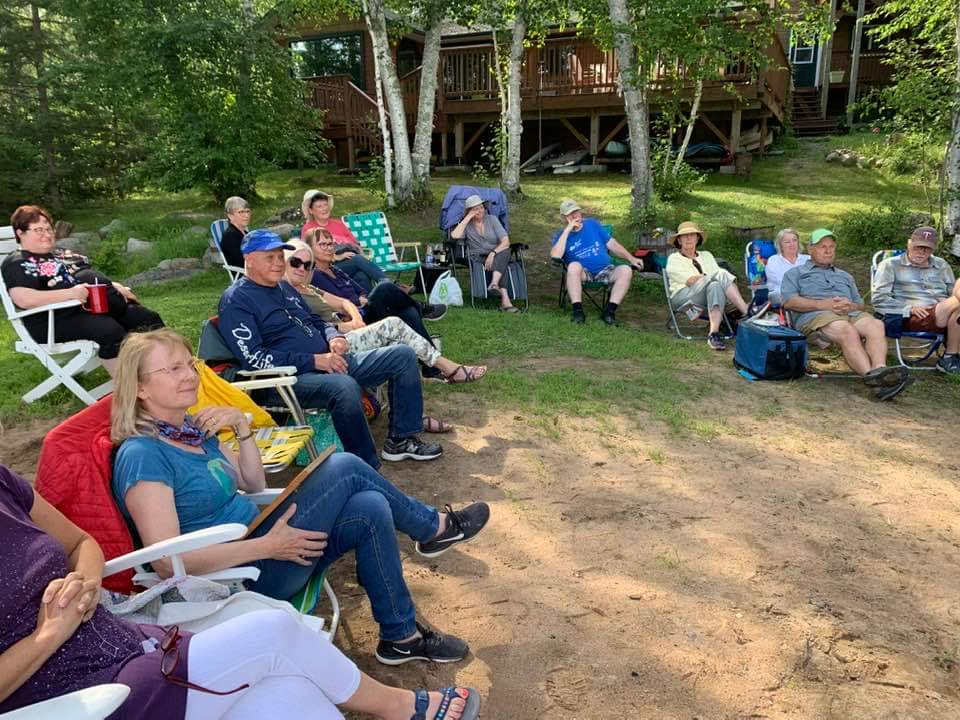
Friends arrived just as the make-shift stage (soon to be returned to its rightful duty as a dock — rather than doc. — segment) was commissioned into service and we chatted and snacked and popped open bottles and cans and congratulated ourselves on being capable of being in such a place… in space and time, on Earth, today.

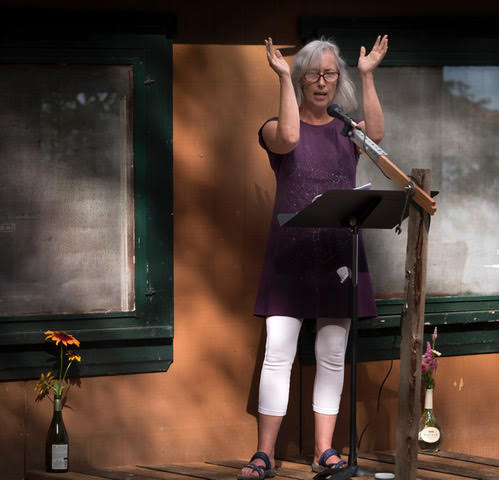
The loaner mic in friend & neighbour Jack Schellenberg’s hand-crafted and skookum-engineered mic stand crackled and away we went, led with panache by author Roger Groening. Knuckleball is Roger’s novel. (The author’s legs appear above, royalty-free; they’re the stems to the right.) He read a recent WIP excerpt that had us reaching for our decades-ago-discarded DuMauriers and l-o-l-ing and giggling through his vivid description of a wry woman tasking a man in a room without solutions.

Next came Leslie Wakeman who brought so much: snacks, wine, a beautiful quilt, handmade cards and her story, “The Goddess Cup.” We were gradually drawn in as her character’s embarrassment grew and our appreciation for Leslie’s deft, humourous-and-so-human touch led us along.

And then it was my sister Marnie Fardoe’s turn with a reading of a diary entry she had repurposed for us, for this perfect evening. She called herself a novice but we knew better. In addition, we got the family discount as Marnie gave us a quiet and moving performance of our sister Char Toews’ powerful poem, “Schedules are subject to change without notice”

[...] If the weather's that shitty it's kind of iffy
You're better off in the air or on the land

Or living or dead, which is what my Dad did
And me with a number of things planned

Then home in May, cutting the grass that first day
Mowing and crying and thinking about worms and their dirt [...]

Vid by Bonnie Friesen: https://www.facebook.com/580948274/videos/800154487823298/
.

The perfect lead-in to Wes Friesen and his soulful playing and singing. Two beautiful Leonard Cohen songs following by a fascist-killing presentation of Deportee/Plane Wreck at Los Gatos, by Woody Guthrie.

Vid by Bonnie Friesen: https://www.facebook.com/bonnie.friesen.9/videos/1403462673497989/

.

More poetry, from Winnipeg poetess Phyllis Cherrett who wowed and dazzled, showing us her calm control over word and emotion, ending with the perfectly-suited dent de lion

Phyllis Cherrett also gave a truthfully written acknowledgement of PLACE.

I offered a pair of flash fictions, “New War — Old Technology” and “Luck!”, bookending our great friend Christiane Neufeld’s spelky delivery of poet Ceinwen Haydon’s Gooseberry, a repeat-performance from Prosetry 2019.

It should be noted that Chris’ hub Hans Neufeld (aka John E. Neufeld) was present but chose not to present this year. Hans was, without doubt, the most prolific writer on the property at Prosetry 22, him being the daily author of THE MEANDERER http://themeanderer.ca/: a most profound and enjoyable gathering place, enjoyed by many online.

Two best-selling and truly masterful authors closed out the evening. MaryLou Driedger (Lost on the Prairie) offered us the first chapter of her WIP SEQUEL novel, set in 1936.

.

Writer, memoirist, author, instructor and warrior-woman Donna Besel did not disappoint, giving us a thematic reading about a boathouse construction job set at nearby Brereton Lake. The story was a piece from her hit collection of short stories, “Lessons from a Nude Man.”

MaryLou Driedger as Gustave Flaubert would have seen her https://maryloudriedger.com/
Donna Besel https://www.mcnallyrobinson.com/9781926710303/donna-besel/lessons-from-a-nude-man

Through all of this, photographer Phil Hossack was doing his quiet and unobtrusive professional best, circulating among us, taking pictures that caught mood and feeling as much as light and dark.

Phil Hossack https://philhossackphoto.ca/workshops/

Cheers to local artists Janice Toews, Gale Bonin, and Allison Rink whose brushwork filled the SheShed with brightness and colour.

NEXT YEAR: Book the day, slot it in and make it sacrosanct… we want you here to read and listen, to watch the clouds part, to smell the woodsmoke and taste the wine, to read, to hear and experience. We’ll make it more of an afternoon event — we’ll start at 1 PM and make it possible to leave without rushing before the sun goes down.

For those who stay, maybe we can set the boreal ringing with this unforgettable folksong refrain:

Wes Friesen

…Goodbye to my juan, goodbye, rosalita,

Adios mis amigos, jesus y maria;

You won’t have your names when you ride the big airplane,

All they will call you will be “deportees”

🎶
Janice Toews
Showtime minus 90 minutes
2017 U.S. Inauguration crowd
Ruth & Roger Groening
2019 Prosetry (July 20)
MaryLou Driedger reading at Prosetry 2019
Yet more Toews
Leslie, Marnie, Bonnie
SEE YOU NEXT YEAR! “Daj Boże!”
Janice and I reside in the boreal forest just north of the Fiftieth latitude in eastern Manitoba on Treaty 1 and 3 lands. Our property is situated on Métis land: Anishinabe Waki ᐊᓂᔑᓈᐯᐗᑭ  http://www.anishinabek.ca/