Humans evolved as viable beings in part through our ability to maximize our senses as a whole. This is unlike many other creatures with specialized areas of excellence: a hummingbird’s flight or an eagle’s vision, for example. We homo sapiens have not been able to supercharge any single sense but have created a life-giving skill of summarization. We’ve been able to condense all of our senses to create almost instantaneous and frequently accurate compound impressions that let us make fast decisions.
When walking in the woods, the leaf-muffled sound of something above makes us instinctively glance in that direction, lower our centre of gravity, and rely on our unconsciously gathered, short-term knowledge of our immediate surroundings to guide us and avoid a falling branch.
These intuitive, “always on” survival instincts are given to us before we are born; these powers are in our genes and the DNA that plots our growth.
We combine all available data to create almost prescient responses to situations and we do it thousands of times each day, even while we sleep. Each second, we are automatically collecting, sorting, saving, discarding and responding—or preparing a response—to the myriad sources of input we insatiably seek to acquire.
Relentless and ruthless, we categorize and make assumptions as a necessary by-product of our rapid-fire process of collect-examine-act. It works! 750-pound sabre tooth felines are extinct but 122-pound soccer moms wearing spandex leggings and hot pink tank tops jog with their stroller-strapped infants through modern society’s statistical valley of death: roadside urban environments.
We depend on our ability to rapidly rate & discern danger or safe haven. This savant-like skill has made our population grow to the point where we have become our own worst enemies.
This island of genius, summarization, extends to our art as well. In fiction, we create characters whose true selves are, to the observant reader, readily visible. Seemingly stereotypical. However, our “bad guys” may at first appear as great dads, loving boyfriends, fearless advocates of the downtrodden, or otherwise trustworthy sorts. And so they may be, until they, like the tree branch, suddenly SNAP!
Like we somehow knew they would.
Bait and switch. Hidden foreshadowing. On Star Trek, the never-seen-before crew member who is featured in the opening segment of the show as a loyal but inconsequential player sets off alarms in our sensory array. We KNOW this character is shown for a reason. This herring with a sunburn is going to: a.) die horribly, b.) be transformed into some unstoppable alien predator, or c.) shapeshift into a lookalike for Kirk, Spock, Bones, or Scotty. The music, dialogue, the point in the story arc, and a dozen other micro telltales (a signature Nimoy eyebrow lift perhaps) give us a sense of certainty that all that remains to discover is the skill with which this yarn is unravelled. We grab a bowl of sugary cereal at the scene break and hurry back when the familiar “back-from-commercial” music entreats us to return and see if maybe there could be some knot in the plot we did not foresee.
Generally, the only way to fool us and our all-seeing assessment tools is to introduce some hitherto unknown, unknowable factor: a force field, a distant planet’s illogical cultural more, or a character flaw for which NO CLUES were ever offered. Shame, screenwriter, for giving us insufficient data. How un-Hitchcock of you! How Bradburyless!
But wait! Is there shame in this lack of situational prep work by the author? Must all characters wear either the white stetson or the black? Is it binary? God and the Devil? Must we be drawn always into our heroic and melodramatic roots over and over again? Can’t there be confusion? Contradiction?
#
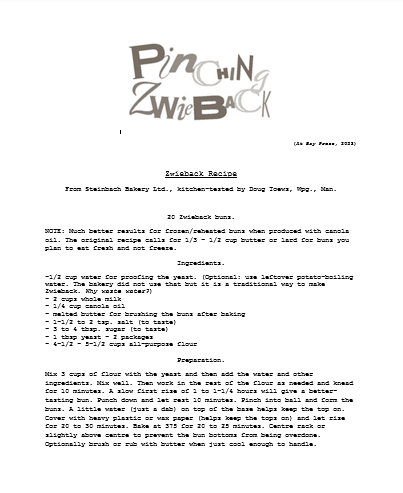
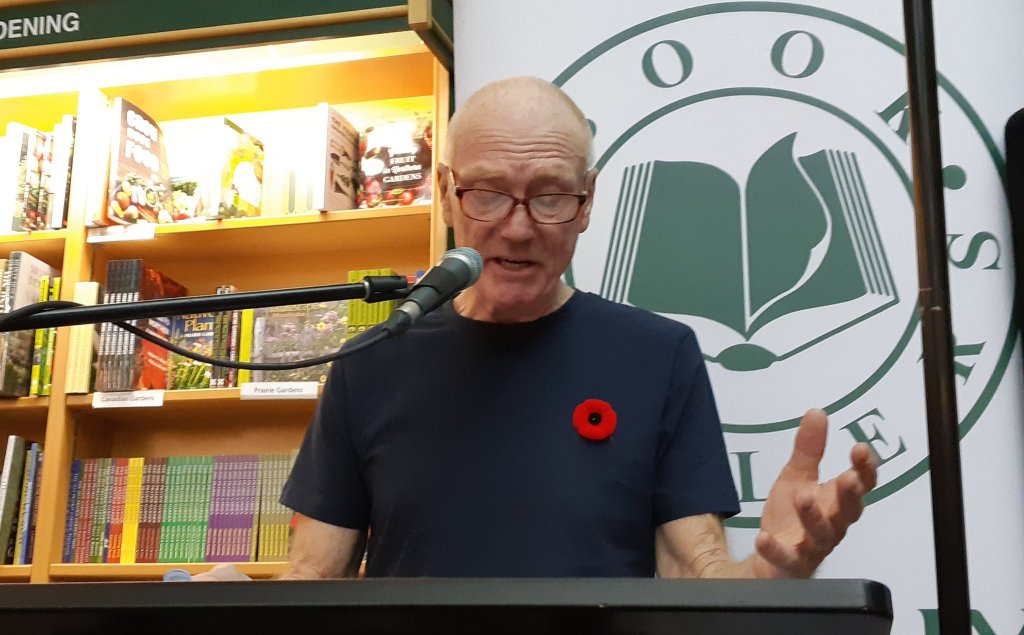
In my “reads like a novel” collection of short stories, “Pinching Zwieback” (At Bay Press, 2023) there is one recurrent character who is, one could say, clearly contradictory. In her first appearance, “Justy” is a stoic, “old-soul” kind of young mom, whose love and earnest devotion for her family is both beautiful and beguiling. When I read this story to audiences, I can feel her charm and purity making them love her and want her to succeed. So do I.
In the next installment, about mid-way through the collection, we meet her again but this time Justy is the world-worn mother of teenagers in a fish-bowl small town where every means of escape has proven futile. This older Justy smokes cigarettes, drinks liquor, and otherwise spits on male Mennonite overreach into her life. The Grittiness of Mango Chiffon showcases her willingness to confront her male antagonist with laser beam accuracy and we find in her a beacon of hope for the lowly. (A group in which she finds herself, despite her powerful character.) Echoing a figurative page from another story in the book (Breezy) she reminds us of the message found in one of my favourite short stories: “Forgive the weak for they are always fighting.” —Layne Coleman wrote in “Tony Nappo Ruined My Life” (Exile V45.2, in which this story was named the $15K winner of the “Best Canadian Short Fiction.”)
Justy’s final appearance shows us the caustic effect of sorrow, self-pity, and surrender. Human frailty is the currency and Justy is no more the bright, heroic young mother willing to take on any burden and defy all odds against her. Nor is she still the cynical but bold and unyielding knight Perceval; older but still focused on her Holy Grail, though we might see in her some flickering signs of weariness and a quiet desire to set herself apart from the constant meanness.
At the end of Grittiness, we are left imagining her in growing despair, abiding a life among the paltry and the unbecoming. She remains unseen until at last, in Rommdriewe, she reappears finally and is forever seen as broken. The defilement of her earlier selves is complete.
The message in Rommdriewe is, as my writer friend Brian Hughes of Winnipeg said during a critique session of this story, “to not hate the poisoned victim—rather, hate the poison.” Justy is cruelly denied this kindness. In Rommdriewe, her son (now a man) and his aging father come to terms with their fractious relationship. Justy is left outside of this treaty, with only the smallest of hopes left for her to save herself and become the pure girl-woman-truth seeker she once was.
Justy is the undisputed hero of the book and yet she is denied heroic status. She becomes the sin-eater for the others, sacrificing herself to show them how honour and defiance (Trotz) and courage can be used to survive. Even as she slips over the icy edge with little Matt at the end of Fast and Steep, we know we’ll not see her again except as the defamed sin-eater who subtly and without troubling us, gives her soul in exchange for others.
In the end, maybe Justy is the opposite of a contradictory character. Perhaps, somehow, she becomes the hero made perfect, without seeking perfection. Justy is no faux male Jesus vainly declaring anguish while knowing his everlasting fate is secure. No, Justy’s stoicism is as pure and giving as her motherly love and her endlessly heroic trotzijch mettle in the face of all adversity against her loved ones.
In this river of love flowing uphill, Justy remains true to her innermost self and is in this way the ultimate contradictory character.
Please feel free to share this post! I welcome all comments.





 Mitchell Toews