Not a diaspora, not a forced march — just a subtle shift.
The new site provides me with a single platform to share my work and, in 2026, to host my debut novel and any subsequent projects. Everything is here: links to buy books or read published stories, a calendar of events, reviews, and more.
Thanks for reading. I’ll keep posting, and I hope you’ll keep stopping by. As before, my big mouth snookery pairs well with caffeine and is best taken with a grain of salt.
Quiet writing in a noisy era
Please feel free to share this post! I welcome all comments.
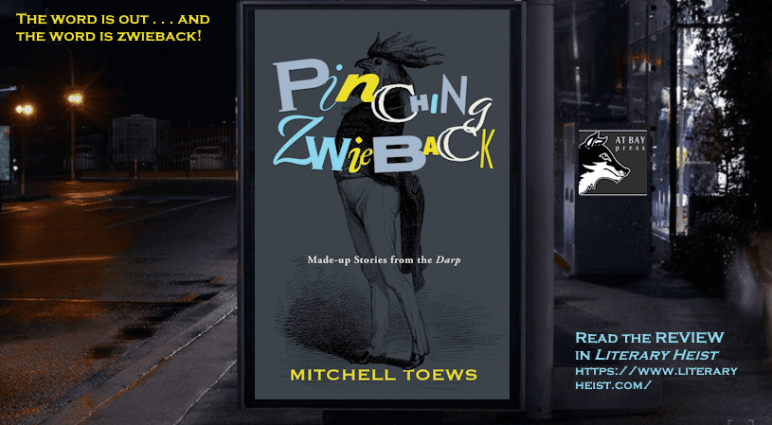
Mitchell Toews is a Manitoba-based fiction writer whose debut short story collection, Pinching Zwieback, was published in October 2023:
Background Toews grew up in Steinbach, Manitoba, in his parents’ Mennonite bakery. He’s been published in over 125 literary journals and anthologies, and has been nominated for a Pushcart Prize four times. He’s also been a finalist in several major contests and prizes.
Pinching Zwieback Toews’s debut collection is a blend of memory, fable, and trauma that explores life experiences in the fictional Mennonite prairie town of “Hartplatz”. The book has been well-reviewed, appeared on several local bestseller lists, and is being discussed in book clubs.
Other work Toews is currently working on a second collection of short stories and a novel. He’s also collaborating with Phil Hossack on an ekphrastic prose/photographic art book.
Engagement Toews reads at libraries, bookstores, and open mics, and also leads a workshop called “Writing Your Culture”. You can find him on:
Mitchellaneous.com: His blog for updates, news, and other information
So that’s it, then? A writer, a Manitoban. No mention of the rest of my life, including living in Chilliwack, my 47-year marriage to Jan, our kids and grandkids (who will change the world, if they have not already), starting and running a manufacturing business, working in advertising for 20 years and being an active sort… out cursing and getting bruised and exhibiting “warning track power” no matter which sport—a trait that includes a highly selective memory when it comes to skills, courage, and accomplishments. (“Still,” I pout, “at least I always got my uniform dirty.”)
I think AI is right to focus on what it has—I use the internet primarily to promote my writing because, dammmit Jim, that’s just what a writer has to do these days!
I am en grade: AI may suddenly turn on me. Why? Well, I often make fun of the AI that runs my daughter’s refrigerator (“Here’s today’s weather for Zanzibar” it says, after I hack the geo-locator in the settings—hee-hee!). I also throw shade at her snooty 3D printer, and my n’er-do-well regular printer (whom I call “O, Brother, where for art thou?” when it fails to print). These bad relationships may colour AI’s appraisal of me. I am courting AI revenge! I need to let AI feel more seen, be more inclusive to AI, and give them/they/it the benefit of my human capacity to be empathetic, even if they are incapable of emotions. (Does AI get my “O, Brother… ” joke? I think it does, on an intellectual level. Does it laugh? Is AI ticklish? Does AI have a weakness for old Carol Burnett Show vids?)
My other question is, “Has AI read my book? Has AI read all of my published work? Does AI like my Menno-Grit style or are they/is it more inclined towards Sci-fi or Fantasy? (I do get a kind of D&D vibe off of AI, don’t you?)
Anyway, do a search for “AI Overview Your Name” and see what my daughter’s refrigerator thinks of you, you Zanzibarian, you.
Please feel free to share this post! I welcome all comments.
On Thursday, February 29 poet and essayist Ariel Gordon of Winnipeg and I motored to Brandon, Manitoba to present workshops and readings at the Western Manitoba Regional Library downtown branch. We represented our mutual publisher, At Bay Press.
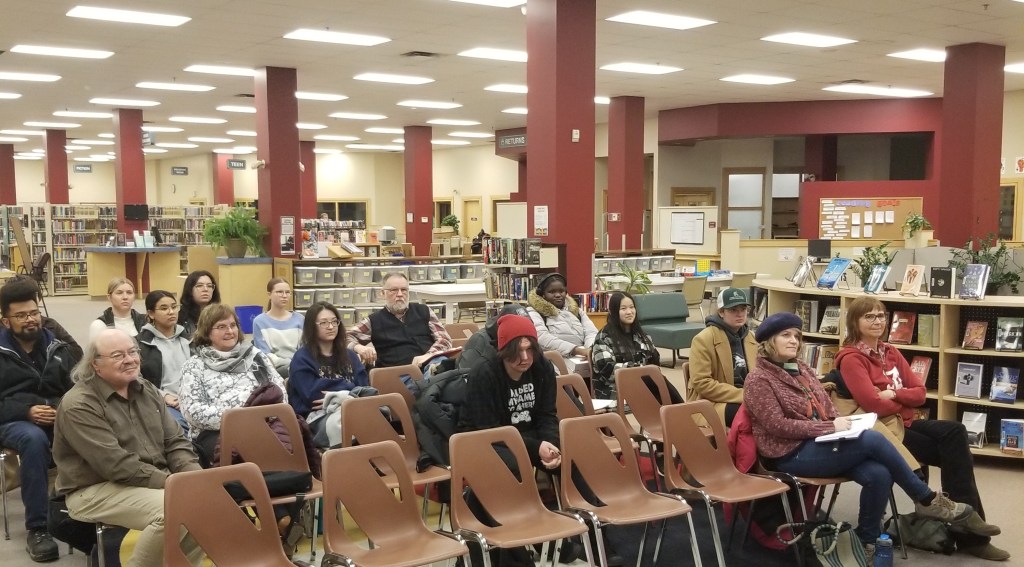
It was an outstanding event, well-attended by an enthusiastic group. Both Ariel and I have posted about it on Facebook, Instagram (prosebytoews), X, and elsewhere. Ariel did a poetry workshop on urban ecosystems and I introduced my break-out session on “Writing Your Culture.” Both of these programs had full classrooms and the reading was also—collectively speaking—pleasingly plump.
We had a Q & A at the “end of regulation time.” (In my imagination, Brian Propp scored the winner, assisted by Ralph Krentz. . . For all you Wheat Kings hockey fans out there.) I really enjoyed the conversation.
One of the questions was concerning “advice for young writers.” Ariel made some valuable suggestions in response. When it was my turn, I held back on expressing my immediate reaction to the embedded inference that all emerging writers are “young.” Of course, many are, but just as we no longer use ONLY male pronouns when discussing a group. . . “If a writer wants to succeed, he must blah-blah-blah,” I find it inappropriate and incorrect to add the fuzzy modifier, “young.” Presumptive gender-fixing (he-him-his) now sounds foreign and antiquated to our ears, and I long for the time when “young” and “emerging” are not used as synonyms for early career artists.
Hot air rises. Heat travels in any direction. When we say “heat rises” in an assured, generalizing, scientific-sounding manner, we become General Wrong of the Wrongsville Army.
Okay, mini-rant over.
I gave several points of advice and I was pleased with the repartee, as John Prine might sing. This morning, over a cup of familiar, at-home coffee, I thought of another way to answer, and it goes a little sumpin’ like this <guitar lead-in>:
“On a business trip to the Green Building Conference in Chicago about 15 Marches ago, my colleague and I stopped in at a pizza restaurant. The place was packed and full of loud hubbub and stratified layers of cigar smoke. We opted for outdoor seating, under the radiant red glare of heaters.
As we waited, we watched a local resident at work. A fat, filthy Norway Rat was trying to free a pizza carton that was wedged beneath a car tire. Grunting, sniffing, scurrying, its pink tail waved and curled and flexed with intense determination.
Pausing for breath, it sat on thick hanches and pondered. Whiskers twitched in a nature-copies-Pixar way. Abruptly, it went to the loose end of the box and, clamping down with white canines, tugged repeatedly like a tow truck trying to jerk a car out of the ditch. Snarling with effort, the noisy activity attracted one of its swarmmates to the scene of the pie.
Without hesitation, Rat Due, as we named the newcomer, immediately joined Rat Uno and in seconds they were pulling in perfect unison, a rodent duet. Outmatched at last, the box lid gave way in ripping surrender. Rats Uno and Due plundered the contents and made good their tail-waving getaway.
My advice to emerging artists: Sometimes you are Rat Uno, and sometimes you are Rat Due, but don’t just sit in the comfort of the mischief and watch.“
CHEERS to playwright and English & Creative Writing Asst. Prof. Dale Lakevold. He brought along a swarm of talented students from Brandon University, and like the Marino’s Pizza he supplied before the event, his contribution made our day. Thanks too to WMRL Mgr. of Programming & Community Svcs., Alex Rogowsky who prepped and managed our twinkly evening.
Please feel free to share this post! I welcome all comments.
Here is a triumvirate of REVIEWS for my debut collection of short stories: Tim Huber, Associate Editor of Anabaptist World…Patricia Dawn Robertson, a familiar Canadian reviewer, critic, and writer with a review from the Winnipeg Free Press…Robert Boucheron, writer and editor/publisher of the Rivanna Review of Charlottesville, Virginia and his review as it appears in Ottawa’s Literary Heist.
Want to borrow PINCHING ZWIEBACK from your local library? NO PROBLEM!
Services like BiblioCommons are linked to At Bay Press and a copy can go to your local library in Canada, the US, the UK, or Australia. ALMOST ANYWHERE. Just request Pinching Zwieback by Mitchell Toews (At Bay Press, 2023) and you can get it. . . In Burlington, Springfield (all of them), Come by Chance, WaWa, Walla Walla, and Wallaby Junction.
Okay, I made the last one up. But seriously, it’s AVAILABLE!
Image: *Preservings* Issue Number 47, FALL 2023: “Marriage of Russlaender Maria Pauls and Old Colony Cornelius Driedger, March 1927. JAKE BUHLER PRIVATE COLLECTION
Here are some thoughts about class and gender conflict with quotes from a variety of observers.
“The indelicate clacking of the men’s heels and the shuffling of their soles reminded him that their grade of culture differed from his. He would only make himself ridiculous by quoting poetry to them which they could not understand. They would think that he was airing his superior education.”—MC Gabriel’s thoughts in “The Dead” from James Joyce in Dubliners (Public Domain).
Is Joyce’s judgemental Irishman not interchangeable with a haughty Russlaender attending some inelegant, rustic affair in a prairie podunk like Gruenfeld or Neubergthal? Could this class-conscious thinking—reductive and dismissive—just as well be aimed at some random Kanadiers; a huddling of farmers in hand-me-down Sunday suits? Are Mennonites not just as guilty as any ethnic or religious group in their tireless search for an unloved “they” to diminish?
“That in the beginning when the world was young there were a great many thoughts but no such thing as a truth. Men made the truth and each truth was a composite of a great many vague thoughts… There was the truth of virginity and the truth of passion, the truth of wealth and of poverty, of thrift and of profligacy, of carelessness and abandon.” —Author Sherwood Anderson from the prologue of Winesburg Ohio (Public Domain).
The distant cannon fire of class and gender warfare, this time from the rolling hills of Middle America, where sinners and their sins are pilloried by the colour of their licence plates.
“I had heard about Mennonites all my life, about the brawls, the fist-fights at socials and hockey games. The hypocrisy as they kept liquor out of their town, but then drove to La Broquerie or Ste, Anne for booze. How they’d look down their noses at us for doing in the open what they did in the dark,” —MC Richard’s acute observations from Matthew Tétreault‘s Hold Your Tongue(NeWest Press, 2023) summarizes the abrasive relationship common between Francophone/Métis Ste. Anne, Manitoba and its nearby, predominantly Mennonite neighbour, Steinbach.
“I hear them (the ‘wealthy church ladies’) get up from the living room and walk past the kitchen. They’re coming down the stairs now, all talking at once. Like cedar waxwings, in a flock, turning in the sky, then landing as one. Beautiful in a way, but still capable of turning on you. Hurting you to make things better for themselves.”—MC Justy Zehen’s thoughts in “Willa Hund” from Pinching Zwieback (At Bay Press, 2023).
“This book is a double bun, doughy anecdotes from a spirited childhood coupled with the realisation that manhood is a more complex goal than just being strong, especially when strength translates into bullying, especially of women, the archetypal bakers of the author’s imagination.” —Linda Rogers van Krugel in her REVIEW of Pinching Zwieback (At Bay Press, 2023).
The quiet shuffling of souls—betraying different classes, genders, racial origins, and beliefs both phobic and apologist together with their ironfast allegiances—appear to be present in all groups, denominations, and Gemeinde: from those who jumped the turnstiles on the Ha’Penny Bridge to those living in the dusty towns of Southern Manitoba to the Buckeyes of Ohio and beyond.
As an author with a momentary, leaky thimble full of influence, I have made an effort to recognize and embed some questions about this “prost” (ignoble) trait that I see in myself and in Mennonites and their selfish schisms. The unfettered compulsion to divide and re-divide until the original differences are impossible to discern. This flaw is present without relief in my life experience outside of Mennonite familiars too. It’s in all the places I have been and in all the people I have learned to know. I’ve seen more marketing and public relations and gossipy slander in these social groups than in all the thousand vulgar ad campaigns I created, put together.
Are we all Baudelaire’s “Les Fleurs du mal?” Or is there is hope?My conclusions in “Pinching Zwieback” are doggedly optimistic, but then, I set out to put hope into every circumstance, even the most vile. I did so despite the constant human wickedness and the despair it has caused. In the end, I suppose I’m like the character Justy Zehen, “I don’t want to be a little Russian boy hiding in the rhubarb.”
Please feel free to share this post! I welcome all comments.
Here are stories written and compiled over the years 2015-2023. Many of them are based on my personal experience in the half-century from the late Fifties onwards but have been given the cloak of fiction. It is Autofiction that is meant to be read in the spirit of openness by all members of the human congregation.
Stories written, submitted, rejected, re-written, combined, disintegrated, edited, and re-submitted many times. Like a treasured recipe, altered and fine-tuned and dependent on the ingredients at hand.
In the end, I believe At Bay Press and I have made a collection that is comfortable on a wide variety of bookshelves, nightstands, coffee tables, and in commuter jacket pockets. An eclectic variety of readers; including but not just Mennonites, nor Anabaptists or Christians, and not just those who are none of those.
I hope all my readers, no matter their filters or experiences, can draw from this book. My aim is to make available meaningful connections for readers and provide thoughtful enjoyment through the characters’ lives and interactions. I also want to enable readers to relate when read as stand-alone vignettes or when viewed as a whole, from the broader narration that the plenary arc seeks to achieve.
Please feel free to share this post! I welcome all comments.
NEW REVIEW! See what Robert Boucheron, Saturday Evening Post contributor & editor/publisher of Charlottesville, VA’s Rivanna Review, has to say about “Pinching Zwieback.”
Find it here: in Ottawa’s Literary Heist
Pinching Zwieback, stories by Mitchell Toews, At Bay Press, paperback, 257 pages, $24.95
IMAGE: Jackson Pollock at the MoMA, by joansorolla Creative Commons site
“I respond to character-driven material, regardless of its origin. I fall in love with the characters and generally respond to stories featuring ordinary people who succeed in overcoming extraordinary challenges.” —Producer Gale Anne Hurd
If I had a mantra while writing Pinching Zwieback, it could have been this.
During the Morden library reading on November 28, an astute reader commented that in a normal short story, the reader can be frustrated because the story ends so soon, unlike a novel where characters receive more development. By using recurrent characters and a narrative arc that goes from beginning to end, much as a novel does, the readers get to know the main characters in PZ quite well.
These observations are true for readers and I can comment that it’s true for the author too! I learned a lot about these characters from the structure of the storytelling and by “letting them tell the story” as they developed personality and definition during the writing of the book.
My expert editors, including Matt Joudrey, Alana Brooker, Nina McIntyre, and Priyanka Ketkar did a lot to bring these distinct characters out and let them fulfil their roles as individuals in the larger story told by the collection as a whole.
This aspect of writing Pinching Zwieback was one of the most enjoyable—and cathartic—for me as I did an emotional freefall and let my imagination go, using the characters as the vehicle to rewrite life events from my past and explore alternate outcomes.
I didn’t always use the outcomes I imagined, but just the act of creating them allowed me to think more freely about my own history without being bound by what “really” happened. My job as a storyteller benefitted from this exercise, particularly with the help of my expert team of editors.
In addition, I tried to let the characters come alive and to have them think and sound in the genuine way I imagined they would.
“[…] I like the rawness of the pure untarnished colloquial voice in the reading. Having something to say is essential to me. That is to say, I’m not impressed with a great volume of rarely used words thrown together to impress the reader with the vast knowledge of the writer on command of English, tricks of writing, ancient history, or the places they’ve travelled.”—An excerpt from an interview by writer, editor, publisher Judith Lawrence in, “Six Questions For…”
Please feel free to share this post! I welcome all comments.

 Quiet writing in a noisy era





 Here are some thoughts about class and gender conflict with quotes from a variety of observers.

 Mitchell Toews