A Writerly Reinvention

A new publication came to my attention and I was intrigued by the unique model it employs.


alsina info“At Alsina, we connect your work with readers from the outset. Our readers are engaging with our product to learn a language, so you are connecting with a whole new group of people that you would not otherwise have access to. When they read your work, they can follow you to get updates when you publish your second or third story with us. They have easily-accessible links to your website, so they can link through to your longer work, sign up for your mailing list, and so on.”

So, it’s a fresh opportunity to put out a flash fiction (1000-word maximum) and have it translated into several languages. Readers use the stories to develop their language skills in an enjoyable and intuitive way.

I submitted a 968-word story called, “The Light Pool”, and was delighted to have it accepted by Alsina Publishing

Opening the window, I listened to the crickets and frogs calling from the valley below as the beautiful silver sedan crossed the Don River Bridge. I inhaled, expecting to smell fresh summertime vegetation – ferns and flowering trees. Instead, there was the vile stench of hog rendering, the heavy synthetic odour of chemical discharge and the sharp, acrid reek of poultry effluent. I pushed the button and the glass hummed up into the thick rubber rim. [snip]

The story will run in the near future, after an editing round. I have been challenged by the Alsina editors to serialize my story and come up with sequels to “The Light Pool”. This approach makes sense for both writer and reader and it’s clear how a “mini-series” could be an especially good way for ESL readers (and learners studying in other languages) to build on the words and concepts they have learned by reading previous instalments in the same set.

meanings

Altogether, a thoroughly innovative and exciting proposition! Stand by for a publication date for “The Light Pool” soon and meanwhile, visit some of the links provided on this page to see what Alsina is all about! http://www.alsinapublishing.com/blog/

allfornow – Mitch

Every Picture Tells a Storgy

A lot of things in life can be streaky. The leading scorer in the league – pick your sport – gets to the playoffs and goes. Ice. Cold.

When it happens to you, you think, “I’ve lost it.  Or maybe I never had it, maybe it was all a massive fluke.” You kick the dog, get bitchy with your friends and co-workers, lock your keys in the car, get the shopping cart that eats your coin – or you think it did, until a lady with a walker comes over and pulls on the handle and the cart pops free. Easy as pie. And she explains that there is no coin required; that you just shoved a dollar into a crack in the plastic grip.

Stupid Home Depot.

Then it turns and while no one really knows what it is… we all know exactly what it feels like when it comes or goes.

But, really, I brought it on myself. I dared it to leave. “How?” you ask?

I took on topics that were harder to write: race, gender, sexual orientation, religion and age. Plus, I submitted to unfamiliar sites and journals with big league reps. So, if I went a little cold, I have no one to blame but the crusty old bugger in the mirror.

Stupid old guy.

Anyway, today I received an email from Anthony Self, Head of Film and Co-Director @ Storgy.com. They liked my story. They are going to publish it.

storgy

It’s back, mother****er, it’s back!

“The Log Boom” will be presented on Storgy.com on May 19.

allfornow – Mitch

P.S. – Thank you, Storgy!

The Rothmans Job

My noirish crime fiction, “The Rothmans Job”, has earned a reprint in SickLit Magazine. Readers seem to like the characters in this story. Me too.

SickLit is an online zine with the tagline, “Bringing the real. Keeping the weird.” I suppose that this twisted tale fits that mandate. Thanks to SickLit for picking me up on such a cold, dark night. Thanks too, to CommuterLit, who ran the story originally.

Like ‘Rella, in the story, I remain optimistic. “Against all odds”, is not such a bad place – at least you know where you stand. If you like this story – please share it. If you hate it – hit me in the face a few times and I promise not to counter-punch or argue. I’ll just get back up and keep trudging until I disappear in a flurry of snow.

bb48de0d4e107d2f3c9922b13a254df5 pegasus

allfornow – Mitch

@Mitchell_Toews

The Creative Economy

Hardworking Old Dude…

I am in the middle – eight hours today – of editing a collection of short stories. 200 plus double spaced, TNR 12 font pages of prose from Toews.

As a formality (I thought) I searched for “ly” in Word and to my dismay, TO MY UTTER DISMAY, I found that my manuscript contained 768 ly words. Lots of adverbs like “nervously”, “amateurishly”, “hopelessly”, “f*ckishly”, and the always-lyrical, “rejectingly”. Non-adverbial LY words like “family” & “only” were present in the text and were not guilty of a felony, but still: 768??

768 is a lot. That number is the total combined career home runs hit in major league baseball by BROTHERS. It’s an easy Google search, but how about a FREE ZWEIBACH BUN for anyone who can name these brave-hearted brothers, without looking it up.

That is almost four adverbs on every page — too many for a self-proclaimed* “dirty realism” adherent like me.

(* And some readers say so too. I love those people.)

“The adverb is not your friend.”  –  Stephen, “The Adverb-Slayer”, King (No less!)

So, having pulled my short fiction collection together, created a TOC, and an Acknowledgements Page, I thought I was pretty close to crying havoc! and pressing send. After all, most of these stories have been accepted by literary journals and have been edited and re-edited many times. Some have gone under the knife so often they look like zombies on The Walking Dead! So they should be somewhat adverb-free. Nope.

As a result, this Sunday was spent curbing my adverbyism. “Out, Out! Damn adverb!”

In Search of Art…

“What is Art?” you might ask. Good question. For a Mennonite, the answer could be, “Art Martens? He’s a farmer,” or “An EMBer,” and so on.

But I ask, “What is Art?” because that appears to be what I am working for: Art for Art’s sake. To scratch the creative itch.

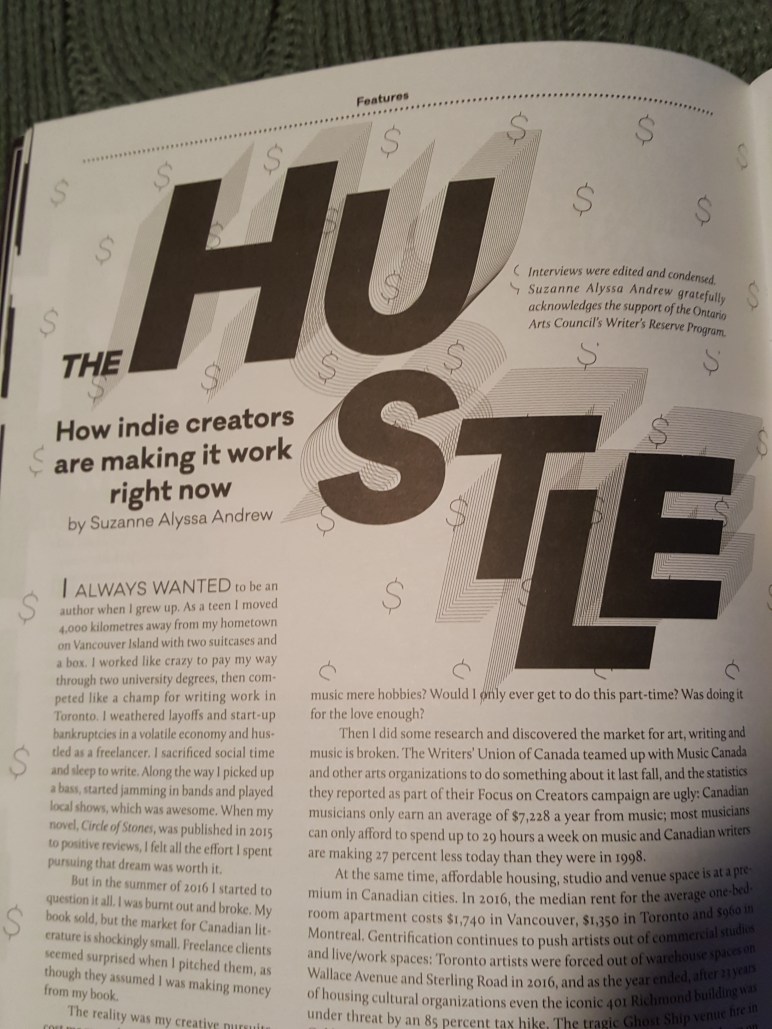
It has come to my attention, thanks to a wonderful article in Broken Pencil Issue 74 by Suzanne Alyssa Andrew (The Hustle, page 20) that, in Canada, “the market for art, writing, and music is broken.”

The author goes on to present these disappointing, but true, statistics for the True North:

  • Canadian musicians only earn an average $7,228 a year from music…
  • Most musicians can only afford to spend 29 hours a week on music…
  • Canadian writers are making 27 percent less today than they were in 1998…

I worked my guts out from 1977 to last year so that I could finance food, heat, power, beer and wine AND write me some fiction. Now it seems like I should have quit in 1998 to become inky.

More dire stats showing the 19-year, and counting, slide away from the ever-increasing COL for l’artiste:

  • Affordable housing, studio and venue space is at a premium…in 2016, the median monthly rent for the average one-bed-room apartment costs $1,740 in Vancouver, $1,350 in Toronto and $960 in Montreal.

Ms. Andrew concludes that, “The creative middle class is dead.”

For me, this is unfortunate but not debilitating. However; had I followed my dad’s advice back in the seventies and followed the creative trail – trying to make a living from the artistic side of the dirty, confused world – it could have been a hard go, with things getting worse every year. I worked for forty years to finance my current slim pickins, so it’s not as bad por moi as it is for the many young artists today working one or two part-time jobs to finance their passion.

Ideas…

I suppose I could pay starving artists $0.10 per adverb for pest control in my short stories? But, with some perseverance, I can eradicate them myself. (Note how I did not write, “Hopefully,  I can eradicate them myself.” Eh? Ehhhh!!!?)

What about:

  • More funding for, less bitching about, Canada Council for the Arts?
  • The PM gives artists a major tax break, because Canada is close to committing the eighth social sin: Living without art. (Art the life-affirming pursuit, not that Martens guy.)
  • For street performers: Plop down a FIVER instead of a meagre Loonie. (Mennonites of course only ever applaud with gusto – we need to start with a Loonie and work our way  up.)
  • TIP HEAVY and prevent someone from sleeping on the streets. C’mon Moneybags, you have made gross, old guy, creepy remarks to the angel that brought you that Caesar with Extra Chicken & Diet Coke – now it’s time to bust the 15% ceiling. He or she may or may not be an artist, but either way — they need that extra coupla bucks more than you.
  • Buy some art. Yes, for the next few birthdays, Xmas, Hanukkah – go downtown, find a seller and shell out top dollar for Canadian art, music, writing. Think of it, sitting at the hockey game telling your buddy you just bought a $400 piece of art. They are gonna think you are loaded and – hoping for a hot stock tip – invite you to their cottage where you and Mrs. Moneybags can consume $425 worth of ribs, steak, wine, beer and outboard motor gasoline. (Do not mix consumables.)

The artist wins, your wife is lookin’ at you kinda funny (the good funny) after her third glass of free merlot, AND you are up $25 bucks! Tax-free!

(PLUS… you have just read an LY adverb-free article. No extra charge.)

allfornow – Mitchly

The Bottom of the Sky

Hi everyone!

I have a new story.

It is a prequel to the story that first appeared in Rhubarb Magazine, “A Fisherman’s Story”. This piece becomes a Part 1 to that original tale of a family on the shores of the Pacific Ocean.

Part 1 is in 1955, in Acapulco and tells of one of the original characters, when he was a younger man, captaining a fishing charter boat. The original piece is Part 2 and is told primarily through the experience of the wife; the mujere.

I have re-named it, “The Bottom of the Sky” , comprising Part 1 Acapulco 1955 and Part 2 Puerta Vallarta 1975.

Here are a few excerpts:

Avelino walked the tourist beaches. His officina, as he liked to joke with the Americans who lay like white cordwood in neat rows, toes pointing at the sun. He had a photo album with pictures of the azul boat; fish strung on the scale at the Acapulco dock; smiling American faces, sun-tanned with movie-star sunglasses and drinks in hand. He was charming and good looking and he hooked many gringo fish.

[Snip]

After a quiet half-hour of trolling they came to a feeding fish. In the split second before it happened, Jose could feel the strike. Then the rod bucked in the holder and the line peeled out in a persistent zazzzzz sound like fingernails on nylon. The pinche yelled and the woman named Angel clapped her hands, her red fingernails looking like spattered blood against the bright horizon.

[Snip]

“Senor Bart! Por favor,” Jose strode rearward with the rod harness, its buckles jingling, passing it to the large man. Then he hurried to the transom where the fishing line danced and swung like a kite tail above the bubbles in the wake of the boat.

[Snip]

The boat rocked in silence at the wharf, next to the scales. Jose sat on the dock staring down into the dirty water. The American had shouted something, cursing as he climbed into a taxi with the women. Doris stared at Jose from the car, her eyes dark and hateful – not the fairy blue they were when she reached over and touched his arm with hers.

[Snip]

YOU KNOW HOW IT IS, RIGHT? You create something that you feel good about – it’s honest, or you believe it to be so. You love it. Shitface drunk love. Then you slowly get to know it – you see it age like a child – and you recognize flaws that you were earlier willing to ignore. You work on it over and over until it is the best you can do; things become stale and the edits you make just become a false shuffle of the deck – nothing really changes.

Then a month goes by (or six) and you read it again. You see things and maybe after a sleep – waking up at three A.M. – you figure out what to do.

And then you love it again the same way it was when it was born, except maybe it’s a more mature love – maybe you accept it in a way you could not before, including the things that you could still change, but, you don’t. The story, like the characters in it, is partly good and partly bad – flawed but capable of splendor.

Blah-blah-blah. 🙂

I am a proud father today and maybe this will find a publication home. I’ll send it to a few “early readers” in the meantime and will report it here if it does get picked up.

Another day in the life — I better get down to the beach before my wife becomes certain that I have lost my mind.

allfornow – mitch

Copyright Mitchell Toews ©2017


And When I Dream of Death


Hi all,

Here are a few excerpts from a new short fiction that I wrote. I will be submitting for publication with journals that feature flash fiction. I flashed the sign for curveball on this one.

1,129 words

And When I Dream of Death

By Mitchell Toews

WHEN I DREAM of death, I dream always of baseball. Oh, how unaligned these two things are! One threatens absence in the lurking dark while the other reaffirms presence and joy at the bottom of the boundless, lighted sky; the bluest thing in all the world, put there so we could, “Play ball!”
 [SNIP]
Remember?
I do: the rasping of rakes on the basepaths and the tink-tink-tink of rusty spikes at 60’6″. And the Gatling-gun, syncopated smacking as the warmup tosses go back and forth. And bantering, “Howza kids, howza job, howza arm?” to settle nerves and shed workaday worries.
 [SNIP]
I see our boys on the bench, leaning forward, chattering as the first batter digs in. Then I am up and I see the red stitches spinning as the soft liner clears short and settles in front of the galloping fielder, one-hopping into his glove.
[SNIP]
I can see the catcher’s eyes through his mask as he gauges my lead. Too much chaw, I think. He looks drunk. As if he heard me, he tilts up his mask and a thin brown stream re-wets a dark spot on the sand. The Mexican pitcher, shoulders like a pit bull, rubs the ball with leathery hands as he looks towards home.
“Never know,” says Kornelsen as I take my lead.
[SNIP]
And then a funny thing happens and the air goes still and so do the crickets and frogs in the ditch. A purple black cloud is edging towards us out of the west and I hear a woman in the stands say, “He flew too close to the sun,” which is a damn strange thing to hear at a ballgame.
[SNIP]

Copyright Mitchell Toews ©2017

The Preacher and His Wife

January 23, 2017

“The Preacher and His Wife” is a comical look at the comings and goings of Mennonite life in a small town in the sixties. It is as pure as the view from inside the cocoon can be — but it’s just one cocoon.

The story goes live TODAY (January 23) on Fiction on the Web

Please find below a few short excerpts and also a couple of links to two other “Mennosphere” stories of mine that are in the FOTW archives.

On FICTION ON THE WEB JANUARY 23
“All family congresses were held in the tiny house and we sat packed as tight as two-yolks in a shell. Chair legs intersected like a village of miniature wigwams, and above that, our arms and forearms were in constant contact; sometimes linked. Our Zehen freundschaft heads – complete with high, overhanging brows – bobbed as one as we laughed or bowed in prayer or swiveled to see the facial expressions of the storyteller of the moment. The incoming newlywed uncles and aunts who found themselves part of this household became used to the close quarters. They soon grew adept at stepping over overlapping legs and socked feet as they picked a path through from the kitchen to the living room, doling out fresh coffee and buns with jam while a dozen conversations hummed and budgies squawked in their cages.”

[SNIP]

“One fall day, when winter parkas were in order, Sarah ran into our house to announce that, ‘Grandma can’t find her engagement ring and she is pretty sure that the Preacher’s wife has it.’
‘What?’ my mother said, stopping in mid-paw as she dug through a box of warm clothes to outfit us for winter. Grandma’s ring was her lone extravagant luxury and unlike other items of some beauty in her possession – furniture and rugs for example – this ring had no redeeming practical use. It symbolized love and fidelity and was purely a thing of pleasure. Grandma loved her ring, which had set a much younger Grandpa back almost a whole season of timber cutting in the Redekopp forests south of town.
‘That’s impossible,’ Mother said, with no opportunity for rebuttal, standing up straight with her hands on her aproned hips.”

[SNIP]

http://www.fictionontheweb.co.uk/2016/07/nothing-to-lose-by-mitchell-toews.html

http://www.fictionontheweb.co.uk/2016/10/heavy-artillery-by-mitchell-toews.html

You may also enjoy, “Our German Relative”. a Christmassy tale from Russia found on Red Fez, or other tales from the fictional prairie darp of “Hartplatz”, on Literally Stories or CommuterLit.

Copyright Mitchell Toews ©2016
Copyright Mitchell Toews ©2017

Three Vignettes

H

Here’s a few excerpts from a new story of mine.

P.S. – The artwork is mine too – a watercolour view of Caye Caulker from the Peach on the Beach looking towards the Split.

920 words

Three Vignettes

By Mitchell Toews

Copyright Mitchell Toews ©2017

One

Albert Thibodeau’s sister Suzanne was sick. His parents were ashen-faced and silent, going about the farm and household business by rote. Albert did homework in her room, his scribblers spread out on the flat, quilted blanket.

Suzanne lay unmoving. When Albert came in the room she would stir, her eyes opening and a thin smile on her lips. Her gums were too red. He would read her jokes from his Archie and Jughead Digest.

[SNIP]

Two

…”One dog, with peppers,” said Bob, busying himself with a bag of buns.

“And MUSH!” said Albert Thibodeau. “Gotta meet sis today and hear about how great she is doing.”

“Tell her I love her.”

“No dice. You are below that woman’s pay grade. You are a smelly dog, selling smelly dogs to other smelly dogs.”

“I love you too, Thibodeau,” said Bob, handing him a foil-wrapped hot dog. Albert tooled down the opposing ramp, skidding into a turn at the bottom in the March slush and then pumping hard twice to get to a picnic table on the courthouse lawn.

“Hey, drivers and registration please!”

[SNIP]

Three

Suzanne lay in the chaise. She was shaded by a wicker palapas and palms. Several green and brown coconuts lay in the sand around her. She gazed out past the reef – “beyond the swash,” like they said here – to where the water was a darker blue.

An easel stood near the lounge chair and a watercolour was underway.

“Carolina blue, cerulean blue, cobalt blue,” she said, from under the brow of a sun hat.

“Labatt’s Blue,” said Albert…

[SNIP]

13:05 1.8.17: Wish me luck in placing this flash fiction with an ezine or lit journal! I’ll post if and when it runs; if it becomes a cherished, “We are pleased to inform you…” 

allfornow – mitch

waiting for class to end, redoux

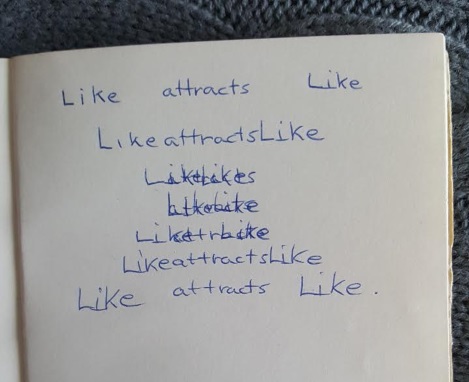
FOUND: In the back pages of my copy of “waiting for godot”, circa 1974, University of Victoria.

godot

I may not have been the pointiest spike in the railroad, but I doodled well.

But, shouldn’t the likes have stopped when they met in the middle? Maybe they collided and then rebounded back out? Or maybe they just went hurtling by each other; having just missed, like trains on parallel tracks?

Like trains attract like trains.

364e85ff00000578-3691573-image-a-11_1468586522513-trains

I suppose, having sped by one another, they would have slowed until they reached apogee and, inch by inch they would each creep backwards; ultimately accelerating until they sped by in the reverse harmonic. Over and over.

Friction, steadily exhausting the propellant energy of attraction, would ultimately slow them to the point where they stopped and rested beside one another.

The like trains would lie together, trembling with unfulfilled attraction, aching to rest as one on the same track at the exact same instant.

Is that good or bad or some of both? Or neither – it just is? 

allfornow – Mitch