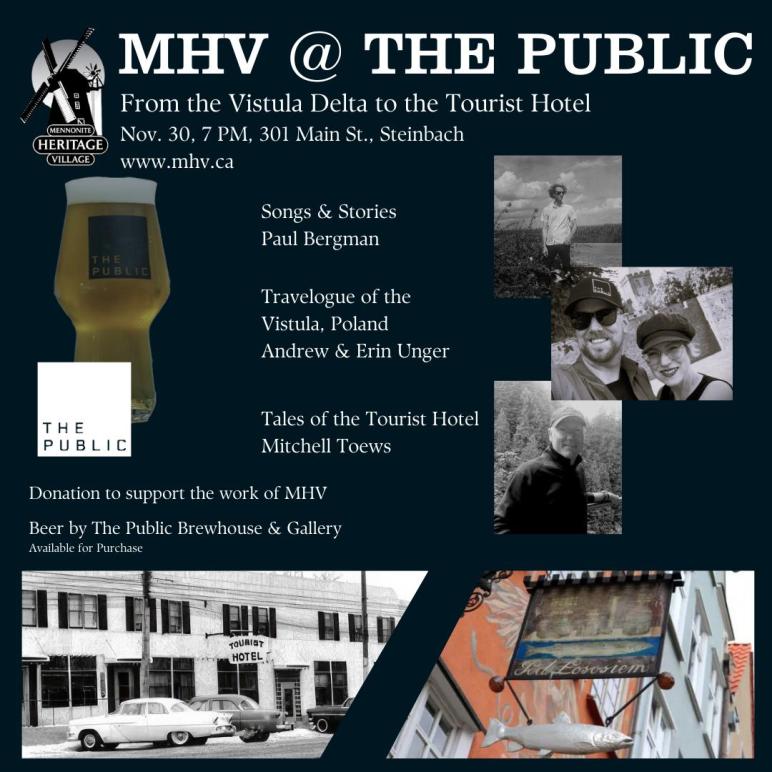
Minus the scuttling of rats and absent Blues Traveler, Joni Mitchell, George Carlin, Hettie Jones, and the Reverend Bob Dylan, Steinbach’s The Public Brewhouse and Gallery did a strong impression of one of the halcyon NYC music-drinks-spoken word shrines of the Sixties, Mennist style. https://thepublicbrewhouseandgallery.ca/
I felt during this evening the “crackle of the universe,” to quote William Burroughs, who—if he was a Mennonite, wasn’t very good at it. Or was maybe extremely good at it. Opinions vary. (He prooooooobably was not a Mennonite. Possibly a Lutheran.)
Mennonites were on tap because it was a FUNDRAISER for the Mennonite Heritage Village Museum, arranged by departing executive Nathan Dyck. A fine vocalist, as it turns out—no great surprise as so many Mennonites are good singers. It’s true, scientific, even. Ask any CSNY (Cornie Stoesz or Neufeld, Yasch). https://mennoniteheritagevillage.com/
Literati Erin Koop Unger and Andrew Unger led off with a travelogue deep dive into the Mennonite enclave that was the Vistula Delta in northern Poland. Their visit to the region generated a fascinating study in Mennonite history from the time when many Anabaptists were “encouraged” to leave the Lowlands of western Europe and found a home in G’dansk, a place of flood and relative religious tolerance. https://www.mennotoba.com/ https://andrewunger.com/
Paul Bergman entertained with music in two rhythmic, jazzy, silky sets that offset the historical mood and gave us some stardust for our beer. https://paulbergmanmusic.com/
I chimed in with some historical factoids from Ralph Friesen’s “Prosperity Ever Depression Never” and other other pub-style fare. I told two extemporaneous stories about personal experiences at the Tourist Hotel, but I think those went unrecorded. Here’s my written text:
I’ll begin by giving you some historical context for the Tourist Hotel, and its alehouse, the likes of which first began in Roman Britain, and according to Wikipedia, one of the most longstanding of which is “Sean’s Bar, in the medieval town of Athlone in the Republic of Ireland… the oldest pub in Europe, dating back to 900 AD.”
More recently, here’s a reading from “Prosperity Ever Depression Never” by Ralph Friesen, Pages 49-50:
[…] (“On Main Street, next to Abraham A. Toews Five Cents to One Dollar store) was the Steinbach Hotel. The hotel, beer parlour included, was owned and operated by Henry Coote, who grew up on a Mennonite farm as one of thousands of British “home children” sent to Canada because their families were too poor to care for them. Immediately next door was another hotel, the Tourist Hotel, built in 1927 by the Peter B. Peters family… descendants of Jacob Peters who had led the Bergthal Colony Mennonites in the 1874 immigration. In 1931… the Peters family bought (Coote’s Steinbach) hotel… running both the Tourist and the Steinbach hotels… In 1934… the Peters family collaborated with Hugh McDiarmid, a retired RCMP officer to apply for their (contentious beer parlour) licence, and this strategy worked…Steinbach remained “wet” for… decades.”
And from Barry Dyck, a Retired Executive Director of the Mennonite Heritage Village, in a mySteinbach article titled, “A Look Back at Steinbach’s former Tourist Hotel:
[…] “The Tourist Hotel… (did business) on Steinbach’s Main Street from 1928 to 1976… In 1930 it expanded to include a dining room and a “men-only” Beer Parlour. The parlour was not without controversy, however, and efforts were made to close it. In 1950 Steinbach voted for the prohibition of liquor sales. However, a separate vote of 398 to 214 allowed the Tourist Hotel beer parlour to stay open under a grandfather clause.”
And now, my own story about spending a night at the Tourist Hotel. “So, in January of 1969, when I was fourteen… ”
~ ~ ~
Next, to bring you to the wide world of bars and beer and drinking establishments—maybe some a bit different than The Public and the Tourist Hotel—here’s a fictional story about another public house. Imagine a saloon in the Irish village of Nobber (where one of my sons-in-law was born), a dimly-lit place dedicated to the sale and consumption of liquor, where they might have a pool table or a jukebox (perhaps playing “Mama Told Me Not to Come” by Randy Newman) and maybe some pickled eggs in a large jar made unappetizing by the presence of indistinct organic flotsam suspended in the yellowed vinegar… as if someone shook out a dusty rag into it. We enter the establishment near closing time when the barkeep and three male customers are the only occupants... (pensive music in background)

One Night at Keogan’s
“If you drinks in this bar, you buys me a pint. Or else.”
I’ve removed the text with the hope that I can sell the story and have it appear somewhere else.
~ ~ ~
Keogan’s Bar is a place you may have visited or might want to, just for the experience. In the case of the Tourist Hotel Beverage Room, you could have visited, as long as you were not a woman. Neither could women tend bar there—of the hundreds of thousands of watery draft beer pulled in Steinbach, none of them were drawn by a female hand. Steinbach was not the only one to have that gender bias; it was relatively common in places as far-removed as Warman, Sask., Winnipeg Beach, and The Terminal Club in Vancouver. In the Sixties, a small glass of beer was—by Manitoba Provincial law—15-cents in a men’s only beer parlour and 25-cents in a beverage room that served women. In 1978, I had a beer with a female co-worker at a soccer-mad tavern in Toronto where women were admitted but not served. This was explained to us and I bought two draft and gave her one of them, as our waiter suggested. (Apparently, gifts were allowed.) So in keeping with these thoughts, and to put you in a fighting mood before I tell my next story, here is a poem by Danielle Coffyn:
If Adam Picked The Apple
There would be a parade,
a celebration,
a holiday to commemorate
the day he sought enlightenment.
We would not speak of
temptation by the devil, rather,
we would laud Adam’s curiosity,
his desire for adventure
and knowing.
We would feast
on apple-inspired fare:
tortes, chutneys, pancakes, pies.
There would be plays and songs
reenacting his courage.
But it was Eve who grew bored,
weary of her captivity in Eden.
And a woman’s desire
for freedom is rarely a cause
for celebration.
~ ~ ~
Finally, here’s a story I also experienced first-hand, which might be called Können Frauen hier kein Bier kaufen???


 Mitchell Toews