After Janice and I sold our manufacturing business in 1996, I ended up (after being a very bad office manager for some very good lawyers) working for a series of conservative Mennonite wood manufacturing companies as “that creative guy.” My role was to do the unseemly work of marketing and advertising. Come up with some shit. You know… imagineer. (Aiyyyeee! That word is like giving an AMC Gremlin to the head designer at Ferrari.)
Before I go on, let’s check the relative humidity here. As a “creative guy,” I’m somewhere on a scale. I am not likely to be named Artistic Director for Exile magazine; not likely to die my hair blue (both of them); not likely to get in a scrap with David Cronenberg because my ideas are, “too out there, Toews!” At the same time, my ideas were more than enough “out there” to send the sucking-up-to-the-boss running dog types scooting like scalded greyhounds for the dark corners of the break room, where they would loudly rattle their dog-collars and profess to be regular folks incapable of such wild ideas.
Anyway, today I find myself somewhere between my old scramble for existence (marketing and advertising) and my new scramble for existence (literary fiction). And no, dog-collar people, the two are NOT the same.
I am working diligently to complete my manuscript and set my collection of short stories loose on the world. There is a hurry-up-and-wait aspect to this and during the in-between times, I get restless. Something that occurred to me in a slightly Cronenbergian moment was a set of icons that offered a graphical depiction of the themes present in my made-up stories. I used my prodigious Paint.net skills to render a 4X4 grid of images.
The result is the orderly graphic collage that headlines this post. The effect appeals to my Andy Warhol gene and I like how the iconography drops hints like a visual Johnny Appleseed. I have not spent time getting the size and hue and style at a harmonic pitch, but it’s good enough for a concept. It imagineers. (Ugh.)
And that’s where I find myself—wallowing like a hungry Menno in the nether region between artistic expression and INTEGRATED MARKETING. My old prof at York (the Pepsi-Challenge guy, Alan Middleton) would be pleased but I’m pretty sure my publisher will heave a big sigh.
Anyway, that’s my sitch. I am (just barely) smart enough to listen to my publisher and ignore my fond memories of Prof. Emeritus Middleton’s old lessons (“Put lye in the Coke…” JUST KIDDING!)
But you know that inside my busy little blue head, there is a steeplechase going on with wild ideas running around like crazed dogs.
Bookmarks
Mousepads
Coasters
Product placement in Mennonite movies
T-shirts
Posters of dangling kittens wearing the T-shirts (it can’t be ALL about dogs!)
Fridge magnets of Menno Simons wearing one of the T-shirts (it can’t be ALL about David Cronenberg!)
So, be ready to buy the book. First 100 purchasers get a free TRAVEL MUG.*
___
*Also just kidding. Shipping extra.
My collection of short stories, “Pinching Zwieback” (At Bay Press) will launch in FALL 2023.
Please feel free to share this post! I welcome all comments.
“But words are things, and a small drop of ink, Falling like dew, upon a thought, Produces that which makes thousands, perhaps millions, think.”
—Lord Byron (1788-1824)
This posting was edited and updated on September 25, 2024.
Timewarp: 1974 me (Photo: Rob Fast)
Note: some of the images and statistical details in this article contain sensitive content.
While preparing a study session article for my writing group (the Write Clicks) about “Writing the Other” with my focus on older adult characters, I take a break. I slurp up a bowl of plain yogurt mixed with turmeric, organic blueberries, and hemp seeds. It’s a snack few people below a certain age—I’m unsure of what that age is, precisely—would eat. Pretty sure I would not have eaten this slop in 1974.
I pause, mid-antioxidant, in front of the TV where a 25-year-old woman discusses how she feels isolated because of her age. She feels old. Oh?
There it is. “Age” in all of its imprecise, vague, fluid, and ambiguous glory.
The woman, one many would readily term a younger woman, is a U.S. Olympic figure skater and her presence on the team is, in statistical terms, an anomaly. The 25-year-old figure skater feels “old,” even though— only days later—a 35-year-old woman wins gold in speed skating.
Context is everything.
For our writing, how do we define the terms: Old, Older, Older Adults (AP and other style guides’ preferred term), Older Persons (another benign choice), Older Writer, Older Author, Older Artist, Elder, Elderly, Aged, Senior, etc.? I’m not sure if any clear-cut definitions can be applied.
While definitions are tricky and may not be necessary, it’s important to use words that describe individuals and groups accurately and without bias or inference, intentional or otherwise.
To be honest, I began this process—researching and preparing an essay on age and ageism in writing—with a sense that I was a part of the stigmatized cohort and therefore had an intuitive, insider perspective. I am a 66-year-old (born in 1955) emerging writer and I have experienced many of the negative situations older people commonly endure. I frequently find examples on “writer Twitter” that are demeaning towards older emerging writers.
While all that is true, it’s also true that there are many others who suffer far more than me. Those who are older than me (not all but some); those who struggle financially, older adults with serious mental or physical health challenges, those who live alone or reside in remote locations or those in regions where exploitation, neglect, abuse, and violence towards older men and women is endemic—all these tolerate more than I. And what of older individuals who also are part of other marginalized, stigmatized, or mistreated groups?
I also need to confess that deeply embedded habits and preconceptions still live on in me despite my recognition of my own advancing age and despite my best intentions. My personal age bias persists. With respect, I suggest you check your own—I’d be surprised if you didn’t find that you too have entrenched beliefs and your vocabulary is rife with problematic (maybe even ageist) word choices. Our society has entrenched in us a vernacular of systemic bias towards older populations.
That’s the point, isn’t it? To become aware of the insidious microaggression of “slings and arrows1” and to stop their proliferation in literature. Ideally, we will embrace better choices and enact our own individual programs to stop the underlying mindset that gives permission to ageism.
Certain phrases and once socially acceptable sayings most people today to experience feelings… Feelings that extend beyond the superficial message in the statement. Take for example, “That’s women’s work.” Say it aloud to yourself. Feel it? An uncomfortable sag in your mood? Depending on your point of view, your feelings may run from “So what?” to “How the eff could that ever have been acceptable?” For most today, I believe, this obsolete, misogynist phrase never was-never can be acceptable. It was insidious and powerful in its time and those who used it as a verbal weapon knew what they were doing. What they were really saying had to do with their view of order: “Males are superior; females are inferior.”
Now, what about age and ageism, today? My observation is demeaning stereotypical statements concerning older adults are not only common but are often given tacit permission and validity by tepid or nonexistent rebuttals. Where is that “uncomfortable sag” when we hear someone described as “just an old fool?” This slur implies that most older adults suffer from dementia, or what used to be called “senility.” And, while we’re on the topic, the etymology of the word “senility” is derived from an ageist source:
Like gender bias, age bias has many false comforts built into the language; into the mindset. Our society still stubbornly accepts most ageist stereotypes as truth. We are conditioned to allow this.
“He’s just having a senior moment…” Stereotyping: seniors lack mental acuity.
“Well, I think it’s just ADORABLE to see her try to waterski!” Condescension or belittling behaviour: treating older adults as if they were children. Another example, one that takes sharp aim at appearance and our enslavement to youth is the title of Editor/Contributor Rona Altrows’ collection of essays, short stories, and poetry, You Look Good For Your Age. Discussing the original idea for her book, Ms. Altrows writes:
“I returned to the same respiratory therapist for my annual checkup. I told her that her words to me, ‘You look good for your age,’ had inspired a book. ‘Wow!’ she said. ‘You wrote a whole book about that?’” —You Look Good For Your Age, The University of Alberta Press, https://www.uap.ualberta.ca/titles/985-9781772125320-you-look-good-for-your-age
“Blue Hairs… Porcelain Hips… Silverbacks.” Caricaturing: Using insulting names like these or “geezer,” “old fart,” “old bag” to let a perceived attribute or broadly applied characterization represent an entire group of people.
Even more deplorable are these two aces in the caricature deck: “Angry Old Man” and “Crazy Old Lady.” These two pejoratives herd all ages and personalities into a single, stigmatic “type” that is at once degrading and handily gender specific. These objectional phrases in fact draw few actual objections.
Then there is the everyday salad bar of feckless labels… A plethora of crudities, code-words, and depricating blanket descriptors:
stingy, creepy, smelly, unpleasant, needy, baffled by technology, slow-witted, simple, demented, senile, incompetent, weak, slow-moving, unfit, has-been, stuck in the past, indifferent, uninformed, uncool
sexually inactive, unattractive or perverse (take your pick or choose column C: [] All of the Above)
Had enough? Me too.
Society has made progress towards de-normalizing negative language and attitudes towards women, and increasingly, towards other groups for whom a history of bias and discrimination exists: look at race, religion, sexual nature… So why is it seemingly still OKAY to malign older individuals?
Furthermore, how can we reduce the importance of age in our assessment of older people, without disregarding the positive aspects of age? How can we properly and appropriately recognize age and approach older adults as equals, albeit ones with a differing set of circumstances, experiences, and background references, among other things?
Once again we must ask, “who—exactly—are ‘the old?’” Finding one definition seems improbable. We need to incorporate individual, circumstantial factors.
Without fail and throughout our lives, every one of us is viewed as if through a constantly shifting kaleidoscope of age: Seen simultaneously by some as “old” and by others as “young.”
II. Diminishing Harm; Normalizing Ageism
Is ageism really that big of a problem? Does ageism compare to racism or misogyny or other societal bias and discrimination? If you really, really love your grandmother, for example, how could you possibly harbour ageist thoughts or sympathies?
Like me, I suspect many of you will start out with a “no-no-no way” self-assessment. Part of what is entrenched in systemic ageism are the diminishing arguments that seek to uphold what we’ve come to see as norms. So, please be wary of blinders you may have in place and take a hard look.
If we don’t honestly confront our own embedded ageism we won’t be able to keep it out of our writing.
“It seems to me that this determination by the non-elderly is a consequence of the death-denying culture in which we live, where youth is overvalued, the middle-aged control the world, and the old are perceived as useless, and therefore, better dead.”
—Sharon Butala (Officer of the Order of Canada) in “This Strange Visible Air – Essays on Aging and the Writing Life”
Butala is not alone in her unflinching appraisal. The Gerontological Society of America sees ageism as having its roots in a kind of hateful miasma, utilizing violent terms like “Coffin Dodger” and “Boomer Remover.” They see a condition in which,
“The rhetoric of disposability underscores age discrimination on a broader scale, with blame toward an age cohort considered to have lived past its usefulness for society and to have enriched itself at the expense of future generations.”
It’s worth reminding ourselves too that, according to the World Health Organization global study, “15.7 percent of older people—or almost one-in-six—are victims of abuse.”
The grief of older people and their plight in our society is greatly undervalued.
This meme is extreme. Few would side with this repugnant comment, but it is in the public domain. No one objected. The online forum did not remove it. In fact, it presents, in my opinion, a perfect example of hate speech and that’s why I shared it—to expose it; for “situational awareness.”
Older adults are unfailingly “young adjacent.” In the everyday workday life of older writers, specifically, there is no escaping to a separate generational safe room where ageism is non-existent. Older writers must operate in the presence of—and sometimes in spite of—those who may wish to denigrate, stereotype, and caricature older adults in their writing and express negative sentiments toward older writers in their writing practices.
2024’s Threads, said to be a “kinder, gentler” forum for writers recently contained a lengthy discussion on “old people” ending with a classic, phobic, toxic “some of my best friends are old and I don’t mind them,” comment from a self-described “young writer invested in life-long learning.”
A recent article in the Canadian literary source, Quill and Quire, stated that approximately 77% of the writing jobs in Canadian literature were held by those age 40 or less. (I don’t have a citation for this, but welcome a correction or a confirming citation.)
The artistic lives of older writers are inextricably interwoven with younger writers, editors, publishers, critics, reviewers, and others who have a say in our professional fate.
Lunatic Fringe?
Ageists are not confined to a small group of outliers. For a present-day, real-world indicator of the state of ageism and its potential for negative influence, consider the Covid experience, worldwide.
“Whether it’s the impacts on their own health or losing their jobs or the isolation or exclusion from treatments [COVID-19] has really shone a light on ageism,”
While older adults (statistically, slightly more men than women) are always going to lead the mortality percentages over more youthful cohorts—not surprisingly, age is a strong predictor of death rates—older Canadians had this statistical abnormality: in 2020, there was a statistical jump of 11,386 more deaths than the long-standing norm, for all age groups. Of these, the cohort of those age 65 or greater recorded 78% of those 11,386 anomalous deaths. This can be attributed to no other factor than Covid.
Covid has revealed a tear in our social fabric and is chilling to consider.
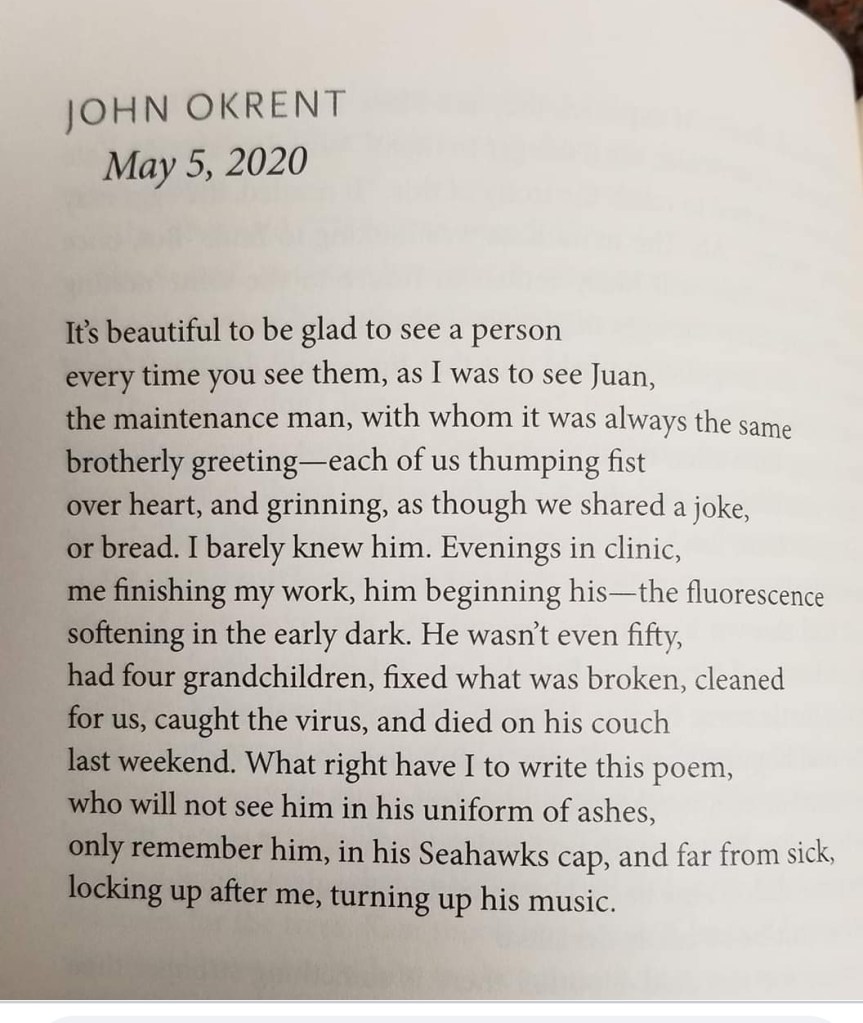
Furthermore, for the many older adults who also overlap certain other marginalized populations (experiencing the effect of intersectionality), there may be an even greater and more shocking comparative “excess” death rate. John Okrent’s moving verse touches on this and offers inspiration to us as writers.
Last, we would do well to remember that older adults represent a significant portion of the Canadian “patchwork quilt.” In Canada today, StatsCan estimates, “Almost one in five (18.5%) Canadians are now aged 65 and older.” This segment is growing—if we assess the number of older characters in Canadian literature today, will it reach 18.5%? Representation, as they say, matters.
Moreover, Saskatchewan Seniors Mechanism reports in Ageism and Media in Saskatchewan, that: “By the year 2050, it is predicted that the number of older adults will exceed the number of younger persons to reach approximately 22% of the world’s population”
—Abdullah and Wolbring 2013; Nosowska, McKee, and Dahlberg 2014
This situation cries out for our attention. It begs our activism as citizens first, but also as writers and communicators because we can so effectively lead by example, help to inform public opinion and drive change in popular culture.
“Ageism can operate both consciously (explicitly) and unconsciously (implicitly), and it can be expressed at three different levels: micro-level (individual), meso-level (social networks) and macro-level (institutional and cultural).”
—Determinants of Ageism against Older Adults: A Systematic Review
III. There are Many Negatives—What are the POSITIVES?
Negative media and gut-turning examples abound (see the images below, if you still doubt that) but we need some positive input to balance the scales and keep us from smashing all the dishware.
Strive for Positive Words
Avoiding negative communication is half the battle.
As artists, we must strive for positive words and phrasing. There is much to be admired in older adults and also in the uplifting canon of writing about elderly individuals. I cite John Okrent above and Old Man and the Sea a bit further on. Here are several other exemplars from my own bookshelf:
—The older characters in The Grapes of Wrath. Steinbeck’s characters, by the way, were drawn literally from real life. He embedded as a documentary journalist with a large group of migrants heading west and his The Grapes of Wrath characterizations were hybrids of the behaviour he witnessed first hand.
—Fight Night, Miriam Toews’ shining, unafraid story of an older woman living out the last joyful but complicated months of her life and the descriptions of her loving—but often fractious—family relationships is a superlative guide. It is an insightful, true depiction of a singular character who, more than anything, “wanted to be in the thick of things!” She did not allow systemic ageism or the social stigma of age or her physical challenges stop her.
—Moonlight Graham is one of my favourite literary characters. W.P. Kinsella brings the character to life in the novel Shoeless Joe. It’s a rich and complex template for writing about an older adult character.
[…] “That’s what I wish for. Chance to squint at a sky so blue that it hurts your eyes just to look at it. To feel the tingling in your arm as you connect with the ball. To run the bases – stretch a double into a triple, and flop face-first into third, wrap your arms around the bag. That’s my wish,”
—Moonlight Graham, in Shoeless Joe, discussing his dream to have an at-bat in a big league ball game
The Graham character expresses his wish, not in terms bound by time or constrained by a stereotypical view of an older person’s body, but rather from the viewpoint of a strong ballplayer, ready to take on the mental and physical challenges that create a definition of who he is. It’s how he sees himself and how we see him too.
—And yet, age is not imagined. Our bodies change and that can include our mental and emotional state as well. There’s no need to sugar-coat this or pretend that an end to life is not real. This must be faced for what it is. Who better than a poet to take this on?
[…] “You live a while and then time happens…
his knobbly hands lying on the white sheet blue almost grey ridges of blood running across his hand’s map his thin arms the pale blue top nurses tied in bows at his back his brown eyes you could see through if you weren’t afraid…“
—Patrick Friesen, The Shunning
—Here’s another moving example: an adult son considering his father’s later-life adversity. It is written with respect and honesty. An excerpt from Ralph Friesen’s lovely memoir, Dad, God, and Me.
[…] “(Mom) called the next morning to say that Dad had died…I hung up the phone, went to the living room, and picked out a Peter, Paul, and Mary LP from the stack on the table…The trio of voices, so harmonious, celebrated Stewball, the legendary racehorse: ‘Oh way up yonder / Ahead of them all / Came a prancin’ and a dancin’ / the noble Stewball.’Tears started in my eyes; I did not know why. Today I think of the song as an ode to my father, who had always put himself second, who abjured dancing, who was humble and slow-moving. Now, released from his pain-body, he was a beautiful thoroughbred, dancing proudly, crossing the finish line first.” https://www.youtube.com/watch?v=hXdQB-mR4tg
IV. If Only There Was a Style Guide.
In Gregory Younging’s brilliant, Elements of Indigenous Style – A Guide for Writing By and About Indigenous Peoples, the author covers the full spectrum of do’s and don’ts and (in my estimation) a few “Hell, NOs!” Older adults and those who write about/depict them could take some pages, literally, from Younging’s book.
Elements of Indigenous Style outlines 22 principles of Indigenous style. The author goes into detail and these tenets are specifically Indigenous, not “cookie-cutter.” It’s worth noting too that in Elements of Indigenous Style the seventh Principle is “Elders.”
“Indigenous style recognizes the significance of Elders in the cultural integrity of Indigenous Peoples and as authentic sources of Indigenous cultural information… Indigenous style follows Protocols to observe respect for Elders.”
Page 100-101, “Elements of Indigenous Style – A Guide for Writing By and About Indigenous Peoples,” Appendix A. Brush Education Inc. 2018.
Younging’s work concerning Elders, in particular, could be seen as a trailblazer and inspirational matter, and writers depicting older adults of all “race, creed, colour, and religions” can draw substance from this work.
A similar groundwork—an “Older Adult Style Guide” perhaps—is needed. Something with Elements of Indigenous Style‘s comprehensive nature; a Strunkian Elements of Older Adult Style.
Happily, such a guide DOES exist! In fact, more than ONE!
Words are Powerful A Style Guide for Writing and Speaking — avoiding ageist concepts and language
An excellent publication from nearby Saskatchewan is Words are Powerful. A link to the PDF and the website is included and I’m sure readers will find this to be an excellent source.
For this resource and more, please see Other Reading, below.
V. A Style Guide for Older Adult Characters, Scenesand Stories
[…] “analysis of past and present literature shows that the aged have been stereotyped and portrayed negatively. By not assigning them a full range of human behaviours, emotions, and roles, authors have categorized them, resulting in ‘ageism’—discrimination against the elderly.”
—Anita F. Dodson and Judith H. Hauser, “Ageism in Literature. An Analysis Kit for Teachers and Librarians.” 1981 (Sponsored by U.S. Dept. of Education.)
It’s cogent to note that the conditions found in the 1981 study cited above have not changed much. For me, this status quo suggests that if there are no rules, the lowest common denominator will continue to prevail for older adults in literature. (The biggest bully wins… well-known to schoolteachers, bartenders, and parliamentarians.) So, as a point of embarkation, here are a few basic ground rules for those writing about older adults as “the other:”
1. Examine your reasons: exactly why is it necessary for you to write for or about someone outside of your own experience, in this particular situation? Could this better be left for older adultauthors to take on? #ownstory
Confession: I’m in the camp of wanting lots of writers to write about “the other;” about older adults. The more often older characters appear, central to the plot and treated as equals, the better.
2. Recognize and avoid “young saviour” syndrome.
3. Do your homework. Know the issues. Read older adult authors. Go to their places, meet with older adults, listen, observe, participate. Ask.
4. Review your draft with older adults. Consult with accredited individuals or those recognized by peers. (You might have to pay them.)
5. Assign older characters to main character roles and place them in a diverse range of occupations and settings.
6. Older adults do not necessarily see themselves as “OLD,”or at least, not entirely.Writers must capture this aspect of self-identification when they write older characters.
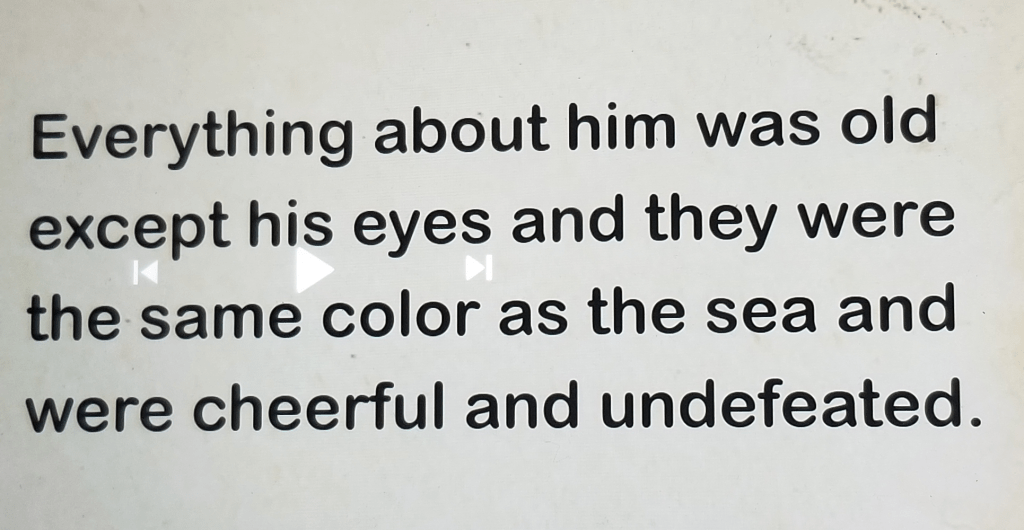
—Ernest Hemingway, describing the MC, “Santiago” in “The Old Man and the Sea.”
Sidebar: The Cojimar fisher upon whom Hemingway based the Santiago character was late forties-early fifties. So “old” as a definitive description is assailed once again.P.S. — Canadian Prime Minister JUSTIN TRUDEAU, who is often used as an example of youth, was born in 1971, putting him in his early fifties.
7. “Older Adults” is not a homogenous or coherent group*—it is as diverse as any younger group in all categories including AGE.Recognize and avoid cliched older adult tropes
8. Older people may not always want to be judged by “young” standards. Older adults are not “failed*” or “under-performing” young people, THEY ARE THEIR OWN DISTINCT COHORT. Furthermore, like other groups who are made invisible by prevailing bias and discrimination, older adults want to be seen as individuals and not just as an interchangeable part of a group or category.
9. Attack your own bias. Seeing, revealing, and dismantling your own personal prejudices will unlock a sense of honesty in others. (And free your writing from a disingenuous constraint.)
10. WHAT IS MISSING FROM THIS LIST?
VI. Conclusions
1. Ageism is unique and distinct from other similar social problems. At the same time, the approaches used successfully by other systemically marginalized groups can be considered and may be adapted to combat ageism.
2. Ageism is no less serious than other forms of discrimination or bigotry.
3. It is within the scope of art, including all kinds of writing, to uplift older adults and address ageism directly and at the source.
Other Reading:
1Treatment of the Elderly in Shakespeare Shakiya Snipes Denison University
One Last Thought…I’ve made over 700 submissions to literary markets in Canada, the U.S. and the U.K. since 2015. In my experience, I’ve seen ONLY ONE submission guideline that prohibits ageism by name: Agnes & True, see below. (If you find another, please place a link in the comments!)
More positively, here is the formal submission guideline from one of the largest circulation literary periodicals of the past three decades, Tin House. They address prospective authors in a Diversity, Equity, & Inclusion statement crafted with care and specificity.
“In particular, we are looking to engage with work by writers from historically underrepresented communities, including—but not limited to—those who are Black, Indigenous, POC, disabled, neurodivergent, trans and LGBTQIA+, debuting after 40, and without an MFA.”
As noted above, a Canadian literary periodical that is noteworthy is Agnes and True, which […] “celebrates the achievement of women…” and also states, “In addition, we are particularly interested in discovering and publishing the work of emerging older writers,” and “We also do not publish work that is racist or sexist or ageist or that would incite others to become racist or sexist or ageist. We reserve the right to define all the above-mentioned terms for ourselves.”
I’ll also add that it is perplexing to see Agnes & True as the only Canadian literary periodical/journal/review that explicitly sets out age/ageism as intolerable. Winnipeg’s Prairie Fire recently took a bold step by publishing a (exceptionally popular) “50 Over 50” collection—a landmark, age-related moment in CanLit. (To be clear, men and non-binary individuals were not included in this submission call.)
I know from personal experience that there are numerous Canadian literary markets that accept work from older writers of any description. My hope is that they will soon feel comfortable enough to stipulate to this, in print, in their DEI statements.
(NOTE: The Canadian Charter of Rights and Freedoms sets ample, legal precedent for publishers: discrimination based on age is prohibited in Canada.)
DEI Addendum
September 25, 2024: During my recent submissions and while prospecting for short story markets I came across these Diversity, Equity, & Inclusion statements in U.S. Publications. There appears to be a discernable surge in the number of top literary markets and affiliated organizations, universities, and other publishing bodies that explicitly specify AGE and AGEISM in their public DEI statements.
Besides Tin House, mentioned earlier, here are some “big market” American examples of how Ageism’s long reign as a covert, modern-day “scarlet letter” seems to finally be coming to an end:
“We are seeking writers whose work speaks to issues and experiences related to inhabiting bodies of difference. This means writing that centers, celebrates, or reclaims being marginalized through the lens of race, ethnicity, gender, sexuality, age, class, religion, illness, disability, trauma, migration, displacement, dispossession, or imprisonment.” —Adina Talve-Goodman Fellowship, Brooklyn, New York
~~~
“Shenandoah aims to showcase a wide variety of voices and perspectives in terms of gender identity, race, ethnicity, class, age, ability, nationality, regionality, sexuality, and educational background (MFAs are not necessary here). We love publishing new writers; publishing history is not a prerequisite either. “ —Shenandoah Literary, Washington & Lee University, Lexington, Virginia
~~~
“The Paris Review is an equal opportunity employer. We evaluate qualified applicants without regard to race, color, religion, sex, sexual orientation, gender identity, national origin, disability, veteran status, age, familial status, and other legally protected characteristics.” —The Paris Review, Big Sandy, Texas
~~~
“Furthermore, we’re interested in working against past and present inequities by publishing work by individuals from systemically marginalized groups, including writers of color, nonbinary and trans writers, members of the LGBTQIA+ community, neurodivergent writers, disabled writers, working-class and low-income writers, older writers, and all others who consider themselves underrepresented in contemporary literature.” —The Cincinnati Review, the University of Cincinnati
~~~
Sidebar: Cincinnati Review Managing Editor Lisa Ampleman further reported, “When we did a survey two years ago, attention to older writers was one of the major requests from those who took it.” (9.25.24)
Please feel free to share this post! I welcome all comments.
Manitoba writer Mitchell Toews will be among those doing readings of flash fiction & excerpts from longer work at ArtSpace May 25 Noon-2 PM on the fifth floor (up on the roof, weather permitting).
Each building tour, on the half-hour, will stop for a brief reading: Seven-minute excursions into the boreal, towards the dim light, to the bottom of the sky, and screwed to the sticking spot, all for free in the 119-year-old Gault Building, now home to ARTSPACE.
Readings may include selections from:
“I am Otter”
“Sweet Caporals at Dawn”
“A Plum of a Night” (for groups with lots of little kids)
“Operation Night Bandit” (for groups with lots of exhausted young moms)
“Pinching Zwichack”
“In the Dim Light Beyond the Fence” (for groups with more than one Blue Jays cap in evidence)
The opening sequence of “The Fisherman’s Story”, Part Two in a trilogy.
“Wide Winter River”, an excerpt from the short story, “The Margin of the River”
“I try to write about everyday people and events, but to see the drama in these lives. Regardless of whether the story takes a turn towards humour, or sorrow, or action, or even fantasy, I often come at it from an underlying perspective of hope, often with a good dose of emotion and courage in the mix.”—Mitchell Toews
49.898064 -97.141090
Please feel free to share this post! I welcome all comments.
My stories—and everyone else’s—spring from life. Life lived, life observed, life imagined. Life reconstructed.
A vital part of each story—and each life—is place and time. Truths from one era or one location or one moment in a given journey alter and define the future.
Driven by my own curiosity, here is a roll-call of Place, Time, and basic protagonist context from my stories:
i — “Encountered on the Shore” A university student makes an unsettling discovery in downtown Winnipeg, in the fall of 1973.
ii — “A Vile Insinuation” During the summer following, the main character from “Encountered on the Shore” considers fate and blessings at a baseball tournament in Vita, Manitoba, near the US border.
iii — “Without Reason” Now retired, the MC from “Encountered” and “Vile”, is diagnosed with cancer and he considers his plight and that of others like him. Set in his small Mennonite prairie hometown, current day.
i — “Zero to Sixty” A retired man is attacked, near Christmas in Chilliwack, BC, current day.
ii — “The Margin of the River”and the audio except,“Wide Winter River” The MC from “Zero to Sixty” considers what happened the day before and sees first hand the inequity and sorrow that is built into life. All life.
“The Rothmans Job” An odd couple set out on a dubious nighttime caper during a fierce winter blizzard in Winnipeg, during the 1970s.
“South of Oromocto Depths” A teenage boy gets into a foolish skirmish with his father on the Victoria Day long weekend in 1971 New Brunswick.
“Nothing to Lose” A former hockey player looks back on his life and his regrets in rural Manitoba during the dusty heat of summer, in the Sixties.
“Heavy Artillery” A young baseball fan in 1962 becomes embroiled in adult suspicion and prejudice in a small prairie town — predominantly Mennonite. (The imaginary, recurrent town of “Hartplatz, Manitoba”.)
“A Fisherman’s Story” In 1970, on the Mexican Pacific coast, an elderly woman and her young daughter are dealt an unfair hand. (P.S. — the prequel and the sequel to this story appear in the trilogy “The Bottom of the Sky”. See link below.)
“The Fifty Dollar Sewing Machine” A straight-laced Mennonite husband and wife take on danger in a dark Winnipeg alley in 1934. (Rerun on Literally Stories, Feb 17.)
“Frozen Tag” A man encounters a strange reprise from his past (at the Minneapolis Athletic Club in 1980) in the Chilliwack Leisure Centre, current day.
“The Business of Saving Souls” A youth pastor in the fictitious city of Tribune, in the northern US Midwest meets challenges in the sanctuary of a gleaming megachurch, current day.
“The Preacher and His Wife” Palace intrigue, Harplatz style, throws a family into an untoward uproar in the 1960s.
“I am Otter” A shunned congregant discusses culture, power, and enfranchisement with a stranger near a lake in Manitoba, current day.
“Graperoo” A piece of Graperoo bubblegum experiences the four seasons in rural Manitoba in the Sixties.
“So Are They All” It’s September 1961 and a young boy receives an education in loyalty and courage in his grandmother’s country raspberry patch.
“The Seven Songs” A middle-aged Canadian man meets a local contemporary at a resort in Mexico, current day.
“Fall From Grace” A boy gets stuck in a fraught adventure and learns about his father through it in the heat of a prairie summer in Hartplatz, 1963.
“Away Game” A 50-something man meets with an older family member at the side of a dreamy, summery lake in Manitoba’s boreal forest, current day.
“In the Dim Light Beyond the Fence” The reader travels back into Canadian small-town hardball with the MC, reliving a fateful doubleheader from the Fifties.
“City Lights” A small-town “up-and-comer” gets in over his head in Toronto, current day.
“Groota Pieter” Spring softball in small-town Mennonite Manitoba is described, from the Sixties to current day.
“Sweet Caporal at Dawn” On a moody Manitoba morning near a spring lake, a youngster and an older confederate fish for pickerel during the mid-Seventies.
“The Bottom of the Sky” A trilogy that follows a “pinche” cabin-boy and the ship’s captain on a fishing charter boat from 1955 Acapulco to the future in a fishing village in the Seventies. (P.S. – If you’re inclined, give this story a read and tell me if you think it could be adapted into a screenplay. I see it in flickering snatches of film in my head and just wonder if that occurs to anyone else. If you’re a screenwriter or in film, I’d love an opinion — tough love included. —mjt)
“Shade Tree Haven” An adult remembers more than he cares to as he thinks back to summers at a favourite swimming pool in the early 1960s.
“The Narrowing” A sensitive boy and his straight-ahead grandfather go through a harrowing experience in the Manitoba wilds, current day. An important secondary character in Abbotsford, BC is part of the story.
“The Phage Match” In a surreal radio broadcast from somewhere in Canada, current day, the evils of drug addiction are the backdrop for some strange characters.
“Died Rich” A high school freshman in a frigid southern Manitoba winter in 1961 struggles to endure.
“Concealment” A fledgling Manitoba business traveller gets more than he expects on a springtime trip to the Atlanta Zoo in the 1980s.
“Mulholland & Hardbar” (Novel WIP) A troubled youth experiences the four seasons in the Canadian Shield: love, friendship, deceit, and violence. 1972.
Drama: From the Greek, “to do” or “to act”
50.012809 -95.514774
Please feel free to share this post! I welcome all comments.
London is calling!Great news from England. My trilogy, “The Bottom of the Sky”, will be published in Fiction on the Web. Editor Charlie Fish read the three-part short story at my request to critique and assess. Normally, FotW does not run stories longer than two or three thousand words, but Charlie has begun to consider lengthier pieces.
“I’ve increasingly been publishing longer pieces (to the considerable detriment of my time, but mostly totally worth it), and this would just about fit into one release.”
– Writer, Editor, Screenwriter – Charlie Fish.
“The Bottom of the Sky” began as a single short story that was published by Rhubarb Magazine in Winnipeg. (Now sadly out of publication.) “A Fisherman’s Story” ran in issue 39, back in September 2016. My thanks to Editor Bernice Friesen who was kind enough to give me my first fiction opportunity in print. Ink!
It was exciting but the full story including the things that had happened to me, or those I had witnessed, the experiences that triggered the story in the first place, remained untold. So too, the many circumstances — both causal and consequential — that I imagined continued to nag at me.
I wrote “A Fisherman’s Story” in 2014. During January of 2017, I was inspired to complete the story. I wanted to write a prequel and a sequel. The first segment, the prequel, was completed that year: “Part 1 – The Mismaloya — Acapulco, 1955”
Part 1 introduces the chief characters, Avelino and Jose, cousins who are partners in a charter fishing boat in Acapulco. The cousins are from the tiny fishing village of Mismaloya, near Puerto Vallarta. A young boy, a pinche named Carlos, signs on as a crew member aboard the Mismaloya for a sailfin day trip.
A number of changes were made to the original story and it became, “Part 2 – The Fisherman’s Story — Mismaloya, 1975”. This account tells of Jose and his wife Violeta and their daughter Josefina. The viewpoint is that of Violeta and the reader also is introduced to Matthew, a Canadian Mennonite church volunteer living in the village. There to help build a school, Matthew meets Jose and the two become oddly-matched friends, fishing with handlines in the bay most evenings.
In “Part 3 – Avelino and Carlos — Acapulco, 1976”, Avelino engineers an unexpected reunion and the story concludes near where it began, on the Pacific shore overlooking the bottom of the sky.
All told, the trilogy involved over three years of writing, on and off, the support of freelance editor James McKnight (another Londoner), and the difficult but necessary learning curve provided by numerous litmag rejections. 🙂
Thanks to Charlie Fish, who is a charming and skilled literary friend with roots in NYC, Birmingham and London.
Charlie Fish wrote an award-winning short film that starred Richard E Grant, Warren Clarke, Emilia Fox and Celia Imrie. He hung out with the guy who wrote Pirates of the Caribbean and Shrek. @fishcharlie
Charlie is the creator, editor and hard-working jackfish-of-all-trades for Fiction on the Web, the internet’s first online literary magazine.
This trilogy has attracted several comments about its suitability as a screenplay.
Cinema ain’t my jam, but I admit that I had visual—and sometimes cinematic—scene-play in mind as I wrote.
So, if you know a screenwriter looking for an intense, visceral story that can be filmed in one location with a small cast – pass along the Fiction on the Web URL! (Sorry: no bloody chainsaws, no aliens, not a rom-com.)
You can read “The Bottom of the Sky” trilogy on October 22.
Check THIS out too, on Amazon UK-CA-US:
Hint: I’ve got a story in it!
allfornow friends, Mitch
Please feel free to share this post! I welcome all comments.
For short story writers, this is the air we breathe – the ink we drink. The, “Thank you for submitting,” e-mail we dare not open. It can be a grind because even the best get rejected. Even the best are shunned.
But occasionally the stars align, the would-be fatal bullet hits you right in the pocket flask (or Bible; it’s either Gibsons or Gideons) and you survive. A story appears. People read it and a few of them comment. One or two like it. The story makes its way around and the editor might think, well, that was a pretty good pick!
Then, riding that rare rogue wave – you get picked again. You are, dear boy, a ‘Best of’ author. (Cue: Whistling Bridge Over the River Kwai music or maybe Chariots of Fire – bare feet slapping through the surf.)
Anyway, this is a long way round to tell you that my story, “Nothing to Lose” is one of those fortunate few to be picked for Charlie Fish’s first ever anthology of Fiction on the Web (1996-2017).
Mine is a story about a Canadian man and some of the choices he had to make on the prairies in the early 1960’s. Do we ever fully release ourselves from the grasp of regret? At what cost?
All I know for sure is it’s nice to be picked.
I remember the ribboned woodgrain of that pale yellow door. I remember the diesel exhaust residue from the Zamboni and the other smells – ice, sweaty leather, and the stick of Juicy Fruit the caretaker gave me. He’s beside me at the back of the pack, me trying to see. It’s the Bantam team try-out results.
.
I had no real chance. I started skating late and despite a love for it, the goalie spot was unlikely for me. “A foregone conclusion,” as my dad, a famous defenceman in his day — try-out with the Red Wings — used to say.
.
“Think you made it?” Mr. Thiessen said, looking down at me.
.
“Nah. Pete, and then Bobby, as back-up,” I said, flipping wet hair off my forehead.
.
“Can you see?” I said to him. The list was taped to the door of the dressing room. It was on the coach’s Royal Bank of Canada stationery. Typed names. Double-spaced.
.
“Gotta do the ice,” he said, chewing hard on his gum. “Huskies play tonight.” He nudged me as he walked off. “Let me know,” he said, turning half around, his boots loud on the skate-scarred wood planks.
Here, deep in the rotting guts of my novel WIP, “Mulholland”, it’s winter. This place is cold and isolated. It’s fearfully unforgiving. I’ve killed one already — a boy — and I’m laying the groundwork to take another life. Meanwhile, my main character is festering; his will to do good snapping like a frozen twig along the trail.
Centipedes, weevils, and maggots follow me around. Crows perch on the sundeck railing like it was a gallows, gossiping loudly in Hitchcock voices about my murderous intent. Snapping turtles have roused from their rock-hard winter sleep, yawning hungrily and awaiting fresh carrion.
My hands already blooded, I can’t go back and I reach for the black-hearted keyboard…
Mulholland drove on, thinking hateful thoughts. He was out of sorts. The sky was cloudless. Blue as a package of Black Cat cigarettes; clear and cold. The red needle on the temperature gauge sagged below the equator into the COLD half of the register. He knew tonight would be bitter, the stars out and bright, but providing no heat – only suggesting that somewhere, far away, it was warm.
Phew! Good thing a diminutive Mennonite named Hardbar (he’s a Friesen) arrives soon to lighten the mood. In Friedensdorf, a town full of Friesens, Hardbar is one of seven sons with six paternal uncles and a dog named… what else? Friesen.
allfornow friends, Mitch
Please feel free to share this post! I welcome all comments.
Dec 30, 2017 – It’s 30 below zero (Celcius) and our sewer line is frozen. Here’s a story to suit. This story appeared on CommuterLit January 30, 2017 and was reprinted on SickLit March 30, 2017.
The Rothmans Job
By Mitchell Toews
A STORM LIKE THIS was rare. Snowflakes blocked out sky and sun and moon and stars. The flakes – as big as baby fists – had been falling for three days. Light and dry, they flew, then settled, then flew again – whipped by a dodgy north wind. At night, the tops of buildings disappeared except for the occasional glimpse of a red tower beacon or a snapping row of flags, like those atop The Bay.
And the people, knowing about these storms, stayed home. In the downtown core, only buses, snow ploughs and police cruisers were out. These motorized vehicles, accustomed to roaring at will, crept along the blanketed streets in peevish silence, their motors and tires muted by the all-enveloping snow.
No humans, no dogs, no birds. It was up to the storefront mannequins – who must have longed to sit – to maintain a watch over the streets. Vigilant, they gazed unblinking through the plastered glass at the frozen lunar streetscape.
Through this otherworld trudged Waxman and Thunderella. The diminutive Waxman led. He wore two snowmobile suits and his knees could not bend more than a few degrees. A bearded Weeble, he waded roly-poly through the drifts ahead of his towering accomplice, Ellen Thundermaker; aka “Thunderella”.
Thunderella towed in her powdery wake a red and yellow child’s sled. It was a Union Flyer and a likeness of flighted Pegasus was screened in reflective paint on both side rails.
Waxman, Thunderella and Pegasus pressed on like arctic explorers. Their goal was the unlocked side door of the Rothmans Cigarette warehouse on Harbour. Waxman had promised fifty bucks to Abie Wiebe – the inside man.
“Hey, Waxman,” Thunderella called from the rear. The wind had died and her voice only had to overcome the snow that coated every surface and baffled the air itself. This snowfall was ultra-absorptive like paper towel brands promised to be.
“WAXY!” she repeated, straining to be heard above the zizza-zazza of his nylon pant legs. He was a heavy man with thick thighs.
“What?” he shouted straight ahead, unable to twist around because of his insulated entombment. He halted, breathing hard, his moustache and scarfed chin hoary with frost. Thunderella bumped into him as she slogged along, head down.
The collision, one of many rear-enders on that street that winter, was enough to push Waxman off-balance. He fell, landing in a puff of white. Cursing and then laughing, he walrused his weight over so that he lay on his rounded backside. He picked a package of Rothmans out of the top pocket of his quilted inner overalls.
“We gonna make it?” she asked, reaching for a smoke.
“No problemo, ‘Rella,” he replied, shooing her hand away. “Two blocks, then through the side door by Perkins Cleaners; then open up the cage. That’s where the expensive stuff is. Abie says that cage lock has been busted for a year.”
#
Roland Barislowski bent forward, touching the freezing cold steering wheel with the absolute least amount of finger skin required to maintain vehicular control.
He peeked through the tiny fan-shaped portal of clear windshield.
“Need a periscope, like Lindbergh,” Roland said aloud. His voice sounded muffled in the anechoic enclosure; six inches of stubborn snow capping the rooftop.
The call had come around two A.M. He had just fallen asleep after pounding Old Viennas with Art, his brother-in-law from Virden. Art was stranded in the city because the highway was shut-down.
“Warehouse alarm went off. Cops’re there,” said his boss, Pozzo.
“Where’re you?” Roland said into the phone, his voice phlegmy.
“Regina airport,” Pozzo said, placing an unenthusiastic Rollie in charge.
Roland’s bottom was warm on the quilt he had tossed into the front seat but the small of his back felt like it was packed in ice. He lit a cigarette and blew smoke rings at the windshield. The rings – twirling in languid slow motion – disintegrated when the blast from the defrost fan hit them.
His brother’s name was Paulos. Everyone called him Poland — Roland and Poland. Very funny, Roland thought. They weren’t even Polish. But nicknames were nothing new in the North End – everybody had one.
Just like Paulos, Roland worked at Rothmans. It was Paulos’ job to take calls like this – the wonky alarm was set off by rats every two weeks or so. But Paulos was out-of-town and so Rollie had been given the key on this cryogenic night.
“Man, there is no one out here!” he said in the coffin quiet of the car interior.
He drove west until he hit a major street that had been cleared. Heading north he came up on the warehouse. An empty police cruiser sat idling at the curb. The trunk was open a crack and a bungee cord, hooked to the underside of the bumper held it shut. He parked beside the police car and went in through the side door of the warehouse, which stood wide open.
“You Poland?” said the cop. There were two of them. This one and a little guy down near the cigar cage. Mutt and Jeff thought Rollie – what his dad, Otto, always said when there was a big guy with a little guy.
“No, I’m his brother, Rollie. I work here too. Paulos is outta town.”
“Eh? Who’s this Paulos guy?” the big cop said, bleary-eyed.
“Paulos is ‘Poland’,” Rollie said, employing the ever-useful air quotes. “His real name is Paulos and he’s my brother. He’s away and I work here too and I got the job of coming out on this mother of a night.”
“Who’s a mother?” said the little cop. He had walked over from the cage and was holding a few crushed packages of cigars and cigarettes. He saw Rollie studying the packages and said, “Gotta take these. Evidence.”
‘Yeah, fine,” said Rollie. “So, I guess you want me to do an inventory – see what’s been taken?”
“Good idea, Poland,” said the big cop, yawning. He yanked his police hat down low over his face, closed his eyes and leaned back against the forklift. “You guys sure you wanna report this?” he said without opening his eyes. “Seems like a lot of bother, this close to Christmas, for a lousy coupla-hun worth of smokes.”
“We’ll see,” Rollie said, grabbing the clipboard from its spot on the cage door. He used the pencil that was attached by a string to check off the missing items.
“Hey, Officer! Flip the cage light on please – the switch is right behind you,” he yelled. “Close that side door too.”
The little cop stopped stuffing the cigar boxes into his overcoat and did what Rollie asked.
#
Rollie sat in his car, which was now uncomfortably warm. The plastic frost-guards on the windows were broken and while the rest of the window was clear, the section in middle was fogged. He keyed letters into his pager, holding his breath as he concentrated on tapping the tiny buttons. He entered Pozzo’s number and typed the message:
Many CASES RothM King missiong. Cops took stuff but don’t think they were in on it. Call me!! – R
It’s gonna be an insurance jackpot, Rollie thought. His boss was crafty. He’d shut up about the stuff that Officers Mutt and Jeff had swiped – including the loot crammed into the cruiser trunk – in exchange for their listing an inflated tally on the police report. Pozzo would use their complicity as “wiggle room” to alter the report as required. Pozzo would make money on the deal; his Caddy stuffed with pricey goods that were easy to sell to bar owners and smoke shops.
Rollie and Paulos would get a C-note or so to play along.
“Nice work if you can get it,” Roland said to himself. That nugget courtesy of his late father, Otto. Otto Barislowski had run a ramshackle sash and door shop – BARIS GLASS – for thirty years. Honest guy. Never made much but his family was fed and clothed. “You get a roof over your head and there’s coal in the chute,” the old man would say to Rollie and Paulos.
Rollie pointed the old Ford east and took side streets home. He coasted through the stop signs at each intersection, as stealthy as Santa’s sleigh. After a few blocks, he killed the lights and prowled along at idle speed from streetlight to streetlight. Cranking down the window, he could hear the snow compressing under the tires. The air smelled clean like the laundry he would bring in from the winter clothesline for his mother – his t-shirts like stiff slabs of flake cod.
“Otto-Matic Windows,” Rollie announced to the empty park that abutted the road. He wound his window up a few turns and thought of his father’s invention – a house window that cranked open and closed like a car window. A year after Barislowski’s gadget came out, a big window brand from Minnesota launched a similar version – but more refined – and that was that. Otto Barislowski always believed the US outfit had stolen the idea from him. Disillusioned, Otto sold the company a few years later.
#
“Jesus H. Christ!” said Waxman. He panted as he lay on his back in a snowdrift, the heavy case of Rothmans Kings beside him. “It is frickin’ hard work being a criminal mastermind!”
Thunderella watched him. The Pegasus sled rested behind her loaded with its own case of cigarettes and also a 24-pack of Super-Fluft Toilet Paper Rolls. Three-ply.
“What the hell are you doing with that?” Waxman had growled at her when they were in the warehouse.
“They were in the bathroom! We are almost out at home – so, I figured, ‘Why not?’” she had explained, in reply.
“I guess we can get $3, maybe $4 per carton for the smokes,” Waxman said from the snow bank, bringing her back into the now. He held a mittened hand up so the big flakes would not land in his face. “So, we got 96 cartons – that’s three hundred bucks! Kids are gonna get some great presents this year.”
“No way, Waxy. It’s gonna be all imported cheese and fancy wine for you and me. Crab meat. Vienna sausages…” she said, stopping to let him join in.
“Ha-ha. Yeah – uhh, Heineken beer, Dijon ketchup, Swiss chocolate – or, you know, one of those giant bars, ahh,”
“TOBLERONE, TOBLERONE!” she shouted out.
“As if,” Thunderella added, suddenly serious. She pointed a gauntlet at the elfin figure below her, “you know the only two reasons I’m in on this stupid caper, right Einstein?”
“Yeah, and they’re both home sleeping, Ellen,” Waxman said, holding a hand up to her.
“It’s a bent-ass world,” she replied. It was her stock comment to the many philosophers who populated the dingy Nox Beverage Room where she worked slinging draught beer. It seemed to fit the moment.
Thunderella helped Waxman up. “Ready to go?” she asked.
#
Rollie saw them about the same time they saw him.
“No sense in running, ‘Rella,” Waxman said without breaking stride.
“It ain’t a cop anyway,” his wife replied. “Maybe we can get a ride? I’m pooped.”
Waxman stopped. He dropped the case of cigarettes down off his shoulder and held it against his belly, arching his back. “Hell, yeah. My back is killin’ me, eh.”
“Fuckin’ A,” she said, tugging at the sled. “Let me go first.”
“Yeah, show a little cleavage,” he said.
Thunderella stuck her tongue out at him and strode; pushing through the fallen snow with purpose towards the approaching car.
“Jesus H. Christ,” Rollie said to himself. He rolled the window all the way down. It’s them! He recognized the “Rothmans” name and logo on the side of the boxes. He calculated: one case on the sled, one case being carried. “That makes two plus one that the cops had and the two in my trunk,” he said out loud. “Five cases of RM Kings altogether.” This was perfect, seeing as he had told the cops to mark down ten cases as stolen.
“Hi, honey!” Thunderella said to him as she neared the car. He shifted into park. She was a tall woman. It looked like she was about six-months pregnant, but it was hard for Rollie to tell because of the puffy parka she wore.
“Mother of a night, or what?” said the man behind her. Roland was surprised by Waxman’s appearance – short and almost round. He walked like a wind-up toy.
“Listen,” Thunderella said, fanning her face with a mitten. “We live maybe ten blocks that way, at Schultz Street,” she said, pointing east. “Any chance a girl could get a lift?”
“What’s that?” Roland said, feigning ignorance and pointing his chin at the cigarette cases.
“Well,” Waxman said, leaning sideways to speak around Thunderella. “We was shoppin; and then this buddy of mine, he got a deal on smokes. So we went down to his place and scored these smokes and then we had a few pops – well I did, anyway, she’s up-the-stump, eh.” Waxman spat the story out and while he did, Thunderella swivelled around so Rollie couldn’t see her face and gave her husband a cross-eyed look.
“Got a helluva deal on the ass-wipe – I mean toilet tissue,” Waxman said – a bit distracted – in conclusion.
“Yeah, I’ll bet,” Rollie said.
Rollie rubbed a glove against the inside of his foggy windshield, thinking about what to do. The cops had left the warehouse by now. These two lived right on his way home. He peered ahead in the headlights – there were no signs of movement in any direction. Not a creature was stirring. He considered himself, Paulos, Pozzo and also Mutt and Jeff. He considered the little beaver of a man and the beautiful, imposing pregnant woman standing beside the road in the frigid, forsaken night with stolen cigarettes and toilet paper.
A minute later the old Ford crept down Flora Avenue, the snow-crusted roof bearing three cardboard boxes and a flying horse. The red taillights vanished in a flurry of blowing snow.
#
Pozzo walked into his office, tucking in his shirt and adjusting his tie. He sat down at his desk and then dialed the phone, pushing the little buttons with extra vigour. He was in a fuming swivet about something.
“Poland!” he said in a loud voice. “What the hell is wrong with that shit-for-brains brother of yours?” Pozzo listened intently to Paulos’ reply.
“What do mean, ‘What do you mean?’” he said in a sing-song voice. “First I get stranded in the bloody Regina airport then I find out we got ripped off. And then,” he re-gripped the phone and moved it close to his mouth. “And then I go to the can just now for my morning constitutional and guess what?”
“No frickin’ TOILET PAPER, that’s what!”
Please feel free to share this post! I welcome all comments.
Whenever our family got together, it was inevitable that we would sit and tell stories. We would gather in my grandparents’ adjoining kitchen and living room, tjinja on the floor to make room on the couches and chairs for our elders. Here at the heart of their warm and crowded house, no one would be out of earshot. Yarns were unravelled and our feelings rose and fell. It was as if we were on a ship and the prairie around us was a rolling ocean – in all that sprawling snowy sea, my grandparents’ house was the safest harbour. And yet the stories often reminded us of the many dangers that exist in what seemed such a placid and familiar world.
At Christmas, Grandma always told the final story. That was our tradition. It was about my great-aunt Rosa when she was a child in Russia.
Enunciating with care in her precise English, Grandma Zehen told the story. Her narration was theatrical and thrilling, but still heartfelt and purely told. She would fill in detail and sentiment, adding dialogue to suit. But most engaging of all, she always told the story as if it was ours. This may not have been strictly so; it may have been cultural lore as much as family history. I never felt that it mattered – I just remember waiting for the story every Christmastime.
Lights were dimmed, candles lit. Out came the platters of Christmas cookies from the warmth of Grandma’s oven. Baked fresh this evening, we had been smelling them since the stories began, all of us waiting for them to arrive. I will never forget the candy taste of the pink icing, the buttery aroma with just a hint of vanilla. I can still see the warm glint of the crystal sugar in the candlelight. Best of all, dee tjinja got first pick from the overflowing trays!
Grandma began her special story once everyone had their cookies and we chewed as quietly as we could to listen.
#
Not too far from Odessa, on the shores of the Black Sea, there was once a place called Molotschna Colony – ‘Milk River’, you know, as Englanders say it. My mother’s sister, my Taunte Rosa, attended grade school in one of the villages there. By Soviet dictate, the lessons were taught in Russian. The teacher, however, was brought in from Germany for the school year. Naturally, she was fluent in Hoch Deutsch – the language the Molotschna Mennonites spoke in church. She spoke Russian too, but best of all, thisLehrerin was also able to get by in her Mennonite students’ native Plautdietsch. Obah, for the tjinja, of course, Plautdietsch was like the difference between day-old rye bread and fresh raisin toast with butter!
After Russia’s Godless Revolution, another state dictate forbade all religions. It was illegal to come together in any kind of gathering, especially for groups with obvious proclivities towards worship. Why even our little get-together today would have been banned under these new laws! Ambitious and diligent, the government officials were particularly strict in overseeing the local Mennonites in everything they did: at work, at home, and in Taunte Rosa’s school.
But there were still some aspects of Christendom that refused to fade in Russia. In a practical sense, this referred to the calendar and the arrangement of holidays, most of which were based on old religious traditions too deeply ingrained in society to go away overnight. Christmas ceased to exist, but a single day of rest near the end of December was permitted in Taunte’s village. Despite this, officially, even the simplest Yuletide symbols were banned.
Can you imagine? We have not experienced oppression like this in Canada, but let me tell you, it was a profound stimulant to Christmas joy back then! There is a kind of enthusiasm for celebrations that only forbidding them can produce. Ha! Bibles came out of secret hiding places. Clandestine late-night services were held in barns and haylofts and carols were sung in whispered voices. Even the auf’jefollna cast aside their backsliding ways and rediscovered their fervour!
Now, kids, I’m sorry for all the big words and grown-up talk! What Grandma is saying to you is that Christmas was taken away. And not just Christmas, but Easter too and even going to Sunday School. It was a mixed-up time, joh? But you little ones shouldn’t worry – the next part of the story is really for you, most of all!
So, now…little Rosa was very excited and too young then to grasp the full extent of the ban. She felt that taking away Christmas was like a game the adults played – the government on one side, trying to catch you; the parents and kids on the other side, trying to be clever and feeling the dangerous exhilaration of outsmarting the apparatchiks and their stuffy No-Christmas rules.
Christmas baking was one of many pieces in this complex game. Most Mennonite families still made Christmas cookies and other festive treats, but these traditions were known to the officials and were part of the ban. Christmas cookies were kept secret and were hidden.
A few days before Christmas Day one year, Rosa joined the game. That day, her mother had baked a batch of these secret Christmas cookies, and young Rosa couldn’t stop herself. She took one of the best, one with pink icing and red and green sugar crystals on top – and snuck away. She wrapped it in oiled paper, then in a folded piece of cardboard and secured it snugly with a thin ribbon she had saved from her birthday. Her coat had an inside pocket and she placed it there, near her heart. This was her Christmas gift for her teacher, Fraulein Rosenfeld. Rosa was so fond of her pretty teacher, you see, and was always broken-hearted in the springtime when Fraulein packed her trunk and left on the train.
Imagine the winter sky, children, as big there and just as blue as it is here. Think of Taunte Rosa as she hummed ‘Stille Nacht’ ever so softly while she walked to the schoolhouse, her boots squeaking in rhythm on the hard-packed snow path. Rosa, you see, felt guilty for not telling her mother about the gift. But, you know just how she felt, joh? She wanted to give this gift so badly and feared if she had asked, the answer would be no.
After lunch at school that day, while the other children dressed to go out and play, Rosa walked shyly to Fraulein’s desk and placed the ribboned gift in front of her. Fraulein tilted her head, not used to gifts from children in her class. Desperately saving for passage to strange, distant destinations like Canada, America, and Mexico, the families of Molotschna had little left over. And, of course, no one in any of the Russian Mennonite Colonies gave gifts for Christmas.
“What’s this?” the teacher asked.
Rosa stood at the edge of the desk, her heavy parka over her arm. At first, she was terrified, sensing that her teacher was angry and that she had done something wrong. “A present, Lehrerin,” was her meek answer.
Fraulein answered with a hum and a slight frown. She was a prim woman, thin and neat and somewhat severe. Her eyebrows raised and her eyes flicked up to see if anyone else was in the room. It was empty; all the children were already on the playground. She picked up the light bundle and unwrapped it with long piano fingers, laying the shiny ribbon on the varnished desktop. She undid the folded oil-paper and looked down at the small Christmas cookie.
“Well, well,” she said, before taking a deep breath and sitting upright in her chair. “How nice, Rosa. But, tell me please: did your mother give you this, for me?” She left her steady gaze on the child but took care not to stare too hard.
Rosa looked down, her cheeks flushing. “Nay, Lehrerin. It was me,” she confessed.
“Nicht Mutti?” replied the teacher in more formal High German; her tone firmer, a hint of accusation lingering.
“Nein, Fraulein. Mother doesn’t know.”
Fraulein Rosenfeld nodded curtly. She rose and walked swiftly to the doorway, her heels like hammer blows on the oiled wood floor. Looking down the hall and then closing the door, she paused there, her hands clenching as she gathered her thoughts. Rosa waited, feeling ever smaller next to the tall desk. The door locked with a sharp snap.
“Nah joh,” Fraulein Rosenfeld began. When she turned back to Rosa she was smiling. “This is so nice.”
Rosasquirmed, basking in the moment.
“It’s just so nice!” Fraulein repeated. “Can we have it now, Rosa?”
The little girl studied her teacher’s face. Then, eyes shining, she said, “Joh!”
Fraulein Rosenfeld looked through the window to the playground. Then she returned to the desk and broke the cookie into smaller bits. She ate some of it, passing a small piece to Rosa.
They ate together, chewing busily like church mice, with the teacher standing between little Rosa and the door. Fraulein fretted from door to window and to the large white-faced clock on the wall behind her, above the lined blackboard, keeping watch all the while.
Soon the cookie was gone. The teacher took the wrapper and folded it over and over until it was a small square. She pushed it deep into her pocket, together with the curly ribbon. She moistened her fingertip and dabbed at the few remaining crumbs. Holding one finger upright in front of her pursed lips, she took Rosa’slittle hands and squeezed them gently, leaning over to kiss her on the forehead in the silent classroom.
“Our secret, joh?” Fraulein said in a whisper.
Rosa nodded, elated to have a secret with Fraulein – an honour she did not fully grasp. But perhaps it was just what the Fraulein had been lacking in cold and distant Molotschna.
Page 232, “Building on the Past”, Raduga Publications, Rudy P. Friesen
You see, Fraulein Rosenfeld was much revered by the officials who ran the school. They saw her presence as a special concession to the Mennonites. On the other hand, the local teachers felt it was a slight to them and they treated her with cool disdain. For Fraulein, from a remote dairy farm in southern Germany, this teaching position was Godsent. It combined her gift for language and her love of children. To her, some minor social distance was a small price to pay. But ask any oma or opa whose children have since begun their own lives and families, and they will tell you, it’s easier to feel lonely at Christmas than at any other time of the year.
Fraulein gazed with fondness at the tiny girl, she saw the brightness in her eyes and touched her braided blonde hair.
Just then, the first of Rosa’s red-cheeked classmates huffed into the cloakroom stomping snow off their boots and unwinding scarfs, their yarn-strung mittens wet and dangling. They looked at the two at the front of the classroom. Rosa’s friend Tina called out that they missed her for the game of fox and geese they had played, running in the fresh snow. Before Rosa could reply, the bell rang and the children returned to their seats.
Now tjinja, you might ask, how dangerous was that one innocent küak? Surely no great peril could come from something so small? But all it would have taken was for the wrong official to find out about the cookie – why what would have happened to them then? Those Russians, obliged by strict orders to find them, might have detained Rosa’s family. Maybe they would have been sent to a distant work camp or suffered some secret cruelty in Moscow, too horrible to name. Who knows?
And all because of a Christmas cookie.
#
Grandma folded her hands in her lap. The house fell still and silent until Grandpa prayed, his voice solemn and thick with emotion. When he finished, after, “Amen,” we sang, giving thanks for our deliverance, rattling the windows, billowing our hearts; “Praise God from whom all blessings flow…”
At last, late on Tjrist’owend, I would lie in my bed and retell myself Great-Aunt Rosa’s story. Fraulein Rosenfeld was like a relative we saw just once a year – a loyal and trusted member of our family there in the tiny house behind the bakery on Barkman Avenue. With this visitor, never distant though she came from far away and long ago, our Christmas was complete.
Reprints and re-blogs are welcome. A version of this fiction appeared on Red Fez Christmas, 2016.
Please feel free to share this post! I welcome all comments.
I recently had a short story accepted by a new start-up in the “Learn a Language Online” business. Given the amount of refugeeism in the world today – not to be confused with refugee-whiz-ism (in short supply, I’m afraid) – there must be a lot of newly relocated people in Canada and other places who would like to speak English.
A company called Alsina Publishing is creating a platform for language learning – English and many others – and one of the central tools they use is the short story. It’s intuitive to imagine a language student, who, when provided with a story produced in both their native tongue and their target language, uses this resource to flip back and forth. They will read the story and learn new words, syntax, and more from the narrative. Furthermore, they can discover the subtleties of conversation through the story’s dialogue. I’m no linguist, but this must be a proven method, I’m sure.
My personal experience confirms this too. I don’t speak much French, but thanks to similar duplicate, bilingual formatting on Canadian cereal boxes and shampoo bottles, etc., phrases like “bien agiter” and “servez froid” are not just letter jumbles to me. I learned them via repetition, without trying, because the material was at hand in front of me at the breakfast table, in the restaurant, or in the tub. (High-concept stuff, wot? Eh? Si?)
The new platform Alsina Publishing has created is called LingoBites and it is in the final stages of development and will launch soon. My story, “The Light Pool” will be one of the first literary works that learners will use to climb the Tower of Babble.
LingoBites refines that basic cereal box concept – with more method and less mirth – and offers it to those who want to learn a new language. Here’s how they describe it at http://www.lingobites.com/:
LingoBites gives you what you’ve been looking for: a way to practice language through creative short stories tailored to your level and interest. Read or listen anywhere on your phone. Support authors from all over the world make a living from their craft and enjoy learning, all at the same time. We are currently in startup stealth mode, but sign up to be the first to hear about our launch plans!
Please follow this link for an interesting third-party description of the LingoBites app from contributor Patricia Duffaud:
It’s always great to be accepted for publication but in this case, my work will be a part of the process of – OMFG – literacy!That is a security clearance I seldom achieve, although I guess LingoBites might just as often be used by leathery travellers from Pittsburgh or Shaughnessy, or maybe Haywards Heath to polish up their “eye-tie” before a trip to the Continent. That’s okay with me – I’ll take readers of all stripes.
“Vi prego di mettere più whisky nel mio cameriere di bevande!”
And, lucky me, LingoBites has accepted a second submission of mine – one I wrote expressly for them. My editor at the publication suggested that serialized stories were a perfect fit because they allowed readers to establish and reuse a knowledge base of words, names, characters and settings developed while reading earlier instalments. My three-part story, “Of a Forest Silent” will also be appearing in LingoBites, after some editing.
It’s interesting to me how closely the publication works with the writer to ensure that the story is appropriate for learners. Within flexible boundaries, the editors strive to keep sentences short, to restrict the vocabulary and to keep cliches, local slang, and regional references out of the stories. I was afraid this might “dumb down” the prose, but instead, I find it clean and readable. (Many are nodding knowingly now – I can feel it!)
LingoBites offers three FREE stories per month and the subscription fee – for full rights to the site – is nominal. It’s a great value for language learners or those just looking to find great new stories and writers.
One more COOL THING: Stories will be converted into audiorecordings presented by professional voice actors.
The LingoBites site is running in Beta now (July 22).




















 Mitchell Toews