Reading

Manitoba writer Mitchell Toews will be among those doing readings of flash fiction & excerpts from longer work at ArtSpace May 25 Noon-2 PM on the fifth floor (up on the roof, weather permitting).

It’s part of the Doors Open event and he has volunteered on behalf of the Manitoba Writers’ Guild 425-100 Arthur Street, Wpg.

Each building tour, on the half-hour, will stop for a brief reading: Seven-minute excursions into the boreal, towards the dim light, to the bottom of the sky, and screwed to the sticking spot, all for free in the 119-year-old Gault Building, now home to ARTSPACE.

Readings may include selections from:

  • “I am Otter”
  • “Sweet Caporals at Dawn”
  • “A Plum of a Night” (for groups with lots of little kids)
  • “Operation Night Bandit” (for groups with lots of exhausted young moms)
  • “Pinching Zwichack”
  • “In the Dim Light Beyond the Fence” (for groups with more than one Blue Jays cap in evidence)
  • The opening sequence of  “The Fisherman’s Story”, Part Two in a trilogy.
  • “Wide Winter River”, an excerpt from the short story, “The Margin of the River”
“I try to write about everyday people and events, but to see the drama in these lives. Regardless of whether the story takes a turn towards humour, or sorrow, or action, or even fantasy, I often come at it from an underlying perspective of hope, often with a good dose of emotion and courage in the mix.”—Mitchell Toews

Happy Mother’s Day Bio

Just sent this bio out. It’s of the long-form variety and I have shorter ones (much) that I use most often. I thought it was kinda fun and less inhibited than some I’ve tried in the past. You tell me?

Bio

After university in Victoria, B.C. and Winnipeg, MB, where Mitchell chose not to take his dad’s advice and follow his creative inclinations, he jumped into adult life. Married at 21, a couple of kids soon after, the couple opened a manufacturing company and commenced to work like hell. After 16 years of busted knuckles, lit & fig, Mitchell and Janice sold their company and he went to work for other hewers and makers of wood products in Canada. Mitch became “the creative guy” for a couple of large manufacturers, working on advertising and marketing communication. He added a degree in marcom to his education and worked in this stream of the creative economy until 2015 when he retired. (It was as soon as they dared!)

Now, Janice and he find themselves living a simple life in their 1950 lakeside cabin in Manitoba. Cold as blue steel in the winter and summers are kinda buggy but they have no real complaints—they left those behind—and they drink drunkenly of nature every day. The only blackfly in the boreal ointment is that they are half a continent removed from their grandkids. “That sucks but whatchergonnado?”

Mitchell’s daily beat, when not fixing or renovating the old girl—their cabin, that is—is to write short fiction and submit to lit mags in Canada, the U.K. and the U.S. He has over fifty stories published, a short list of anthology contributions, and one Pushcart Prize nomination. Please see the author’s blog for the full catalogue. https://mitchellaneous.com/write-clicks/

In print, Mitch has made contributions to these available-to-purchase titles: https://www.goodreads.com/author/show/18450919.Mitchell_Toews Two more are underway but are not yet published.

Mitchell has also written:
✒️ a sci-fi-fantasy novella about an insidious mutant swarm of giant kakkerlaks and a group of stranded teenagers. It awaits the TLC that will allow it to seek self-actualization in the outside world of readers and reviewers.
✒️ A short story trilogy set on the Mexican Pacific coast for which he maintains a bothersome notion that someone could adapt it into a great screenplay; and,
✒️ a noir debut literary novel that is in its first full edit. He is about a year-and-a-half into it. Mitch has connected with a Brit editor to help get this WIP tale of Mennonite mayhem set in the wilds of Manitoba to the query stage.

Mitchell was recently accepted as a “New/Early Career Artist” by the Canada Council for the Arts and this allows him to apply for funding to help finance his second act. He is actively considering opportunities for grant application.

#

Last, FYI, here is an unsolicited list of the folks I’d most like to share a beer with, around the campfire here at Jessica Lake:

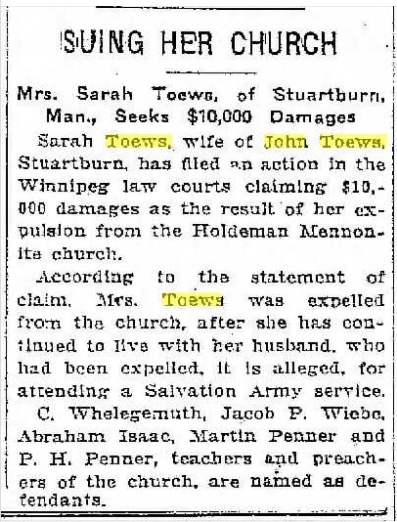
First, in recognition of Mother’s Day, my great-grandma Sarah Toews who, in 1917 (!) sued her Mennonite Church (run entirely by men) for shunning her. Next, novelist Phillip Roth who first made it “normal” to insert lots of Yiddish into his books and opened up a rich and fascinating way of incorporating culture and setting. I try to follow his lead. In my case, it’s Low German or *Plautdietsch*. One of my true author heroes, Miriam Toews, would also get an invite. She comes from the same little town as me and she, a bit like Roth did for the American Jewish community, opened things up in the conservative Mennonite community.

She comes from the same little town as me and she, a bit like Roth did for the American Jewish community, opened things up in the conservative Mennonite community. Both Ms. Toews and Mr. Roth enlarged the tolerance for dissent from within, especially when offered in a comical or satirical way, despite the serious subject matter.

Both Ms. Toews and Mr. Roth enlarged the tolerance for dissent from within, especially when offered in a comical or satirical way, despite the serious subject matter. She followed the lead of a renowned writer named Rudy Wiebe, who would also have a lawn chair at the fire. CNF novelist, journalist, speaker, socialist and all-around shit-disturber Chris Hedges would be asked to keep things lively—him with a Doctor of Divinity and a Pulitzer and all. Finally, Moonlight Graham, from W.P. Kinsella’s “Shoeless Joe”, because I love baseball and he seems like a pretty good guy.

P.S. – the Mother’s Day tag would come out under normal, non-Mother’s Day situations. 🙂

Cheers,
Mitchell Toews
Jessica Lake, Manitoba
https://www.facebook.com/mitch.toews
@mitchell_toews
https://www.pw.org/directory/writers/mitchell_toews

“Died Rich” Coming to Fabula Argentea

My heartfelt tale of a neophyte basketball player—slash—jung Reiba ☠️ will be included in the May 2019 edition of the American literary magazine Fabula Argentea

https://duotrope.com/listing/8261/fabula-argentea

Thanks to Editor Rick Taubold for accepting my work. This is a “silver story” of both friendship and hardship that comes from personal experiences and a buddy who left too soon.

Active since 2012, Fabula Argentea receives over 500 submissions per year and from that produces three issues of about 8-12 stories each. Here’s an interview with Editor Taubold that succinctly describes the magazine’s approach:

https://duotrope.com/interview/editor/8261/fabula-argentea

allfornow,
Mitchell

☠️

jung Reiba is Plautdietsch (Low German) for “young pirate”.


See Change

“Can a sixty-three-year-old aufjefollna Mennonite living next to a lake in the boreal be part of change in the worldwide artistic landscape?”

Sure. In a small way, why the Mitchell not?

I’m quite sure some of the change champions featured in this article would agree:

12 Leaders Who Are Shaping the Next Generation of Artists

http://time.com/longform/art-leaders-next-generation/

I found this piece inspiring, even for a schnuddanäse like me.

I’m four years into a smashmouth experiment — my longtime dream to write fiction. To be published and to leave something good behind. To ask some interesting questions. All that stuff that sounds like a lot of fluff and horseshit, but is in fact, as tough it comes.

Chris Jackson

Publisher and editor in chief of One World, a Penguin Random House imprint

“But his goal is not to acquire any book by a writer from a marginalized background for diversity’s sake alone. ‘The idea that the imprint is committed to diversity is kind of absurd,’ Jackson says. ‘We want to reflect the world we live in.’ The imprint allows writers to tell subversive stories in an authentic way, without what he calls ‘white filtering,’ or couching stories in ways that feel comfortable or familiar to white readers.”

This is a helpful communication for me.

I am a grizzled old white guy, writing about real life in small towns, times bygone and present day, the northern forest, basketball and baseball, bruised knuckles, and Mennonite themes. While I personally have not benefitted directly from the near past’s traditional preponderance of white men in literary fiction, I undoubtedly benefitted in many ways in other parts of my life in Canadian and American society. I have a legacy of privilege. So, I don’t feel I can or should complain—at all—about other cohorts like minorities or women who, these days, might get a small advantage for not being a white guy.

Jackson’s clear call to, “…reflect the world we live in,” explains what has been a difficult and highly coded part of lit fic for me. I take this editor’s message to mean that I am not to be excluded, I just have to share. Proportionately, or even a little less, and accept the new status quo with some grace.

I believe I can do that, in fact, that’s just what I want to do. Thank you, Chris Jackson.

I also find clarity in his comment about “white filtering”. I know this too well. While I don’t “white filter”, per se, I sure as H-E-double-hockey-sticks know how to structure a story to appeal to conservatives, especially my Mennonite brethren. I also know how to pimp up a story to fit more liberal (my own true bearing) perspectives. Horses for courses, but not for literary honesty.

To engage in this posturing is specious at worst, unnecessary at best. My charge as an artist is to invest my work with honesty and courage, not to try to predict the audience reaction and pander my story. No filtering, of any colour or creed.

Sounds easy, but it ain’t. We writers want to be liked. But, again, Mr. Jackson’s leadership is helpful to me. Maybe I’ll be liked as one of the new age of subversive Mennonite authors writing, “in an authentic way” and without parsing readers by pew, rank, and political or social geist.

* * *

I hope you enjoy the article, I sure as hell did!


Place and Time

foc flannery place and time quote only

Ah, eternity.

My stories—and everyone else’s—spring from life. Life lived, life observed, life imagined. Life reconstructed.

A vital part of each story—and each life—is place and time. Truths from one era or one location or one moment in a given journey alter and define the future.

Driven by my own curiosity, here is a roll-call of Place, Time, and basic protagonist context from my stories:

i — “Encountered on the Shore” A university student makes an unsettling discovery in downtown Winnipeg, in the fall of 1973.

ii — “A Vile Insinuation” During the summer following, the main character from “Encountered on the Shore” considers fate and blessings at a baseball tournament in Vita, Manitoba, near the US border.

iii — “Without Reason” Now retired, the MC from “Encountered” and “Vile”, is diagnosed with cancer and he considers his plight and that of others like him. Set in his small Mennonite prairie hometown, current day.

i — “Zero to Sixty” A retired man is attacked, near Christmas in Chilliwack, BC, current day.

ii — “The Margin of the River” and the audio except, “Wide Winter River” The MC from “Zero to Sixty” considers what happened the day before and sees first hand the inequity and sorrow that is built into life. All life.

“The Rothmans Job” An odd couple set out on a dubious nighttime caper during a fierce winter blizzard in Winnipeg, during the 1970s.

“South of Oromocto Depths” A teenage boy gets into a foolish skirmish with his father on the Victoria Day long weekend in 1971 New Brunswick.

 “Nothing to Lose” A former hockey player looks back on his life and his regrets in rural Manitoba during the dusty heat of summer, in the Sixties.

“Heavy Artillery” A young baseball fan in 1962 becomes embroiled in adult suspicion and prejudice in a small prairie town — predominantly Mennonite. (The imaginary, recurrent town of “Hartplatz, Manitoba”.)

“A Fisherman’s Story” In 1970, on the Mexican Pacific coast, an elderly woman and her young daughter are dealt an unfair hand. (P.S. — the prequel and the sequel to this story appear in the trilogy “The Bottom of the Sky”. See link below.)

“Winter Eve in Walker Creek Park” A trio of females on a wintery night in St. Catherines, Ontario, near Christmastime, current day.

“Breezy and the Six-Pack Sneaker” A rainy, beery night in Hartplatz in the Sixties is the scene for a tangled yarn of deception.

“The Fifty Dollar Sewing Machine” A straight-laced Mennonite husband and wife take on danger in a dark Winnipeg alley in 1934. (Rerun on Literally Stories, Feb 17.)

“Frozen Tag” A man encounters a strange reprise from his past (at the Minneapolis Athletic Club in 1980) in the Chilliwack Leisure Centre, current day.

“The Business of Saving Souls”  A youth pastor in the fictitious city of Tribune, in the northern US Midwest meets challenges in the sanctuary of a gleaming megachurch, current day.

“The Preacher and His Wife” Palace intrigue, Harplatz style, throws a family into an untoward uproar in the 1960s.

“I am Otter” A shunned congregant discusses culture, power, and enfranchisement with a stranger near a lake in Manitoba, current day.

“The Beefeater and the Donnybrook”  A mild-mannered Halifax, NS tourist is mistaken and mistook in drizzly London, current day.

“The Log Boom” Poignant points of view — a father, son, and grandfather in the Lower Mainland of BC, current day.

“The Peacemongers” War, bullies and knuckle justice from the perspective of a boy in Hartplatz, circa 1965.

“Fairchild, McGowan and the Detective” Recalling employment, both the good and the bad in Hartplatz and Winnipeg, 1970-80.

“Graperoo” A piece of Graperoo bubblegum experiences the four seasons in rural Manitoba in the Sixties.

“So Are They All” It’s September 1961 and a young boy receives an education in loyalty and courage in his grandmother’s country raspberry patch.

“The Seven Songs” A middle-aged Canadian man meets a local contemporary at a resort in Mexico, current day.

“Fall From Grace” A boy gets stuck in a fraught adventure and learns about his father through it in the heat of a prairie summer in Hartplatz, 1963.

“Away Game” A 50-something man meets with an older family member at the side of a dreamy, summery lake in Manitoba’s boreal forest, current day.

“In the Dim Light Beyond the Fence” The reader travels back into Canadian small-town hardball with the MC, reliving a fateful doubleheader from the Fifties.

“City Lights” A small-town “up-and-comer” gets in over his head in Toronto, current day.

“Groota Pieter” Spring softball in small-town Mennonite Manitoba is described, from the Sixties to current day.

“Sweet Caporal at Dawn” On a moody Manitoba morning near a spring lake, a youngster and an older confederate fish for pickerel during the mid-Seventies.

“The Bottom of the Sky” A trilogy that follows a “pinche” cabin-boy and the ship’s captain on a fishing charter boat from 1955 Acapulco to the future in a fishing village in the Seventies. (P.S. – If you’re inclined, give this story a read and tell me if you think it could be adapted into a screenplay. I see it in flickering snatches of film in my head and just wonder if that occurs to anyone else. If you’re a screenwriter or in film, I’d love an opinion — tough love included. —mjt)

“Shade Tree Haven” An adult remembers more than he cares to as he thinks back to summers at a favourite swimming pool in the early 1960s.

“The Narrowing” A sensitive boy and his straight-ahead grandfather go through a harrowing experience in the Manitoba wilds, current day. An important secondary character in Abbotsford, BC is part of the story.

“The Phage Match” In a surreal radio broadcast from somewhere in Canada, current day, the evils of drug addiction are the backdrop for some strange characters.

“Died Rich” A high school freshman in a frigid southern Manitoba winter in 1961 struggles to endure.

“Concealment” A fledgling Manitoba business traveller gets more than he expects on a springtime trip to the Atlanta Zoo in the 1980s.

“Mulholland & Hardbar” (Novel WIP) A troubled youth experiences the four seasons in the Canadian Shield: love, friendship, deceit, and violence. 1972.

Drama: From the Greek, “to do” or “to act”

Smoking Jacket Mennonites

There’s a lively discussion current now on one of the Mennonite chat rooms online. It’s about the existence—like a newly discovered tribe of Yeti, I guess—of “Cultural Mennonites“.

Here follows a sizzling grenade I decided not to lob into that chat room (too much collateral damage) but, well, I wanted to share…

As Religious Mennonites will confirm, Mennonite is a religion. I feel it’s a good one, as these things go. The doctrine of peace & non-violence, above all, and the notable generosity and charity inherent in Mennonite churches are, indeed, “full of grace.” The Mennonite Disaster Service is the Gretzky of volunteer disaster relief in North America.

Many—myself included—feel Mennonitism also has a distinct, modern (awakened in the 1960s?) cultural derivative. It was during that turbulent period when the idea of being a Mennonite without baptism or a deep commitment to church life first began to gain acceptance. Around the same time that divorce, irrespective of the Sermon on the Mount, first started on the path to toleration within the plenary Mennonite church.

meat pudding
The basic argument against the existence of Cultural Mennonites

“Cultural”, btw, has interesting roots, for the etymologically inclined. “Tillage”, indicating to me that culture is tilled, or incorporated, into its subject – an individual, a gathering, a congregation, a population, a society. That root has a lot to do with why I believe I am part of the Cultural Mennonite phenomenon: I was born and raised—innocently so, but without my direct adult consent—in the cult of Mennonite. My childhood nuclear family did not attend church but in all other ways, my extended family and our community was as Menno as Dirk Willems.

The complex and often contradictory Mennonite culture was TILLED into me from birth and it continues to exert itself on me even as I cast aside the learned knowledge of others and depend more on my own experiences and my familiarity with the world.

My formative influences were different than those of my Religious Mennonite kin & kith but also far different from my non-Menno “import” friends.

I see the Cultural Mennonite emerging as a distinct sub-set because of their (my) “half-breed” existence, suspended between disparate worlds.

Those who disavow a stand-alone cultural variant often point instead to a kind of “Mennonite Imposter” creed. I and several of my antecedents are seen to be of this lowly pretender ilk. I tend to object, but maybe I should embrace this tag even if it is pejorative and imposed by others?

imposter
The Mennonite Imposter

I’ll propose a fourth iteration: “Smoking Jacket Mennonites“. Those who gather in a shadowy, virtual quorum and represent the interests of:

  • industry & commerce
  • finance
  • government
  • education

These subverters (a “den of thieves” according to one angry historical observer) are connected via interlocking directorate. They gather within the friendly, hallowed confines of the church’s tax-exempt status where they typically hold high rank or are able to exert influence by proxy.

smoking jacket mennonites

One SJM prerequisite is membership in the Religious Mennonite superstructure. Or just good’ol wealth and power. Ideally both.

Membership to SJM, the leadership elite, is by subtle invitation. Its congregation comprises fewer women than men. Likewise, there are not many “fringe” members: those financially challenged, POC, First Nations peoples, and LGBTQ are not strongly represented cohorts. By extension, those overtly tolerant of the non-mainstream or accused of “liberal extremist” social beliefs need not apply either.

These are not hard membership rules. But like the current U.S. Cabinet, it just tends to work out that way. Gender, race, wealth and social standing (or close association to wealth and power) are predictable. Good hair, a tan, and nice teeth are increasingly helpful for videos, podcasts, and evangelizing, but those attributes are furniture, not architecture, and in the hands of a deft PR shop, could be re-framed as a weakness. “He’s almost too pretty to be taken seriously.” 

Smoking Jacket Mennonites are not the first or the best at this specious, old-boyistic full meal deal of [wealth creation] & [worship of the divine], but are starting to really get the hang of reciprocal back-scratchery. I can see a Doug Ford getting a standing “O” in the right sanctuary, at the right time. Maybe he already has.

doug ford

Hmmm.

In conclusion, I don’t believe I am a “Non-Mennonite”. Nope, that just does not fit; that thread is too coarse. I definitely feel I am a “Mennonite“. In fact, I have an undeniable, unshameable set of Menno credentials and antecedents, but I am not a member of a Mennonite church so some would keep me on the büte with those who don’t know the difference between Ditsied and Jantsied.

Seeking a finer definition, you can go right ahead and call me a Religious Mennonite (if you’re willing to accept a highly non-conformist definition) or use the Cultural Mennonite tag, or brand me as a Mennonite Imposter – I’ll accept any of those labels without complaint.

As for the arm-waving megafellas of the Smoking Jacket Mennonite elite, I don’t qualify, I don’t have the price of admission, nor do I seek entry to the club. You guys go on without me.

~ ~ ~

Two stories that grab a root and dig at these themes:

“I am Otter” in The Machinery – A Literary Collection

Literally Stories presents a satiric peek at Big Church in, “The Business of Saving Souls” 

Four Fantasies

A group of artists gathers for a meal. They each bring two dishes, one edible and the other inspirational.

The first of them lifts the lid on a steaming Dutch oven full of exotic stir-fry. She is small, with fine features and possessing a direct, flowing gaze that makes each one at the table feel a personal connection to her before she even says a word.

“Each mouthful is different, an adventure, a departure from the last, an experience defined by its variety,” she says, flourishing the lid with eloquence. “And yet, they each come from a similar culinary tradition and are all prepared by the same chef, in one communal pot. Each ingredient is spiced with varying amounts of identical additives: conflict, joy, desire, personality, sorrow and more. Much more.”

After plates are loaded and the group tucks in, a thin man with a sparse beard stands.

“My friends,” he begins, “I’ve brought wine. It’s meant to complement and heighten the enjoyment of the meal, but if you give it a chance, I hope that you can find in its complexity a fulfillment that stands alone. Savour it for what it contains, however well-hidden and blended the constituents are and enjoy the way each lends itself to the plenary, just as each wave adds its own shape to the shore.”

Glasses chime and there is a moment of satisfaction expressed by the table as collective stillness while the wine’s secrets are shared.

Without introduction, a brassy fanfare sounds followed by the swirl of parting curtains that separate the dining room from the house. A brawny, serious figure enters. With long, powerful strides this latest presenter commands the room’s immediate attention and is followed by a troupe of brightly costumed servers.  Perfectly conceived and composed plated entrees are set before the diners.

“Each is a masterpiece—with a beginning, a middle and an ending—that is delivered not only by taste but by the presentation, artistry, and the interaction between each delicacy. The arrangement of every morsel a work of art of its own!” Music swirls and fills the room from some unseen orchestra and those assembled take their seats, voices hushed, attention rapt.

In a dark corner, unnoticed, a furtive, wide-eyed rat keeps an unblinking watch with keen lamps that blinter like wee distant winter stars.

“How? Where did they learn these arts? How do I join them? Won’t I be crushed by their greatness?”

In sensuous forepaws, a shred of cabbage is braided and interwoven with a trifle of cheese so thin it is opaque. The grey rat weaves with busy concentration. Clawed fingers fret, the fragile conception set on a single sparkling sequin dropped without care or worry from the bedazzlement above, so far above.

“I’ll offer this portion from my pantry. Perhaps, someone will like it…”


Interview with a Mennonite Imposter

http://bit.ly/MennoTOEWSba

Writer interviews can be kinda boring. This is a little more in the Mennonite wiseguy range of the register, but still—you know—predictably boring. And great fun to do, especially with such an engaging set of questions! My thanks to Editor Erin Unger.


Shade

FAMILY TREES sometimes cast shade. Due to the unbending quality of light and the laws of nature, this shade falls where designated by physics, not preference. We can’t change history to suit our current disposition.

The above is the mental garden in which the following Facebook post took root:

https://www.facebook.com/mitch.toews

Macdonald, Mennonites, and Métis: these things have been ricocheting around inside my bulbous, roomy-and-well-lit cranium lately. My daughter, a woman of letters considerable and the possessor of a mind much more well-tended and well-educated than her dad’s, did some research on the goings-on of 1870-1873, part of Sir John’s tenure.

It’s worth noting too that the grandchildren she has provided own a much less homogeneous ancestry than their maternal predecessors. Her rugrats are Menno-Ukrainian-Franco-Métis. This moves the issue out of the theoretical and right into Nanna & Gramps kitchen!

Her scholarly digging turned up some unsavory evidence about how Manitoba Métis were given “scrips” for land titles along many southern waterways in the then-new province. That was in 1870, before our Toews antecedent and his Molotschnan peacenik delegation rolled in and said, “Sure, we’ll take this stoney ground off your hands for frie, ommsonst.” As the research suggests (to some), the post-1870 gov of the day appeared slow-handed in making good on the scrips and many would-be Métis land-owners left for greener pastures, tired of waiting.

Historians also wonder whether the 1873 governments (Fed + Prov) had some prejudicial racial motivation; they were all out of Scots settlers from Ontario and if they didn’t act fast and populate the prairies, they stood to lose the territory to the avaricious Yanks. These industrious, white, tabular-headed Mennos, well-schooled in the way of farming floodplains and (as it turned out) compound interest, were juuuust the ticket! Exit Métis, enter Kleine Gemeinde.

The whole issue is complex and unsettling. What did the delegates weehte and when did they weehte daut?

* * *

This whole Mennonanigan got reinitiated, for me, when I read,

Canada’s First Scapegoat 

in The Walrus. An article that was preceded by “Old Macdonald”.